by Holly
It’s been awhile since I’ve blogged. Partly, I think because I didn’t have any interesting photos to go along with what’s kept me busy. I thought about taking one of me and the team of people (Anthony, Sylvia, Charles, Godfrey, Ben) who were working on one of two intense proposals we’ve done this year. It would have had all of us gathered around a computer very late at night and pulling out our hair and gritting our teeth. The title would have been, “Is this Framework Really Logical?” But, like most people, I don’t bring my camera with me for long days of office work.
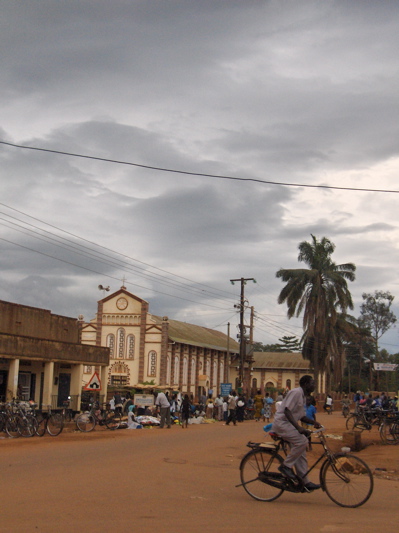
Finally, I’ve broken out of the office again. I’ve been in Gulu this week monitoring the office there with the Program Manager. Ben always teases me because I love meetings so much—and I really like trying to improve systems to manage and support and supervise our staff and programs. It’s so much fun—although I sometimes want something really concrete that I can point to and say that-that’s what I do and why I’m here. We had a conversation with a friend last night who (among many other things) has installed playground equipment at a water hole near our office. I ride past everyday on the way to work on my bike. There are always kids there laughing and playing. He said how encouraging that was. I’d like to have something like that—a daily reminder that what I’m doing makes a difference to somebody. I get moments. In Gulu I spent a few hours under a mango tree in a camp talking with community members that are in a committee that protect children’s rights. In the past month because of what they’ve done one kid is back in school, another that was neglected is getting medical treatment and a girl that was sexually abused is in a safe environment. That’s wonderful—but it doesn’t even scratch the surface of what’s facing kids in the camps.
Last week I joined the TOTs (Ben’s project) in Soroti to learn more about “Traditional and Religious Ways of Healing in Acholi and Lango.” I went to learn and to spend time with the facilitators and ask my burning questions. I’ve been reading and thinking a lot about traditional ways of reconciliation and restorative justice--an integral part of healing. The instructors for the training were the key people from the traditional leadership of Lango and Acholi. The discussions were remarkably honest and I was encouraged by how progressive those entrusted with the preservation of traditions are.
Sometimes I start to feel like I’ve really adjusted and know the people that I work with and for and then I get a window into something deeper—something that I will never be a part of and may never understand. I was reading a book (which I hope to post about soon) about the ICC. It’s insightful, but there were times when reading it when I thought to myself, “This author doesn’t really know people here.” He’s probably spent more time with them than the majority of researchers, but still, he doesn’t understand the world view. I said this to myself with a kind of smug self-congratulatory tone—until last week when I had to confess that I don’t really know people here either. There is so much that surprises me, that seems unreal, or that even when it’s translated and explained I just can’t understand.
Once after a session where the Acholi leader was describing how to read signs of impending success or failure before leaving on a journey (like which direction birds chirp from or which toe you stub first or whether you first meet a man or woman on the road) he came up to me and asked if we had similar things. The only thing I could think of was a black cat crossing your path, but I explained that was a superstition that we don’t take very seriously and in general we don’t know how to read the noises of animals and birds. He looked at me with disbelief and said, “Do you mean to say that you just do things blindly? You have no idea what is coming and don’t try to read the signs that are there for you!” He admitted though, sometimes the signs can really disrupt life. What do you tell your boss when you don’t go on a business trip because the morning you were meant to leave you stubbed your left toe instead of your right and met the opposite sex of your first born child when you walked down the street? I’ve never felt particularly blind, but maybe I am. Could it be that in the physical world there are messages that if interpreted could guide us in constructive ways and avoid danger?

One night we practiced Wang Oo a communal time of gathering around the fire at night. It’s a time to educate the young children, to tell stories and riddles, share local brew, dance, and “deceive the hunger” while you wait to eat supper. Though I sat as the women should slightly away from the fire (traditionally to avoid eye contact with men who might want an “appointment”) with bare feet on a grass mat and shelled g-nuts and told riddles—I felt very much a foreigner. I was taught a riddle so that I could share it. “Two birds crossed the sea.” The answer is “eyes.” I don’t understand. Apparently, that’s really hilarious—but I have no idea why. All night I laughed with our friends but mostly because I loved the shared joy. Whenever the jokes were translated (or even when they were simple enough for me to catch in Luo) I rarely understood why they were funny—but I was so happy to be an accepted member of the circle around the fire.


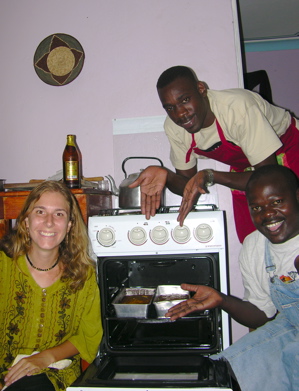
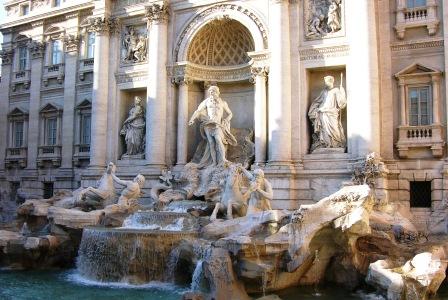
 I liked looking at all the beautiful stuff I can live without. I appreciated all the material comforts of “home” and was happy to discover that I don’t need them but they’re there whenever I want to enjoy them. One morning I was drinking some thick Italian espresso out of adorable cups the appropriate size. My own set of equally adorable espresso cups are in a box somewhere in Ben’s parents basement and who knows when I’ll use them again. I thought of my cups and was about to tell my mom that I missed them when I realized that I didn’t--this was in fact the first time that I’d even thought of them since they were packed away. I am grateful for many things when they’re there to enjoy but I’m okay without them. That knowledge is freeing.
 by Holly
 Of course Philip came so late that he missed the meal but no one minded or apologized. When we told him to come for dinner he said, “Oh, I’ve learned that when you come to dinner here you’re supposed to bring your own drinks like a bottle of wine.” He told us this as if we would think that it was as socially bizarre as he did. I remember when we first got here and were surprised that no guest ever brought anything to share.
 Re-entering the western world I was surprised by obvious things. First, there are a whole lot of white people. I haven’t seen so many in one place for a long time. I’ve kind of gotten used to being a minority. In England my skin didn’t feel so novel. On New Year’s Eve for a few minutes with Philip and company I was once again the token white.

 It broke my heart. Partly, because I miss it and partly because it seems impossible for the people of northern Uganda. And then at the same time those moments happen here too. Some are quiet and simple and others are more profound. I had a simple one yesterday when I walked home under a red sun after a meeting with the management team that was energized and full of common purpose. And then Ben and I sat on the front porch and watched the sun sink and talked about the day. I had a moment like that last year when I first saw Acholis dance. While they sweat and kicked up the red dust to the drums I thought, “this is what they were meant to do, this is how it’s supposed to be with the young people dancing and the children trying from the sides and the old people nodding and watching—they weren’t meant for this war, destruction, displacement and poverty.” But that moment happened right in the middle of it. In a way that’s comforting, because it means that whatever those moments are or whatever they reflect—the longing for home—the restoration of things to the way they should be—life at its fullest—they are more powerful and can’t be overcome by the most gruesome war, or by massive displacement or abject poverty. Human beings will still dance.