Showing posts with label gender. Show all posts
Showing posts with label gender. Show all posts
Wednesday, October 19, 2011
Bad news for women?
The New York Times reported "Contraceptive Used in Africa may double risk of HIV"
The most popular contraceptive for women in eastern and southern Africa, a hormone shot given every three months, appears to double the risk the women will become infected with H.I.V., according to a large study published Monday. And when it is used by H.I.V.-positive women, their male partners are twice as likely to become infected than if the women had used no contraception.
A lot of Ugandan women use this method of contraception. It's one that they can easily control themselves, even somewhat secretly if they need to--and so those with resistant partners can still do some family planning on their own. It would be a real shame if it turns out that the risks outweigh the benefits. I agree with the WHO epedemiologist, “We want to make sure that we warn when there is a real need to warn, but at the same time we don’t want to come up with a hasty judgment that would have far-reaching severe consequences for the sexual and reproductive health of women,” she said. “This is a very difficult dilemma.”
Like many contraceptive methods, how the method works isn't always well understood resulting in ineffective use. Yesterday I was chatting with a woman who used the injection plan. She patted her swollen belly. "I don't even know when I'm due," she said, "I must be a very stupid woman. I didn't get injections at regular times. I only went to get injections when my husband would come back from Juba every few months. I guess that doesn't work." This might be bad news for women like her, who are aware of their husbands extramarital exploits. On the other hand, it just might give them more leverage to push their partners to use contraceptive methods that offer more protection against HIV transmission.


Friday, May 21, 2010
'Poverty & the Pill' or Gender and the Pill?
I know, my suggestion doesn't quite roll of the tongue as easily as the title of Kristof's article in the NY Times about the use of contraception in the Democratic Republic of Congo--but I think it might be a more precise identification of the core issue.
He talks about the "fixable" challenge of unavailable birth control in many poor countries. Referencing a report by the Guttmacher Institute, he writes that,"If contraception were broadly available in poor countries, the report said, more than 50 million unwanted pregnancies could be averted annually. One result would be 25 million fewer abortions per year. Another would be saving the lives of as many as 150,000 women who now die annually in childbirth." By all means, every woman who wants contraception should have access to it. But most interventions in this regard vastly overestimate women's freedom to make choices about birth control for themselves.
In my research I also ask women about how they make decisions around family planning. Most of them are familiar with the idea of "child spacing" and have various methods for achieving it, some of which are free--but the majority are denied the ability to make those decisions. If I ask who does, most respond: "my children's father." (and a few: "God") A number of the women who have reported sexual violence within their marriages said the man justified his actions in relation to having more children.
Poverty isn't the cause and money isn't the solution. Kristof does allude to the gender factor, for example, noting the practice of hospitals requiring women to bring their husbands with them so they know whether the man has agreed to using family planning methods and men's resistance to condom use--both of which are as relevant in Uganda as in the DRC. Though he raises a few of the challenges that make family planning "harder than it looks" the article misses the crux of the issue. Although I think I'd be all in favor of re-appropriating 2 weeks of military expenditure in Afghanistan to make contraception available "worldwide"--the real issue isn't unavailability--it's the relationships between men and women that are socially entrenched that prevent women from exercising power over their reproductive health.
I could link a photo to liven up the blog from his article--but instead of attaching the somewhat forlorn expression of a woman who almost died in childbirth--I share this one with you:

He is a beloved former colleague who confesses to having 28 children that he's aware of. How many does he think he actually has, "I don't know. Around 50 maybe?"
He talks about the "fixable" challenge of unavailable birth control in many poor countries. Referencing a report by the Guttmacher Institute, he writes that,"If contraception were broadly available in poor countries, the report said, more than 50 million unwanted pregnancies could be averted annually. One result would be 25 million fewer abortions per year. Another would be saving the lives of as many as 150,000 women who now die annually in childbirth." By all means, every woman who wants contraception should have access to it. But most interventions in this regard vastly overestimate women's freedom to make choices about birth control for themselves.
In my research I also ask women about how they make decisions around family planning. Most of them are familiar with the idea of "child spacing" and have various methods for achieving it, some of which are free--but the majority are denied the ability to make those decisions. If I ask who does, most respond: "my children's father." (and a few: "God") A number of the women who have reported sexual violence within their marriages said the man justified his actions in relation to having more children.
Poverty isn't the cause and money isn't the solution. Kristof does allude to the gender factor, for example, noting the practice of hospitals requiring women to bring their husbands with them so they know whether the man has agreed to using family planning methods and men's resistance to condom use--both of which are as relevant in Uganda as in the DRC. Though he raises a few of the challenges that make family planning "harder than it looks" the article misses the crux of the issue. Although I think I'd be all in favor of re-appropriating 2 weeks of military expenditure in Afghanistan to make contraception available "worldwide"--the real issue isn't unavailability--it's the relationships between men and women that are socially entrenched that prevent women from exercising power over their reproductive health.
I could link a photo to liven up the blog from his article--but instead of attaching the somewhat forlorn expression of a woman who almost died in childbirth--I share this one with you:

He is a beloved former colleague who confesses to having 28 children that he's aware of. How many does he think he actually has, "I don't know. Around 50 maybe?"
Thursday, February 25, 2010
Sex is a mental thing
by Holly
It was a hard day. For vicarious reasons. I have little claim to feel sad, angry and betrayed. I’m trespassing on someone elses pain and I have no right to take it home with me. But I do and I can’t help it. I always come home to a violence-free house and a partner that loves me madly. I never, ever worry what he might do to me tonight.
No one I talked to today* could say the same. I've decided I need several hours in the presence of really wonderful men to each hour of hearing about rape. Thankfully, there are amazing men in my daily life—Ben—and many excellent Ugandan colleagues and friends that help me balance out my over-exposure to the wake of other men’s depravity.
A couple of days ago I went to a meeting with some agencies working on Gender Based Violence. Suddenly, I was taken back to Lira, 2005. It’s funny how little “coordination” meetings change in 5 years. But that’s beside the point. (the point, is still to be determined—perhaps it’s just the catharisis that comes after sharing things too heavy to carry alone) Sitting there, I kept thinking of how many women have no idea these NGOs exist or what services they could provide them. I’ve been asking women who they would go to for help if something happened to them. They typically say something like, “Well, I hear that there is a group in town called ‘Human Rights’ but I don’t really know what they do.” Several different NGOs have hotlines—one for counselling, another for legal advice, etc. I suggested they make a joint card with all of the available hotlines—written in Acholi and distribute it as widely as possible. I’d like to have such a card to leave with some of the women I talk to.
It might do a little good. I recalled one of the women. She’s not going to report her husband to the police or seek legal advice. She just wants him to stop. She wants to talk to someone without them making her feel more ashamed than she already does. “If I tell anyone,” she lamented,” they’ll just ask me why I got married if I don’t want to have sex. They’ll say it’s my duty to satisfy him.” She wants someone to tell her it’s not her fault. She wants someone who can commiserate. “My sister,” she touched my arm and shook her head, “when he comes home so drunk and violent and with the smell of alcohol, how am I supposed to begin?”
A card with phone numbers isn’t going to help her. She can’t read. She doesn’t have a phone.
And then I remembered (the gist of) a provocative question my supervisor asked me. (I think/hope he was going for a reaction and not reflecting his opinion.) If marital rape is a normalized experience, does it do more damage than good to problematize it? Maybe, if women don’t perceive being violently forced to have sex as wrong they are less traumatized by it’s occurrence, accepting it as a normal part of interaction with husands.
Preposterous. (this is my obligatory more refined substitute for what I really think: b*** sh**. My mom always said that using vulgar language was a sign of a poor vocabulary—but honestly, once in awhile profanity is simply most apt.)
Every woman I’ve talked to that shared her experience of being raped by her partner experienced it as something wrong. They KNOW it’s not right. To suggest otherwise is demeaning. “What I know,” one of them told me after sharing the violent forced conception of her first child, “is that making love is supposed to be an agreement between a man and a woman.” Living in a village in Africa, makes this no less true than anywhere else. Another woman told me how she has never talked to anyone about it except for her husband. “I tell him, ‘What you’re doing is bad! This is the wrong way to treat your wife! Strangers do this to strangers but you should be ashamed to do it in your own house!”
Say what you want about cultural relativity. Acholi women like foreplay just as much as the next woman. Whether you sleep on a papyrus mat on a dirt floor or a pillow-top king-size mattress, women want the person lying next to them to respect their yes and their no. Perhaps to persuade them—but never to force them. Most of them are angry that they live in an environment where people around them identify ways they are to blame and make excuses for the man’s behavior. One of my personal fravorites: “well, maybe he is just trying to save them both from HIV” –implying that the only alternative to benevolently forcing one’s wife to have sex is to have sex with someone else.
A couple of months ago I had a chat with the Resident District Commissioner for Gulu. A male colleague came along and made a comment I might’ve been tempted to slap him for if I weren’t a pacifist (to be fair, I’ve seen how well he treats his wife and he’s a good guy)—something about how marital rape was a difficult issue because men have “greater sexual appetitites than women.” I bit my tongue. And sat on my hands.
Ochora, (the RDC) leaned back in his chair and stared at the ceiling thoughtfully before he delivered his verdict. His gigantic belly protruding onto his desk when he leaned forward. “Sex,” he pronounced, “is a mental thing. It is mentally driven. If the wife says she is not in the mood then men should be able to understand.”
(*For confidentiality purposes, I did not post this on the day I wrote it.)
It was a hard day. For vicarious reasons. I have little claim to feel sad, angry and betrayed. I’m trespassing on someone elses pain and I have no right to take it home with me. But I do and I can’t help it. I always come home to a violence-free house and a partner that loves me madly. I never, ever worry what he might do to me tonight.
No one I talked to today* could say the same. I've decided I need several hours in the presence of really wonderful men to each hour of hearing about rape. Thankfully, there are amazing men in my daily life—Ben—and many excellent Ugandan colleagues and friends that help me balance out my over-exposure to the wake of other men’s depravity.
A couple of days ago I went to a meeting with some agencies working on Gender Based Violence. Suddenly, I was taken back to Lira, 2005. It’s funny how little “coordination” meetings change in 5 years. But that’s beside the point. (the point, is still to be determined—perhaps it’s just the catharisis that comes after sharing things too heavy to carry alone) Sitting there, I kept thinking of how many women have no idea these NGOs exist or what services they could provide them. I’ve been asking women who they would go to for help if something happened to them. They typically say something like, “Well, I hear that there is a group in town called ‘Human Rights’ but I don’t really know what they do.” Several different NGOs have hotlines—one for counselling, another for legal advice, etc. I suggested they make a joint card with all of the available hotlines—written in Acholi and distribute it as widely as possible. I’d like to have such a card to leave with some of the women I talk to.
It might do a little good. I recalled one of the women. She’s not going to report her husband to the police or seek legal advice. She just wants him to stop. She wants to talk to someone without them making her feel more ashamed than she already does. “If I tell anyone,” she lamented,” they’ll just ask me why I got married if I don’t want to have sex. They’ll say it’s my duty to satisfy him.” She wants someone to tell her it’s not her fault. She wants someone who can commiserate. “My sister,” she touched my arm and shook her head, “when he comes home so drunk and violent and with the smell of alcohol, how am I supposed to begin?”
A card with phone numbers isn’t going to help her. She can’t read. She doesn’t have a phone.
And then I remembered (the gist of) a provocative question my supervisor asked me. (I think/hope he was going for a reaction and not reflecting his opinion.) If marital rape is a normalized experience, does it do more damage than good to problematize it? Maybe, if women don’t perceive being violently forced to have sex as wrong they are less traumatized by it’s occurrence, accepting it as a normal part of interaction with husands.
Preposterous. (this is my obligatory more refined substitute for what I really think: b*** sh**. My mom always said that using vulgar language was a sign of a poor vocabulary—but honestly, once in awhile profanity is simply most apt.)
Every woman I’ve talked to that shared her experience of being raped by her partner experienced it as something wrong. They KNOW it’s not right. To suggest otherwise is demeaning. “What I know,” one of them told me after sharing the violent forced conception of her first child, “is that making love is supposed to be an agreement between a man and a woman.” Living in a village in Africa, makes this no less true than anywhere else. Another woman told me how she has never talked to anyone about it except for her husband. “I tell him, ‘What you’re doing is bad! This is the wrong way to treat your wife! Strangers do this to strangers but you should be ashamed to do it in your own house!”
Say what you want about cultural relativity. Acholi women like foreplay just as much as the next woman. Whether you sleep on a papyrus mat on a dirt floor or a pillow-top king-size mattress, women want the person lying next to them to respect their yes and their no. Perhaps to persuade them—but never to force them. Most of them are angry that they live in an environment where people around them identify ways they are to blame and make excuses for the man’s behavior. One of my personal fravorites: “well, maybe he is just trying to save them both from HIV” –implying that the only alternative to benevolently forcing one’s wife to have sex is to have sex with someone else.
A couple of months ago I had a chat with the Resident District Commissioner for Gulu. A male colleague came along and made a comment I might’ve been tempted to slap him for if I weren’t a pacifist (to be fair, I’ve seen how well he treats his wife and he’s a good guy)—something about how marital rape was a difficult issue because men have “greater sexual appetitites than women.” I bit my tongue. And sat on my hands.
Ochora, (the RDC) leaned back in his chair and stared at the ceiling thoughtfully before he delivered his verdict. His gigantic belly protruding onto his desk when he leaned forward. “Sex,” he pronounced, “is a mental thing. It is mentally driven. If the wife says she is not in the mood then men should be able to understand.”
(*For confidentiality purposes, I did not post this on the day I wrote it.)
Thursday, May 04, 2006
Mangoes & Millet Flour

By: Ben & Holly
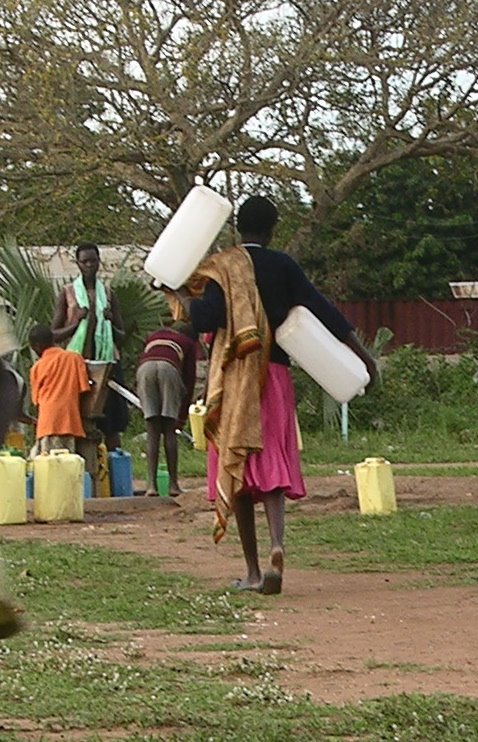
Notice anything about this photo? It might be hard to tell. We ride our bikes past this watering hole every day. There is always a line of women and children with large plastic jugs lined up to collect water. Yesterday there was a lively and colorful soccer game going on in the same field. Not one girl was playing soccer. Not one boy was collecting water.
Last week we were talking to some MCCers who are working in the field of education. They told us that female attendance in school is quite high. Unfortunately, the quality of education they receive is not on par with their male classmates. Girls are required to bring cooking knives to school to help in the kitchen while boys are given free time for studying. Principals have been heard making statements to the effect of, “Girl-child education is a waste of money. All they do is distract the boys from their studies.”
On the weekend I, (Holly) went to Gulu with a friend to see a traditional concert and dance. Apparently, it was meant to be celebrating and appreciating women. But the way women are celebrated and appreciated is as producers of children, cooks, and providers of sexual satisfaction. I wanted to appreciate the culture—and I do—I love so much of it, but there is a part of the culture that is unjust and needs to change. My inner cultural relativist cringes to write that, but really, cultural relativism has its limits and for me at least issues of gender fall outside the boundaries of prudent application. It felt awkward clapping and enjoying amazing dancers and musicians when what they were dancing to and singing about was perpetuating discrimination against women. The mentality that is nurtured is a breeding ground for the high prevalence of sexual and gender based violence.
There was one song about how "all women cook the same" which is code for all women are the same in bed. Apparently, that is supposed to be a song that encourages men to be faithful to their wives because if all women are the same than why bother having more than one. Then there was another one that was supposed to appreciate the work that women do but instead it sounded like a song that encourages women to stay in the kitchen. One line said something to the effect of: "be careful men when you try to do a woman's work, when you grind the millet flour you might get your testicles caught in the grinder."
During the concert something smacked me on the top of the head. I looked around to see who'd thrown something at me, and then I saw a mango had fallen out of the tree and my head happened to be in its path. One of my CPA friends said that is a blessing. Everyone around me insisted I should eat it to get the full benefit of the blessing. Since I’m a woman, I’m sure the blessing has something to do with producing children.
Wednesday, February 01, 2006
A Case Study
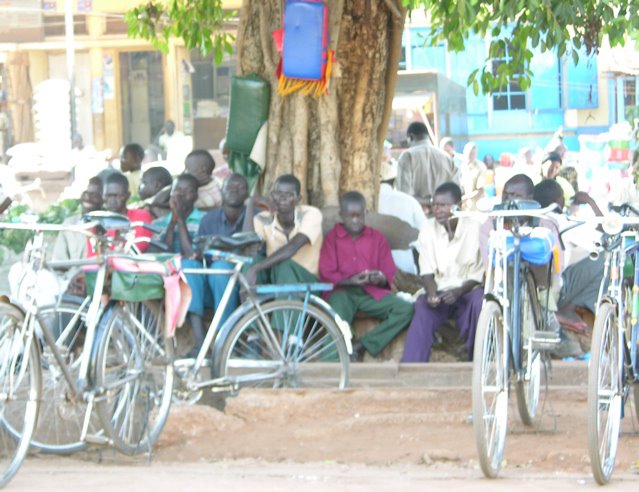
A group of Bodas waiting for their next customer.
By Holly:
Before the training I asked the participants to each write about two real conflicts that affected them. We used them as case studies during the training. As I read through a stack of 40 conflicts there was one that stuck out, not for its severity but as depressingly commonplace. It was about a participant’s neighbors. The breadwinner is a “Boda” someone who makes money by carrying people on the back of their bicycle. Income comes slow at about 15 cents per trip. The boda was supporting his wife and 8 kids on his meager and irregular income. All year he had been struggling to save enough money to buy his family meat for Christmas. Because of the Christmas rush he bought the meat one week before the expected feast. It would be the first time for most of the children to ever eat meat and in the novelty of it they would smell the meat and increase their anticipation. The family felt like the week “lasted for two years.” While the father was at work on the 23rd the smell and desire became so overwhelming that they cooked the meat and ate it. When the boda came home he found that most of the meat was gone and that the choicest pieces had been given to the children (in Ugandan culture it should be given to the man). In a rage the boda beat the woman and smashed her hand badly breaking it. The neighbors all heard the sounds of domestic violence and rushed to take her to the hospital.
Subscribe to:
Posts (Atom)