Showing posts with label in the news. Show all posts
Showing posts with label in the news. Show all posts
Wednesday, October 19, 2011
The most disturbing thing I read this morning
15 activists who took part in the walk to work to demonstrations (which I wrote about here and saw first hand) are being charged with treason, which is punishable by death. So, protestors can face the death penalty.
Some consolation, to my freedom loving soul: the article is in the news. The comments in the online version are critical—even evoking the days of Idi Amin—and these things are said in the open--at least for now.


Bad news for women?
The New York Times reported "Contraceptive Used in Africa may double risk of HIV"
The most popular contraceptive for women in eastern and southern Africa, a hormone shot given every three months, appears to double the risk the women will become infected with H.I.V., according to a large study published Monday. And when it is used by H.I.V.-positive women, their male partners are twice as likely to become infected than if the women had used no contraception.
A lot of Ugandan women use this method of contraception. It's one that they can easily control themselves, even somewhat secretly if they need to--and so those with resistant partners can still do some family planning on their own. It would be a real shame if it turns out that the risks outweigh the benefits. I agree with the WHO epedemiologist, “We want to make sure that we warn when there is a real need to warn, but at the same time we don’t want to come up with a hasty judgment that would have far-reaching severe consequences for the sexual and reproductive health of women,” she said. “This is a very difficult dilemma.”
Like many contraceptive methods, how the method works isn't always well understood resulting in ineffective use. Yesterday I was chatting with a woman who used the injection plan. She patted her swollen belly. "I don't even know when I'm due," she said, "I must be a very stupid woman. I didn't get injections at regular times. I only went to get injections when my husband would come back from Juba every few months. I guess that doesn't work." This might be bad news for women like her, who are aware of their husbands extramarital exploits. On the other hand, it just might give them more leverage to push their partners to use contraceptive methods that offer more protection against HIV transmission.
Tuesday, June 28, 2011
Political Demonstrators, Rebels--what's the difference?
This blog was originally posted on May 12th. It was removed by blogger for maintenance but never restored, thanks to several faithful readers who responded to the last post--Here it is again:
In the last month or so many Ugandans have participated in "walk-to-work" demonstrations across the country to express dissatisfaction over rising costs of food and fuel in Uganda among other political grievances. The main organizers are also political opposition leaders and they have been arrested (sometimes with excessive force) and released several times. Some demonstrations have turned violent. Police and military were not exclusive in their use of non-lethal force using live ammunition with fatal consequences. People have been injured and even killed (9 unarmed civilians according HRW)--including a two year old girl. Most of this has taken place in Kampala, and a few other towns. We had one day of it in Gulu.
There are many things I could say about the demonstrations and the state's reaction to them--but there is one aspect that I've found particularly troubling:
State actors keep making references to Joseph Kony and the LRA when they are talking about the demonstrators.
One friend actually witnessed police beat people in the street outside her shop in Gulu and heard them say, "We dealt with Kony--we can deal with you!"
I was shocked to hear that such inflammatory language is being used in a place where violence at the hands of the LRA is no distant memory. Those in the street and even being beaten had suffered from the war--some of them, undoubtedly, were formerly abducted people who had been forced to take part in LRA activities. I hoped that such statements were just isolated incidences of some over-zealous and insensitive soldiers, but then I watched President Musevini on the news discussing the demonstrations in a press conference. He assured the room full of journalists, "We have the capacity to defend the people of Uganda. We defeated Kony, we are going to defeat these opportunists and criminally minded people."
Then I read an article where General Tinyefuza, the coordinator of Uganda's national intelligence agencies was commenting on the excessive force of police and military and unlawful arrests of many opposition leaders in the past weeks during "walk to work" campaigns:
On how our police handled the situation, yes there could have been mistakes but that is Besigye’s (an opposition leader's) plan to provoke the State to make mistakes so that he gains political capital. These mistakes of the police which I am talking about should be put into perspective. Uganda has been peaceful for the last 25 years and our people know how to handle armed insurgents like Kony or violent demonstrators.
um,what? Uganda's been peaceful for 25 years? someone forgot to tell my neighbors--and just curious, if it's been so peaceful, who's this Kony character you mention? and what relation is he to the demonstrators?
It's not clear to me if the associations being made between demonstrators and the LRA are somewhat unconscious--the product of viewing the world through the lingering lens of the "liberation war"leading to an inevitable interpretation of political demonstrations in tribal/regional terms, or if it is slightly more calculated:
1) to emphasize that the government is in control, and capable of maintaining the security of the country/stamping out any challenge to its' rule.
2) to deliberately evoke a public opinion that associates the demonstrators and the political opposition's leaders to Joseph Kony, playing on negative north/south Ugandan dynamics and perpetuating an image of Acholis/political opposition as dangerous, militant, untrustworthy, brutal, bent on the destruction of the peace--AND therefore justify the harsh reaction of military and police.
Fortunately some people see the situation a little more clearly. “The excessive use of force by security officers was plain to see in the television footage of the event. While I do not condone the violent rioting that followed, the Ugandan authorities must realize that their own actions have been the major factor in turning what were originally peaceful protests about escalating food and fuel prices into a national crisis.” That's the UN High Commissioner for Human Rights. read the full release here
In Gulu, I did't want watch it on TV, I got caught in the middle of it. We turned around as quickly as we could when we saw rubble in the road and a crowd of people shrouded in tear gas. But not fast enough. Riot police almost hit our car while they swerved at terrible speed cutting us off and stopping in front of us to fire tear gas. Three times they fired tear gas toward us while we yelled "there's a baby in the car," until we finally managed to get past them and out of the line of fire.(I'd take issue with anyone claiming that the military and police were only targetting those involved in the demonstrations--Z even watched as they shot teargas into a primary school and a crowd of children scatter) After a rather surreal encounter with Mao on the side of the road where we discussed topics as common as the weather, as personal as our adoption process and as significant in that moment as non-violence and how he intended to lead people in a moment of political upheaval in a context where, as he said "anything can happen. this is a traumatized people," We finally got home and had dinner in the dark with explosions and gunfire in surround sound. Things quieted after a couple of hours and we listened as best we could to a neighbours' radio with Mao's voice in Acholi admonishing the demonstrators not to resort to violence. "I don't support anyone who throws stones," he said.
Yeah, there are one or two differences between demonstrators and rebels. There are also a few differences between demonstrators and rapists and murderers but apparently President Musevini thinks they ought be in the same category and wants to have the constitution amended to exclude each of those categories from eligibility for bail--rather making them stay in prison for a mandatory 180 days! (I smiled a little, when I saw one commenter suggest that changing the constitution in that way would be just fine as long as it was also changed back to having term limits...)

On a side note, the new, less brutal, more colorful police tactic is to spray people with pink water. A friend came over for dinner last night and shared what I think is wonderfully creative twist on Mao's statement after being sprayed and arrested yesterday, "I'm all pink." The walk-to-workers should adopt pink as their color of protest--and start off by all wearing pink T-shirts.
In the last month or so many Ugandans have participated in "walk-to-work" demonstrations across the country to express dissatisfaction over rising costs of food and fuel in Uganda among other political grievances. The main organizers are also political opposition leaders and they have been arrested (sometimes with excessive force) and released several times. Some demonstrations have turned violent. Police and military were not exclusive in their use of non-lethal force using live ammunition with fatal consequences. People have been injured and even killed (9 unarmed civilians according HRW)--including a two year old girl. Most of this has taken place in Kampala, and a few other towns. We had one day of it in Gulu.
There are many things I could say about the demonstrations and the state's reaction to them--but there is one aspect that I've found particularly troubling:
State actors keep making references to Joseph Kony and the LRA when they are talking about the demonstrators.
One friend actually witnessed police beat people in the street outside her shop in Gulu and heard them say, "We dealt with Kony--we can deal with you!"
I was shocked to hear that such inflammatory language is being used in a place where violence at the hands of the LRA is no distant memory. Those in the street and even being beaten had suffered from the war--some of them, undoubtedly, were formerly abducted people who had been forced to take part in LRA activities. I hoped that such statements were just isolated incidences of some over-zealous and insensitive soldiers, but then I watched President Musevini on the news discussing the demonstrations in a press conference. He assured the room full of journalists, "We have the capacity to defend the people of Uganda. We defeated Kony, we are going to defeat these opportunists and criminally minded people."
Then I read an article where General Tinyefuza, the coordinator of Uganda's national intelligence agencies was commenting on the excessive force of police and military and unlawful arrests of many opposition leaders in the past weeks during "walk to work" campaigns:
On how our police handled the situation, yes there could have been mistakes but that is Besigye’s (an opposition leader's) plan to provoke the State to make mistakes so that he gains political capital. These mistakes of the police which I am talking about should be put into perspective. Uganda has been peaceful for the last 25 years and our people know how to handle armed insurgents like Kony or violent demonstrators.
um,what? Uganda's been peaceful for 25 years? someone forgot to tell my neighbors--and just curious, if it's been so peaceful, who's this Kony character you mention? and what relation is he to the demonstrators?
It's not clear to me if the associations being made between demonstrators and the LRA are somewhat unconscious--the product of viewing the world through the lingering lens of the "liberation war"leading to an inevitable interpretation of political demonstrations in tribal/regional terms, or if it is slightly more calculated:
1) to emphasize that the government is in control, and capable of maintaining the security of the country/stamping out any challenge to its' rule.
2) to deliberately evoke a public opinion that associates the demonstrators and the political opposition's leaders to Joseph Kony, playing on negative north/south Ugandan dynamics and perpetuating an image of Acholis/political opposition as dangerous, militant, untrustworthy, brutal, bent on the destruction of the peace--AND therefore justify the harsh reaction of military and police.
Fortunately some people see the situation a little more clearly. “The excessive use of force by security officers was plain to see in the television footage of the event. While I do not condone the violent rioting that followed, the Ugandan authorities must realize that their own actions have been the major factor in turning what were originally peaceful protests about escalating food and fuel prices into a national crisis.” That's the UN High Commissioner for Human Rights. read the full release here
In Gulu, I did't want watch it on TV, I got caught in the middle of it. We turned around as quickly as we could when we saw rubble in the road and a crowd of people shrouded in tear gas. But not fast enough. Riot police almost hit our car while they swerved at terrible speed cutting us off and stopping in front of us to fire tear gas. Three times they fired tear gas toward us while we yelled "there's a baby in the car," until we finally managed to get past them and out of the line of fire.(I'd take issue with anyone claiming that the military and police were only targetting those involved in the demonstrations--Z even watched as they shot teargas into a primary school and a crowd of children scatter) After a rather surreal encounter with Mao on the side of the road where we discussed topics as common as the weather, as personal as our adoption process and as significant in that moment as non-violence and how he intended to lead people in a moment of political upheaval in a context where, as he said "anything can happen. this is a traumatized people," We finally got home and had dinner in the dark with explosions and gunfire in surround sound. Things quieted after a couple of hours and we listened as best we could to a neighbours' radio with Mao's voice in Acholi admonishing the demonstrators not to resort to violence. "I don't support anyone who throws stones," he said.
Yeah, there are one or two differences between demonstrators and rebels. There are also a few differences between demonstrators and rapists and murderers but apparently President Musevini thinks they ought be in the same category and wants to have the constitution amended to exclude each of those categories from eligibility for bail--rather making them stay in prison for a mandatory 180 days! (I smiled a little, when I saw one commenter suggest that changing the constitution in that way would be just fine as long as it was also changed back to having term limits...)

On a side note, the new, less brutal, more colorful police tactic is to spray people with pink water. A friend came over for dinner last night and shared what I think is wonderfully creative twist on Mao's statement after being sprayed and arrested yesterday, "I'm all pink." The walk-to-workers should adopt pink as their color of protest--and start off by all wearing pink T-shirts.
Friday, May 21, 2010
'Poverty & the Pill' or Gender and the Pill?
I know, my suggestion doesn't quite roll of the tongue as easily as the title of Kristof's article in the NY Times about the use of contraception in the Democratic Republic of Congo--but I think it might be a more precise identification of the core issue.
He talks about the "fixable" challenge of unavailable birth control in many poor countries. Referencing a report by the Guttmacher Institute, he writes that,"If contraception were broadly available in poor countries, the report said, more than 50 million unwanted pregnancies could be averted annually. One result would be 25 million fewer abortions per year. Another would be saving the lives of as many as 150,000 women who now die annually in childbirth." By all means, every woman who wants contraception should have access to it. But most interventions in this regard vastly overestimate women's freedom to make choices about birth control for themselves.
In my research I also ask women about how they make decisions around family planning. Most of them are familiar with the idea of "child spacing" and have various methods for achieving it, some of which are free--but the majority are denied the ability to make those decisions. If I ask who does, most respond: "my children's father." (and a few: "God") A number of the women who have reported sexual violence within their marriages said the man justified his actions in relation to having more children.
Poverty isn't the cause and money isn't the solution. Kristof does allude to the gender factor, for example, noting the practice of hospitals requiring women to bring their husbands with them so they know whether the man has agreed to using family planning methods and men's resistance to condom use--both of which are as relevant in Uganda as in the DRC. Though he raises a few of the challenges that make family planning "harder than it looks" the article misses the crux of the issue. Although I think I'd be all in favor of re-appropriating 2 weeks of military expenditure in Afghanistan to make contraception available "worldwide"--the real issue isn't unavailability--it's the relationships between men and women that are socially entrenched that prevent women from exercising power over their reproductive health.
I could link a photo to liven up the blog from his article--but instead of attaching the somewhat forlorn expression of a woman who almost died in childbirth--I share this one with you:

He is a beloved former colleague who confesses to having 28 children that he's aware of. How many does he think he actually has, "I don't know. Around 50 maybe?"
He talks about the "fixable" challenge of unavailable birth control in many poor countries. Referencing a report by the Guttmacher Institute, he writes that,"If contraception were broadly available in poor countries, the report said, more than 50 million unwanted pregnancies could be averted annually. One result would be 25 million fewer abortions per year. Another would be saving the lives of as many as 150,000 women who now die annually in childbirth." By all means, every woman who wants contraception should have access to it. But most interventions in this regard vastly overestimate women's freedom to make choices about birth control for themselves.
In my research I also ask women about how they make decisions around family planning. Most of them are familiar with the idea of "child spacing" and have various methods for achieving it, some of which are free--but the majority are denied the ability to make those decisions. If I ask who does, most respond: "my children's father." (and a few: "God") A number of the women who have reported sexual violence within their marriages said the man justified his actions in relation to having more children.
Poverty isn't the cause and money isn't the solution. Kristof does allude to the gender factor, for example, noting the practice of hospitals requiring women to bring their husbands with them so they know whether the man has agreed to using family planning methods and men's resistance to condom use--both of which are as relevant in Uganda as in the DRC. Though he raises a few of the challenges that make family planning "harder than it looks" the article misses the crux of the issue. Although I think I'd be all in favor of re-appropriating 2 weeks of military expenditure in Afghanistan to make contraception available "worldwide"--the real issue isn't unavailability--it's the relationships between men and women that are socially entrenched that prevent women from exercising power over their reproductive health.
I could link a photo to liven up the blog from his article--but instead of attaching the somewhat forlorn expression of a woman who almost died in childbirth--I share this one with you:

He is a beloved former colleague who confesses to having 28 children that he's aware of. How many does he think he actually has, "I don't know. Around 50 maybe?"
Saturday, February 27, 2010
No Smoke Without Fire?

*Photo from BBC link below
By Holly
In January the BBC aired a Newsnight special on ‘ritual child murder in Uganda.’ It provoked an unfavourable reaction, where a number of critiques were brought against it that I talk about below. I wrote this about a month ago, but didn’t get around to posting it and then attention had moved on until child sacrifice splashed out in the news again on the BBC and, this time, nationally in the New Vision. The Ugandan Government was evidently embarrassed by the piece and arrested the primary BBC informant, a “reformed witchdoctor” Pollino. The word on the street is that he was given a choice: be charged with 70 counts of murder that he confessed to the BBC and subsequently the police or be charged with lying (less jail time for the latter). Whether this ultimatum was truly delivered, I don’t know. But those close to the situation say that he was certainly involved in numerous child sacrifices even if 70 might be an exaggeration and he is now being held for giving false information to a police officer. Since I wrote this I was finally able to listen to the radio version of the programme (a new café in Gulu opened with faster internet!). I still haven’t been able to watch it. The friend that I mention was with the BBC film crew who hadn’t seen it, finally did. More than a month after it had aired they received a DVD copy that the BBC sent.
I’m in a village a few kilometres from Gulu town sitting in a grass-thatch hut with a group of about a dozen people, my laptop and a portable modem. We load the BBC website and navigate to Newsnight’s special on child ritual murder in Uganda that aired several weeks ago. Five or ten seconds play at a time, broken by a rotating circle assuring us it’s ‘loading’. The Internet is slow here. In an exchange between the BBC and several anthropologists, the BBC pointed out that criticism has only been from British-based academics. People in Uganda must like the report since they haven’t complained. Looking around the room, this defence is perceptibly feeble. I hoped to remedy the paucity of Ugandan voice in the discussion by showing the piece today and sharing reactions. But after repeated broken promises from the twirling icon we finally give up and discuss a few issues raised by people far away on a report that none of us have seen:
Generalized use of the term ‘witchdoctor’ is unhelpful
There are diverse practices of people involved in the supernatural: people born with uncontrolled power to harm or help, herbalists, those involved in divination, séances, exorcisms, curses and charms. The group lists titles in English and Acholi: wizard, witch, night dancer, Ajwaka, Lajok among others. Categories I draw from their descriptions and that anthropologists have outlined (p’Bitek, Girling) are much more neat than the complex fluid social understandings. I asked how they would feel if the BBC referred to them all as ‘witchdoctor’? One woman responded, “If they misrepresent the situation, it doesn’t bother me since all of them are doing bad things.” Another person disagreed citing positive work of herbalists. Unfortunately, the Ajwaka who lives next door wasn’t around. Her main activity is to bang her shoes together, throw them on the ground and read your future by the way they fall. She would certainly be appalled at the idea that she belonged in a category accused of brutally murdering children.
Perpetuating fear poses danger to the accused
If there were any indication that Ugandans were watching this would be a significant worry. Northern Uganda is in transition, when such issues should be handled with extra care. Disordered times create space for the enactment of widespread fear in extraordinarily violent ways. In the lat time of transition a predecessor to the Lord’s Resistance Army, Cilil, was infamous for torturing ‘witches’ forcing them to carry hot coals or burning them with melted plastic. One person in the room admitted she set a trap seriously injuring a night dancer.
Everyone has a story about ‘witchcraft’ usually speculative and told as fact. A few months ago, one of the young women recounted how her friend had fallen sick after stepping on charms placed by an old woman in their village. It took a lot of prodding before she admitted she had not seen the charms and her reason for suspecting the woman was that she “looks sideways when she fetches water from the well.” One day I passed the apparently witchy lady while we were collecting water together. The young woman looked at me triumphantly, “You see!?” she said, sure that I witnessed manifest evil. I have an untrained eye, but the woman appeared quite ordinary and not unfriendly.
They all assured me, however, that the six known Ajwaka in their village were in no danger as long as they continued activities within the law. I would add, as long as there are no rumours to the contrary.
Such stories revive myopic prejudices
Unfortunately, we could not comment on whether the ‘stylistic requirements’ of the BBCs audience that Whewell defended in his correspondence were fair or sensationalized. It’s clear that the target audience was not in Ugandan. Even a friend who helped Whewell’s crew in Lira was not shown the final product and, like me, has been unable to access it online. But, I asked in general, how they felt about such stories in western media. A young man said he worried that people would think Ugandans are “backward.” Another woman wondered how BBC decides which stories to report. She paused thoughtfully, “Well, we’re tired of people always giving attention to the war. At least now they are reporting on something else.” Yes, it’s nice to see media breaking from perpetuating the image of Africa as a place of endemic political violence to focus on witchcraft for a change.
Medicine murders are rare, not new and not the result of modernization (as the BBC suggests)
The only thing new modernisation contributes to ritual murder is media’s effect on public perception. According to the group, ritual murder has “always been there” but tends to have clusters of popularity followed by lulls. Competition among powerful people resorting to similar dark methods is followed by negative attention that forces practitioners to withdraw until the popular imagination moves on. I asked them, what they believe prompted this particular perceived cluster of child sacrifices. They suggested politics. Some politicians are rumoured to use witchcraft to secure power, or in campaigns to manipulate fear in their favour. One person had personally witnessed evidence of child sacrifice. She saw the body of two-year-old boy that was used in ritual. The police stopped a crowd of people from stoning the man who was later convicted.
There have been a small number of similar cases documented by police. In addition to these reports, the BBC included a child rights NGO consortium among their main sources. I worked for one of the member organizations for three years. It’s worth noting that sensational violence against children is more likely to tug at the heart and purse strings of potential donors. Past funding to the consortium has been used on advocacy campaigns such as bumper stickers urging people to ‘Stop child sacrifice.’ It’s difficult to imagine that someone who kills children for ‘medicinal’ purposes would read this and suddenly see the error of their ways. Instead, the message feeds the “growing concern” that (those who have seen the report say) the BBC has taken as evidence of growing practice.
“We have a saying in our language,” a woman offers by way of conclusion. As she says it, you are reminded how universal some things are: “There is no smoke without fire.” I pushed the issue, recalling an instance a few months ago when a severed hand in the middle of a road sent people into superstitious panic until a one-handed woman turned up in a hospital. She was driving with her arm out the window when a lorry carrying sharp cargo passed. Well, sometimes, they concede, there is smoke without fire. However, on the issue of child sacrifice, “there is fire. But it seems the BBC also reported the smoke.”
Friday, January 15, 2010
Who says truth is stranger than witty satire?
Oh yes, that was me (Holly)—inspired by the headlines “Christmas Bull Kills Butcher” and “Buried Girl Survives Death” which appeared in the Monitor recently.
But the Onion has given the Monitor’s “Truth Every Day” a run for their money with this one.
Congo Approves Economic Stimulus Package Of AK-47 For Every Citizen
But the Onion has given the Monitor’s “Truth Every Day” a run for their money with this one.
Congo Approves Economic Stimulus Package Of AK-47 For Every Citizen
Wednesday, September 13, 2006
Hopeful Skeptic
by Holly
Cautious optimism characterizes the mood around the peace process for Northern Uganda. That is how I feel anyway. In general, I consider myself a naturally hopeful person, but I want it so desperately for this place that it hurts to allow hope too much liberty—the obstacles to any meaningful peace mean a high risk of disappointment.
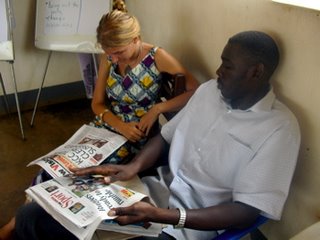
We all follow carefully the daily developments in newspapers that unreliably print shadows of truth. We listen to Kony and Otti on the radio. They both apologized “for everything” on two different days within the past weeks on an Acholi broadcast. And I dared to be thrilled at such watershed statements. At the same time, their voices sounded hollow and the words echoed off of so many atrocities. If they were sorry for the abductions, truly, than why do they still refuse to release the women and children?
Otti has said his “wife and children” are part of him and they will all go home together. The women and children are a shield, a bargaining chip, they are still useful—and they are evidence that though they might be “sorry” they aren’t willing to make things right, not yet.
The irony of having men who have committed some of the worst crimes against humanity raising issues that are actually of legitimate concern and are real political grievances of people in the North is sometimes overwhelming and borders on the absurd. A cartoon in the paper depicted new seats being added to Parliament and Kony sat in one of them with a bloodied machete. A nameplate on the table in front of him read: “Minister of Child Rights.”
I read an editorial this morning (by Charles Onyango-Obbo in the Daily Monitor) He says, “If you ask those of us, who support dialogue to end suffering, but are opposed to these pacts with the devil, what creative alternative there is to that, we don’t have an intelligent answer. That’s the real tragedy of Uganda.” I join him, and many others in the fear that, “sleeping with the devil” could produce some very ugly children.
When I passed through Gulu on the way home from Kitgum on Friday I had a drink with the Public Relations Officer for the UPDF in Northern Uganda. I got the party line, or the military line, instead of the medias interpretation of it. He told me the meeting went well with Dominic Ongwen, (one of the ICC indicted) he said Kony was lying when he said they’d been shot at after the cease-fire by the UPDF. He told me about the one abduction that has taken place since the cease-fire. I asked him if he was hopeful about peace. “Honestly,” he said, “It’s hard to tell, I say it’s still a fifty/fifty chance.” I’ve talked with him before—it’s his job to put the best foot of the military forward, and he does it well. So, I was disheartened by his prediction, if he says fifty/fifty, I’m guessing the UPDF is thinking and planning for thirty / seventy—or worse.
Still, hope finds ways of asserting itself. While we were in Kitgum there were hundreds of rebels walking, sitting under mango trees, waiting for others to join them and then continuing. Presumably they were going to the assembly points. They weren’t hostile. They weren’t causing trouble. They were “friendly.” I don’t know whether to let myself get excited or not. It is so delicate, fragile, and precarious. There are so many variables and so many unknowns.
Right now, Angelina, the Chairperson for CPA is moving with a team of others on a National Reconciliation team. The team is meeting with leaders all over the country and while they discuss and reconcile with each other they are gathering consensus around the messages they want to send to the government, the UPDF, and the LRA and to ordinary people in Uganda. She consulted me just before she left on the most recent leg of her journey to Bunyoro. We discussed the dangers of “unconditional forgiveness,” that can encourage impunity and conceal the truth. We discussed the need to convince the ICC that the crimes which have been committed against humanity—not only the people of Uganda--could somehow be redressed in a local context, in the interests of peace, through Roco Wot and Mato Oput. Angelina is admirably reckless with her optimism. While it strengthens my heart, my mind finds some safety in skepticism that guards me against the disappointment that may come.
Cautious optimism characterizes the mood around the peace process for Northern Uganda. That is how I feel anyway. In general, I consider myself a naturally hopeful person, but I want it so desperately for this place that it hurts to allow hope too much liberty—the obstacles to any meaningful peace mean a high risk of disappointment.

We all follow carefully the daily developments in newspapers that unreliably print shadows of truth. We listen to Kony and Otti on the radio. They both apologized “for everything” on two different days within the past weeks on an Acholi broadcast. And I dared to be thrilled at such watershed statements. At the same time, their voices sounded hollow and the words echoed off of so many atrocities. If they were sorry for the abductions, truly, than why do they still refuse to release the women and children?
Otti has said his “wife and children” are part of him and they will all go home together. The women and children are a shield, a bargaining chip, they are still useful—and they are evidence that though they might be “sorry” they aren’t willing to make things right, not yet.
The irony of having men who have committed some of the worst crimes against humanity raising issues that are actually of legitimate concern and are real political grievances of people in the North is sometimes overwhelming and borders on the absurd. A cartoon in the paper depicted new seats being added to Parliament and Kony sat in one of them with a bloodied machete. A nameplate on the table in front of him read: “Minister of Child Rights.”
I read an editorial this morning (by Charles Onyango-Obbo in the Daily Monitor) He says, “If you ask those of us, who support dialogue to end suffering, but are opposed to these pacts with the devil, what creative alternative there is to that, we don’t have an intelligent answer. That’s the real tragedy of Uganda.” I join him, and many others in the fear that, “sleeping with the devil” could produce some very ugly children.
When I passed through Gulu on the way home from Kitgum on Friday I had a drink with the Public Relations Officer for the UPDF in Northern Uganda. I got the party line, or the military line, instead of the medias interpretation of it. He told me the meeting went well with Dominic Ongwen, (one of the ICC indicted) he said Kony was lying when he said they’d been shot at after the cease-fire by the UPDF. He told me about the one abduction that has taken place since the cease-fire. I asked him if he was hopeful about peace. “Honestly,” he said, “It’s hard to tell, I say it’s still a fifty/fifty chance.” I’ve talked with him before—it’s his job to put the best foot of the military forward, and he does it well. So, I was disheartened by his prediction, if he says fifty/fifty, I’m guessing the UPDF is thinking and planning for thirty / seventy—or worse.
Still, hope finds ways of asserting itself. While we were in Kitgum there were hundreds of rebels walking, sitting under mango trees, waiting for others to join them and then continuing. Presumably they were going to the assembly points. They weren’t hostile. They weren’t causing trouble. They were “friendly.” I don’t know whether to let myself get excited or not. It is so delicate, fragile, and precarious. There are so many variables and so many unknowns.
Right now, Angelina, the Chairperson for CPA is moving with a team of others on a National Reconciliation team. The team is meeting with leaders all over the country and while they discuss and reconcile with each other they are gathering consensus around the messages they want to send to the government, the UPDF, and the LRA and to ordinary people in Uganda. She consulted me just before she left on the most recent leg of her journey to Bunyoro. We discussed the dangers of “unconditional forgiveness,” that can encourage impunity and conceal the truth. We discussed the need to convince the ICC that the crimes which have been committed against humanity—not only the people of Uganda--could somehow be redressed in a local context, in the interests of peace, through Roco Wot and Mato Oput. Angelina is admirably reckless with her optimism. While it strengthens my heart, my mind finds some safety in skepticism that guards me against the disappointment that may come.
Monday, February 27, 2006
The Proof, The Trick & Restorative Justice
by Holly
Over a mug of coffee this morning I read the Sunday paper of one of the two most prominent Ugandan newspapers. The article that caught my attention was discussing how the political opposition uses the ongoing war to cast a shadow on the incumbent’s track record while addressing crowds of supporters in the North. It was an op-ed piece that was sharply criticizing the practice and setting the record straight: those who are responsible for the war are the LRA rebels—not the current government. The proof, the journalist opined, is that the International Criminal Court(ICC) has issued warrants for the top 5 in LRA command. I’ve been meaning to write a few thoughts about the hotly debated role of the ICC in Northern Uganda and this article is an excellent example of one of the many (unintended) byproducts of the international community’s attempt to administer justice. While I hold my own opinions on ICC involvement it seems most appropriate to focus on the perception and desires of those who are directly affected by it—the people in the North. While I can’t claim to speak for them, in my limited time here my conversations with colleagues, formerly abducted children, parents, camp leaders, religious leaders, and others have confirmed without exception empirical research that has been conducted that I’d read. (Justice & Peace Commission and Refugee Law Project are two main organizations). Three main beliefs about the ICC are reoccurring themes in conversations and research on the subject.
It is not seen to be objective. The case was referred to the court by the government of Uganda and by indicting only the top 5 in command of the LRA the perception (whether it is valid or not may be another story) is that the ICC has “chosen sides” in an ongoing conflict. Although virtually no one supports the LRA, many in the North don’t support the current government either and have been victims of human rights abuses committed by both warring parties. Most people believe that if there is to be accountability for injustices it should be comprehensive. The ICC has made statements indicating that the government would not be exempt from investigation. However, they only indicted top LRA and those statements seem to have only been read by a rare few who relish sifting through reports and not by your average (often illiterate) camp resident in Northern Uganda.
It undermines amnesty and therefore, many believe, the only shot at achieving sustainable peace. The government’s attitude towards the amnesty process is widely perceived to be at best ambiguous and at worst a trick to lure rebels out of the bush and then when peace is achieved to use the documentation of amnesty recipients as incriminating evidence to prosecute them—letting a thousand flowers bloom Ugandan style. In a strictly legal sense, if I understand it properly, it truly only undermines the amnesty of five individuals, however, it is NOT understood properly by the general population and even less so by those (children) who remain in the bush afraid of what will happen to them if they try to come out. The risks of escape are great. The stigmatization experienced while trying to reunite with a community and a family plagued with grievance is inevitable. The perceived liklihood of being prosecuted for crimes committed involuntarily does not provide the assurance that many need to even begin contemplation of surmounting the other hardships. Couple that with the fact that many of those trying to decide if they should risk escape and apply for amnesty are or were children when they were abducted and have undergone significant “mental conditioning” since then. The ICC has said that it would consider postponing the case “in the interests of justice.” If even one child is dissuaded from coming home to his/her family by confusion over the ICC is that in the interests of justice?
It imposes a western version of justice ignoring both the traditional way as well as the needs of the victims. Someone recently told me that they don’t want Kony sent to the Hague and then shipped to some comfortable jail somewhere. Nor do they want him tried by Ugandan courts where capitol punishment (by hanging) would be his likely sentence. No, they don’t want his blood on their hands, they want him to spend his life working in the fields. He should have to plow and sweat just like the rest of Northern Ugandans. While this scenario might not sound viable it reflects a widely held belief and practice of reintegrating perpetrators into their communities. If the victims do not believe the ICC is achieving justice—than who is the justice for? Does it only satisfy the international community’s desire to do something? It pours some water on our burning consciences as each day we continue to fail to effectively respond to the growing suffering of the people of Northern Uganda. While the crimes that the ICC deals with are those against humanity—we must not neglect the fact that the victims of those crimes have faces and names and many of them are still alive and thinking about their futures. One mother told me that there could be no meaningful restitution for what she has suffered—the injury is too great. For her, justice means that her daughter and the children that she bore in captivity receive the best possible education. Justice for Northern Uganda, will not be achieved by 5 arrest warrants. It will need to move beyond retributive and punitive justice and draw from the deep traditional well that the people of Northern Uganda have used for centuries—of restorative justice.
Over a mug of coffee this morning I read the Sunday paper of one of the two most prominent Ugandan newspapers. The article that caught my attention was discussing how the political opposition uses the ongoing war to cast a shadow on the incumbent’s track record while addressing crowds of supporters in the North. It was an op-ed piece that was sharply criticizing the practice and setting the record straight: those who are responsible for the war are the LRA rebels—not the current government. The proof, the journalist opined, is that the International Criminal Court(ICC) has issued warrants for the top 5 in LRA command. I’ve been meaning to write a few thoughts about the hotly debated role of the ICC in Northern Uganda and this article is an excellent example of one of the many (unintended) byproducts of the international community’s attempt to administer justice. While I hold my own opinions on ICC involvement it seems most appropriate to focus on the perception and desires of those who are directly affected by it—the people in the North. While I can’t claim to speak for them, in my limited time here my conversations with colleagues, formerly abducted children, parents, camp leaders, religious leaders, and others have confirmed without exception empirical research that has been conducted that I’d read. (Justice & Peace Commission and Refugee Law Project are two main organizations). Three main beliefs about the ICC are reoccurring themes in conversations and research on the subject.
It is not seen to be objective. The case was referred to the court by the government of Uganda and by indicting only the top 5 in command of the LRA the perception (whether it is valid or not may be another story) is that the ICC has “chosen sides” in an ongoing conflict. Although virtually no one supports the LRA, many in the North don’t support the current government either and have been victims of human rights abuses committed by both warring parties. Most people believe that if there is to be accountability for injustices it should be comprehensive. The ICC has made statements indicating that the government would not be exempt from investigation. However, they only indicted top LRA and those statements seem to have only been read by a rare few who relish sifting through reports and not by your average (often illiterate) camp resident in Northern Uganda.
It undermines amnesty and therefore, many believe, the only shot at achieving sustainable peace. The government’s attitude towards the amnesty process is widely perceived to be at best ambiguous and at worst a trick to lure rebels out of the bush and then when peace is achieved to use the documentation of amnesty recipients as incriminating evidence to prosecute them—letting a thousand flowers bloom Ugandan style. In a strictly legal sense, if I understand it properly, it truly only undermines the amnesty of five individuals, however, it is NOT understood properly by the general population and even less so by those (children) who remain in the bush afraid of what will happen to them if they try to come out. The risks of escape are great. The stigmatization experienced while trying to reunite with a community and a family plagued with grievance is inevitable. The perceived liklihood of being prosecuted for crimes committed involuntarily does not provide the assurance that many need to even begin contemplation of surmounting the other hardships. Couple that with the fact that many of those trying to decide if they should risk escape and apply for amnesty are or were children when they were abducted and have undergone significant “mental conditioning” since then. The ICC has said that it would consider postponing the case “in the interests of justice.” If even one child is dissuaded from coming home to his/her family by confusion over the ICC is that in the interests of justice?
It imposes a western version of justice ignoring both the traditional way as well as the needs of the victims. Someone recently told me that they don’t want Kony sent to the Hague and then shipped to some comfortable jail somewhere. Nor do they want him tried by Ugandan courts where capitol punishment (by hanging) would be his likely sentence. No, they don’t want his blood on their hands, they want him to spend his life working in the fields. He should have to plow and sweat just like the rest of Northern Ugandans. While this scenario might not sound viable it reflects a widely held belief and practice of reintegrating perpetrators into their communities. If the victims do not believe the ICC is achieving justice—than who is the justice for? Does it only satisfy the international community’s desire to do something? It pours some water on our burning consciences as each day we continue to fail to effectively respond to the growing suffering of the people of Northern Uganda. While the crimes that the ICC deals with are those against humanity—we must not neglect the fact that the victims of those crimes have faces and names and many of them are still alive and thinking about their futures. One mother told me that there could be no meaningful restitution for what she has suffered—the injury is too great. For her, justice means that her daughter and the children that she bore in captivity receive the best possible education. Justice for Northern Uganda, will not be achieved by 5 arrest warrants. It will need to move beyond retributive and punitive justice and draw from the deep traditional well that the people of Northern Uganda have used for centuries—of restorative justice.
Tuesday, February 14, 2006
News Flash...
This morning Ben and I were watching BBC and sipping on instant coffee at our hotel here in Gulu. Across the bottom of the screen it read 'Ugandan elections unlikely to be free and fair--U.S. based Human Rights Watch reports.' They catch on quick. Check it out: http://www.hrw.org/english/docs/2006/02/13/uganda12669.htm
Elections are in a week and we're praying, hoping and working for peace.
Elections are in a week and we're praying, hoping and working for peace.
Subscribe to:
Posts (Atom)