Showing posts with label mental health. Show all posts

Monday, March 24, 2008

Exported Ideals

On a recent field visit to an IDP camp near the border of Sudan, I came by a clinic. I was interested in knowing the services available in this remote location so I greeted the nurse and was invited in.


The majority of the nurses and patients were gathered under mango trees as the clinic building was very small. As I walked into the building I saw a room titled "Group Counseling Room". I was delighted to see that the patients were receiving both medical treatment and psychological care. As I approached the room I noticed that room was stacked from floor to ceiling with food aid.

I imagined the expatriate staff writing a proposal for this clinic. The donor wanted to see something to do with "psychosocial support" or "counseling" fitted into the clinic proposal. Unfortunately, it is not uncommon for international actors to recognize the importance of psychological wellbeing in sustainable development, yet most have no idea how to implement healing interventions. Exporting the concept of group counseling and allotting a space is not enough. Real psychosocial healing takes a massive investment from the local community and trained healers with long-term commitment. Many mental health professionals are contented with short-term consultancies or establishing a system of care. However, psychological healing takes imagination and creativity; fostering this cannot be accomplished through a one-off input. There must be a commitment to the individual and his or her process. This commitment is not "cost-effective" and may not yield immediate results but underpins the entire process of restoration in the individual and wider community.

The World Health Organization has a motto that says "There can be no health without mental health". While we can agree to this truth, the investment in mental health remains lacking in many developing countries.

While I was saddened at the missed opportunity for psychological healing through group counseling, I applauded the community members for their utilization of space. I turned to Holly and said, "Hunger always wins out over half-baked ideas of emotional support"

Is psychological wellbeing a luxury or a necessity?

Can we expect the community to value psychological healing when current interventions are superficial and material aid has been fine-tuned?

Sunday, June 24, 2007

A few pictures and thoughts

by Ben
I don't have any profound thoughts or insights, but I wanted to put a few pictures on our blog. Life has been full...and good.

Two weeks ago a group from our home church came to Lira. We set one day aside for a "solidarity day". Upon our arrival at an IDP camp about 2 hours out of town, men and women were divided and assigned everyday life tasks. Women went to go shopping and prepared food, while men dug in a rice field and tried to thatch a roof. It was probably a first for many of the women to get beef from a recently butchered cow placed on banana leaves on the side of a dirt road. They simply pointed to the part they wanted and someone hacked it off.

(This is Zach, Kimuli, Patrick and a guy from the camp digging in the rice swamp)


(This is Zach sitting on a grass roof after separating the grass, thinking, "So, I'm suppose to jump down like that too?" This is a hut for two boys who lost both of their parents in an LRA attack)


(This is a picture of a baboon after stealing our cookies out of the truck. Ask Zach for an impersonation.)


We also went on a game drive.

(The raw beauty of Uganda never ceases to amaze me)


On a different note, I was in Gulu last week, for the first of a four-week training in Narrative Exposure Therapy (for my trainers and other local staff from rehabilitation centers across N. Uganda). I am very excited about this training. It is being facilitated by researchers and professors from Germany. The therapy model is adapted for children in Northern Uganda and research has proven its effectiveness. Until recently any empirical data on prevelance or effective treatment of mental health disorders has been almost completely absent. I am grateful to be a part of this training and really sense people's committement to raising standards of psychosocial care in N. Uganda. I also co-chaired the first meeting of a new group called "Mental Health and Psychosocial Support Technical Team for Northern Uganda" with Quaker Peace and Social Witness last Friday. There seems to be increasing mommentum for this kind of work and I'm excited to see where this group takes us.

Friday, September 22, 2006

Stress and Trauma Healing


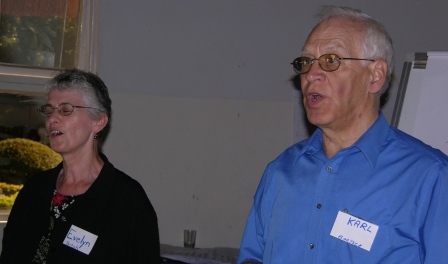
Karl and Evelyn Bartsch came to Uganda to offer the fourth training module for the training of trainers project. The topic was stress management and trauma healing. I was fortunate to receive the training this time around. Normally, I am responsible for writing the manual, conducting the training, and coordinating logisitics, but to my great relief, I was nurtured by the caring support of Karl and Evelyn.
Karl and Evelyn have successful private practices in America, but they chose to leave their comforts behind to stay in a place without electricity, drinkable water, and thier usual diet, to give us a new and deep perspective on our work as caregivers. Karl and Evelyn have been married for 45 years.
In the picture above Karl and Evelyn are leading us in a song called, "Healing River". The participants loved it, and are translating it into Luo.

Monday, September 04, 2006

The State fof Mental Health Services in Lira, By Ben

In the community, you will frequently here of the “community volunteer counselor” and of their efforts to provide “psychosocial support”. What isn’t clear is how they go about counseling those in need. These individuals are deemed counselors after a one or two day workshop (a week if they’re lucky). Crisis and trauma counselors in rehabilitation centers for formerly abducted children become qualified to do the work with a bachelor’s in social studies (or less) and no clinical experience. While the international community has recognized the great need for psychological recovery in conflict and post-conflict settings, actors seems satisfied with slapping a superficial, insufficient and unprofessional “band-aid” on the ubiquitous and complex psychological issues. This may be a result of the general absence of mental health practitioners in decision-making positions for programming strategies of INGOs.
I’ve been doing a bit of research on the state of mental health care in Lira and have come up with disheartening results. Here is an example of a short interview I had at the main hospital a week ago. The “mental health clinic” was three weeks old. It was staffed by one Psychiatric Clinical Officer (education equivalent: 2 years after high school) and two psychiatric nurses (one was still enrolled). For an office, they were given the tiny room that hosted the electrical breaker for the entire hospital; the room wasn’t painted and the ceiling was leaky.
Me: What do you use as a screening tool for diagnosis and treatment?
PCO: The ICD-10
Me: Okay, do you have a copy of the ICD-10?
PCO: No
Me: Any photocopies?
PCO: No
Me: So, how do you know if you’re asking the right questions?
PCO: I learned all the diagnosis in school.
Me: Do you make referrals for counseling services?
PCO: No, I learned how to do that in school too.
Me: How many clients do you see in one week?
PCO: Around 200.
This man was doing the best that he could, but it was obvious that he needed some help.
I will be going to Italy in Nov. to attend a “Masters Certificate Course” in Global Mental Health: Trauma and Recovery. It is a program run by Harvard University’s program for refugee trauma (since I am unpaid at the moment, they have graciously granted me a full-tuition scholarship!). It consists of two weeks of on-site training in Orvieto and 5 subsequent months of web-based learning. As a component of the program, we will be analyzing trauma clinics in a variety of international/conflict settings. The Concerned Parents Association and I are looking forward to new prospects in bringing a heightened level of mental health expertise into Lira and other Northern districts. Any volunteers? More later…