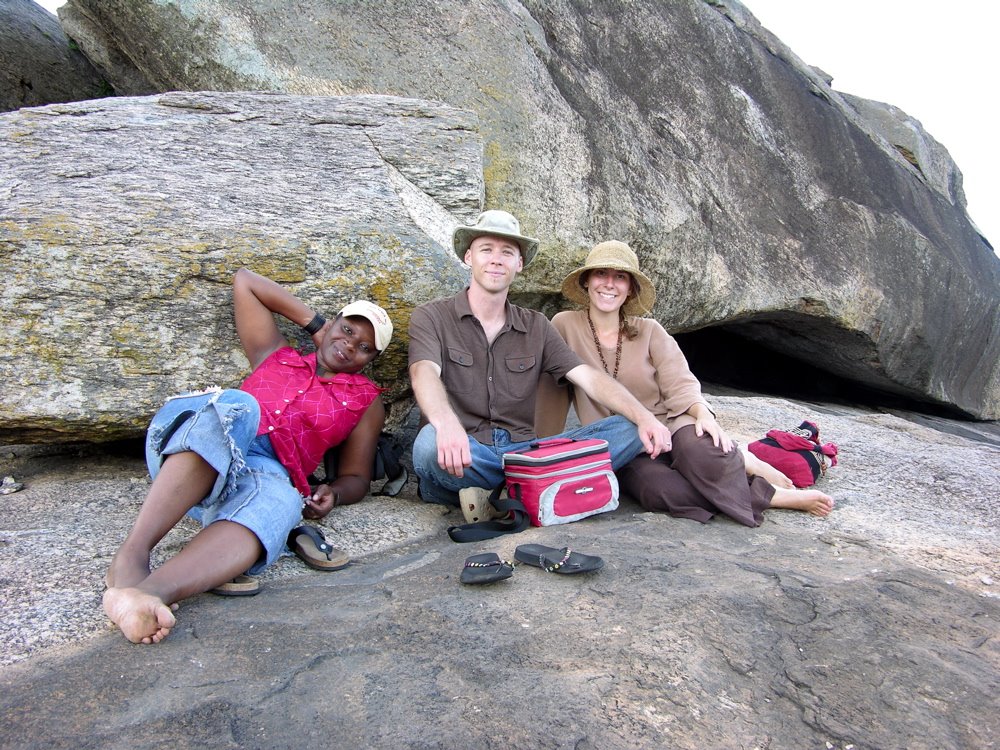
Showing posts with label this is Uganda. Show all posts

Friday, March 19, 2010

Going south: false/wishful advertising & laughable logic


Right.

This is the bus I took last week from Gulu to Kampala
Scheduled departure: 8:00am
Time I was told I should come to catch the bus: 8:30am
Time I decided to show up (because I think I've learned from experience): 9:30am
Actual departure time: 11:47am

We really miss out if we're too aggravated to laugh at the irony. It reminded me of a similarly long wait for a bus a few years ago. After the wheels finally started moving, the bus made it several blocks before breaking down. We waited for the next bus which also broke down. When the third bus, which finally proved itself road-worthy came, it had a slogan painted across the upper part of the windshield: "God likes patience." The increasingly disgruntled passengers had to laugh in spite of themselves. Waiting patiently is a useful spiritual discipline. So much of life is waiting for something, without exercising it, we spend too much time frustrated and annoyed. There are many opportunities to practice. One little celebration of the road: hundreds of speed humps which have in the past apparently served some often-speculated but little-understood constructive purpose have been removed! I'll have to find something else to practice my Acholi counting skills to pass the hours heading south--but the journey is so much more painless without an hour of jostling over kilometers of bumps.

Proof that I really am learning from experience: I went to the bus park in Kampala early, booked my seat back to Gulu and left my luggage. Exchanged phone numbers with the conductor. "Waited" in a cafe for a couple of hours with a friend. Conductor called me 10 minutes before the bus left, just enough time to clear the bill and boda back to the park. It was great! I highly recommend the strategy.

A new feature of the journey: the police stop the buses at every check point. Ostensibly, this is because they register the bus at each point to regulate speed. At one stop, the inspector boarded the bus in an immaculately cleaned and starched white uniform and black beret. He introduced himself and gave us all his phone number. I still have it in my constant moleskine companion where I quickly tried to write every word he said--his logic was truly dizzying. He marched up and down the aisle of the bus for the next 15 or 20 minutes lecturing the passengers and driver in turn about the perils of speeding, societal ills of corruption, benefits of taxes and healthcare. Well, sort of. "You are bribing us too much!" he shouted. "You have bribed me enough. You're giving me that money and I am eating alone, yet you are the one's who are all dying just because you are in a hurry." He asked passengers if they were satisfied with the speed of the bus since we left Gulu and how we rated the driving of the man behind the wheel. We mumbled a mediocre response. He was driving fine. "You are in a hurry and going fast can end life! Then we catch you and you bribe us with fifty thousand (around $25) but how much is the life of a person worth? It's better if you get a speeding ticket to go to court. Then you pay the government. Then the government will use that money to offer you health care when you are all injured from motor vehicle accidents because of over speeding! You should pay your taxes and go slowly instead of me eating all this money from bribes alone and all of you dying!" He paused, for dramatic effect, I imagine, "Go safely!" He finally finished and the bus responded to this rousing end with a round of applause!

It's not every day a police officer admits to taking bribes and is publicly lauded. But then, no day, is really like any other day.

Saturday, February 27, 2010

No Smoke Without Fire?


*Photo from BBC link below
By Holly

In January the BBC aired a Newsnight special on ‘ritual child murder in Uganda.’ It provoked an unfavourable reaction, where a number of critiques were brought against it that I talk about below. I wrote this about a month ago, but didn’t get around to posting it and then attention had moved on until child sacrifice splashed out in the news again on the BBC and, this time, nationally in the New Vision. The Ugandan Government was evidently embarrassed by the piece and arrested the primary BBC informant, a “reformed witchdoctor” Pollino. The word on the street is that he was given a choice: be charged with 70 counts of murder that he confessed to the BBC and subsequently the police or be charged with lying (less jail time for the latter). Whether this ultimatum was truly delivered, I don’t know. But those close to the situation say that he was certainly involved in numerous child sacrifices even if 70 might be an exaggeration and he is now being held for giving false information to a police officer. Since I wrote this I was finally able to listen to the radio version of the programme (a new café in Gulu opened with faster internet!). I still haven’t been able to watch it. The friend that I mention was with the BBC film crew who hadn’t seen it, finally did. More than a month after it had aired they received a DVD copy that the BBC sent.

I’m in a village a few kilometres from Gulu town sitting in a grass-thatch hut with a group of about a dozen people, my laptop and a portable modem. We load the BBC website and navigate to Newsnight’s special on child ritual murder in Uganda that aired several weeks ago. Five or ten seconds play at a time, broken by a rotating circle assuring us it’s ‘loading’. The Internet is slow here. In an exchange between the BBC and several anthropologists, the BBC pointed out that criticism has only been from British-based academics. People in Uganda must like the report since they haven’t complained. Looking around the room, this defence is perceptibly feeble. I hoped to remedy the paucity of Ugandan voice in the discussion by showing the piece today and sharing reactions. But after repeated broken promises from the twirling icon we finally give up and discuss a few issues raised by people far away on a report that none of us have seen:

Generalized use of the term ‘witchdoctor’ is unhelpful
There are diverse practices of people involved in the supernatural: people born with uncontrolled power to harm or help, herbalists, those involved in divination, séances, exorcisms, curses and charms. The group lists titles in English and Acholi: wizard, witch, night dancer, Ajwaka, Lajok among others. Categories I draw from their descriptions and that anthropologists have outlined (p’Bitek, Girling) are much more neat than the complex fluid social understandings. I asked how they would feel if the BBC referred to them all as ‘witchdoctor’? One woman responded, “If they misrepresent the situation, it doesn’t bother me since all of them are doing bad things.” Another person disagreed citing positive work of herbalists. Unfortunately, the Ajwaka who lives next door wasn’t around. Her main activity is to bang her shoes together, throw them on the ground and read your future by the way they fall. She would certainly be appalled at the idea that she belonged in a category accused of brutally murdering children.

Perpetuating fear poses danger to the accused
If there were any indication that Ugandans were watching this would be a significant worry. Northern Uganda is in transition, when such issues should be handled with extra care. Disordered times create space for the enactment of widespread fear in extraordinarily violent ways. In the lat time of transition a predecessor to the Lord’s Resistance Army, Cilil, was infamous for torturing ‘witches’ forcing them to carry hot coals or burning them with melted plastic. One person in the room admitted she set a trap seriously injuring a night dancer.

Everyone has a story about ‘witchcraft’ usually speculative and told as fact. A few months ago, one of the young women recounted how her friend had fallen sick after stepping on charms placed by an old woman in their village. It took a lot of prodding before she admitted she had not seen the charms and her reason for suspecting the woman was that she “looks sideways when she fetches water from the well.” One day I passed the apparently witchy lady while we were collecting water together. The young woman looked at me triumphantly, “You see!?” she said, sure that I witnessed manifest evil. I have an untrained eye, but the woman appeared quite ordinary and not unfriendly.

They all assured me, however, that the six known Ajwaka in their village were in no danger as long as they continued activities within the law. I would add, as long as there are no rumours to the contrary.

Such stories revive myopic prejudices
Unfortunately, we could not comment on whether the ‘stylistic requirements’ of the BBCs audience that Whewell defended in his correspondence were fair or sensationalized. It’s clear that the target audience was not in Ugandan. Even a friend who helped Whewell’s crew in Lira was not shown the final product and, like me, has been unable to access it online. But, I asked in general, how they felt about such stories in western media. A young man said he worried that people would think Ugandans are “backward.” Another woman wondered how BBC decides which stories to report. She paused thoughtfully, “Well, we’re tired of people always giving attention to the war. At least now they are reporting on something else.” Yes, it’s nice to see media breaking from perpetuating the image of Africa as a place of endemic political violence to focus on witchcraft for a change.

Medicine murders are rare, not new and not the result of modernization (as the BBC suggests)
The only thing new modernisation contributes to ritual murder is media’s effect on public perception. According to the group, ritual murder has “always been there” but tends to have clusters of popularity followed by lulls. Competition among powerful people resorting to similar dark methods is followed by negative attention that forces practitioners to withdraw until the popular imagination moves on. I asked them, what they believe prompted this particular perceived cluster of child sacrifices. They suggested politics. Some politicians are rumoured to use witchcraft to secure power, or in campaigns to manipulate fear in their favour. One person had personally witnessed evidence of child sacrifice. She saw the body of two-year-old boy that was used in ritual. The police stopped a crowd of people from stoning the man who was later convicted.

There have been a small number of similar cases documented by police. In addition to these reports, the BBC included a child rights NGO consortium among their main sources. I worked for one of the member organizations for three years. It’s worth noting that sensational violence against children is more likely to tug at the heart and purse strings of potential donors. Past funding to the consortium has been used on advocacy campaigns such as bumper stickers urging people to ‘Stop child sacrifice.’ It’s difficult to imagine that someone who kills children for ‘medicinal’ purposes would read this and suddenly see the error of their ways. Instead, the message feeds the “growing concern” that (those who have seen the report say) the BBC has taken as evidence of growing practice.

“We have a saying in our language,” a woman offers by way of conclusion. As she says it, you are reminded how universal some things are: “There is no smoke without fire.” I pushed the issue, recalling an instance a few months ago when a severed hand in the middle of a road sent people into superstitious panic until a one-handed woman turned up in a hospital. She was driving with her arm out the window when a lorry carrying sharp cargo passed. Well, sometimes, they concede, there is smoke without fire. However, on the issue of child sacrifice, “there is fire. But it seems the BBC also reported the smoke.”

Tuesday, February 23, 2010

On hypocrisy...

Why is it hypocritical to be a human rights activist that doesn’t support gay rights?

www.ugandans4rights.org

Seems pretty straightforward—(why is it so darn hard for us to get a handle on what it means to be “human”?), but this was the topic of a lecture, one of many efforts to address issues and attitudes expressed in the Anti-homosexuality bill. You can visit the link here to follow the campaign against the bill and see how you can support the campaign. There is info on legal implications, video of lectures and speeches given (including debate and those who support the bill like a Ugandan MP who wants to be the “hangman” of LGBTI), a one stop shop for any press coverage, etc.

Monday, January 25, 2010

American opposition to the Anti-Gay Bill has potential to curb corruption and encourage fiscal responsibility

by Holly

I've been wanting to post something for quite awhile on Uganda's Anti-Homosexuality Bill that includes the death penalty for "aggravated homosexuality" that is being considered in Parliament. There is just so much to say, it's hard to know where to start. So I've included most of a slightly altered comment I made on another blog for your benefit/to get myself started: (you can find the blog post and my original comment here)

This bill is a crying shame. It’s a crying shame that Musevini and others would only consider opposing it because of money—not because it’s obvious that if enacted it would be an unjust law. I’ve been totally appalled by how the religious leaders in particular have supported it and the extreme threat that they seem to think homosexuality poses to health and family life (not to mention that in a lot of the rhetoric the words homosexuality and pedophilia are used interchangeabley..um, what?). If the Ugandan Christian clergy really wants to fight for an issue of sexual morality that is threatening their communities, spreading HIV and breaking up families it should be to promote faithfulness in marriage through their lives and pastoral work rather than throwing their weight behind this insidious and hateful legislation against homosexuality.

I'm deeply concerned about the legal impact, but perhaps even more so about the social implications. Citizens taking justice into their own hands is not only common but encouraged by police and many will inevitably interpret this bill as the state condoning violence against homosexuals (even without it we’ve heard cases of sexual violence against homosexuals to "turn them straight").

I don’t even know how to begin engaging this issue with friends and colleagues here (although I regularly try--and would love some new ideas if anyone's got them)—and have a hard time getting my mind around how people who are otherwise compassionate human beings can think that it’s okay to imprison if not kill homosexuals. (It's already illegal to be gay in Uganda, and you can get up to 7 years in prison for it--really, do we need a harsher law?) I know maybe I shouldn’t be surprised by this stuff anymore, but even Ugandan friends who are involved in human rights advocacy and that I’d consider relatively progressive will dismiss the issue as “cultural” and are at best ambivalent if not supportive of the bill. It seems that in Uganda, like the Minister of Ethics and Integrity (the irony of his title kind of makes my stomach churn) said, “gays can forget about human rights.” Seriously, I lose sleep having imaginary arguments with people about this. It’s a crying crying shame.


I should note, that since i wrote about my dismay of the Christian clergy's support of the bill, I was encouraged that at least the Catholic Archbishop has described the bill as "Un-Christian." It seems like somewhat of an understatement, but it's something.

Get off our backs, donors told was published in the Monitor the same day I had an intriguing discussion with a friend. Here is the most amazing quote in the article from Steven Mukitale, the chair of Parliament's Committee on National Economy:
"We can cover the aid money they (the US) want to stop through disciplined spending and curbing corruption."
Wow. It's not every day you hear a government official boast that all the money the US gives is lining officials pockets and undermining accountable and responsible government spending. I wonder what USAID in Kampala thinks about this...

I was discussing this article with a Ugandan friend with a refreshingly different if somewhat conspiracy-theory-esque take on it all. He's one of the first Ugandan guys I've talked to that opposes the bill, although, he really doesn't take it all that seriously. Instead, he thinks it is political posturing. He had three arguments, two that I found somewhat compelling. First, the bill has hugely distracted from the massive swindling of CHOGM (Commonwealth Heads of Government Meeting) funds. The evidence of corruption was climbing up the President's cabinet. After it reached the VP hints of the big man's implication were made and then this bill was introduced and little attention has been given to it since. Second, Musevini is quite aware that he has in recent years fallen from favor in the eyes of many western leaders. As my friend says, "he's not the blue-eyed boy they once thought him to be." His plan, my friend believes, is to rush in at the last hour to kill the bill and save the homosexuals, scoring points with the west. I pointed out that this seemed an odd time to be so concerned in appeasing the international community when the constituency that has to re-elect him is warming up for the poles and seems to support the bill. "He's not worried about that. He knows he'll go through--so he only cares about restoring his image in the international community." The third, I didn't really follow the logic--somehow human rights NGOs were part of a conspiracy to attract funding for promoting human rights of homosexuals but all the money that would pour in would somehow be diverted for political campaigns. I'm not sure about all that, but I do find the idea that there's no reason to fear this bill will ever be enacted rather comforting. Sadly, I think there is still good reason to be concerned. Parliament has planned public dialogues and gathering views from the 'grassroots' that risk giving an air of legitimacy to what can only be an unjust law if enacted.

If you're interested, the Civil Society Coalition on Human Rights and Constitutional Law, that formed in response to this Bill, has compiled articles, opinions, press statements and other information on the Bill that is available to download.

Sunday, December 27, 2009

24 Years Coming

by Holly (I know, it seems so long, you thought the title of this blog referred to our blogging absence--but no, it's about this christmas)

Christmas in Mzee Oling's home, with six daughters, one son, an aunty, two cousins, and some of the most adorable grandkids imaginable. This is where I spend most days learning Acholi and doing "participant observation" for my research. Today is different. It's christmas. The 4 huts that make up this home are teeming with smiling friends, chickens oblivous to their destiny, and kids laughing chasing Ogiko (our dog) who we brought with us. The neighbors father works in the local radio station so he's brought home a huge sound system that is competing with Mzee's small hand held radio to play alternating traditional Acholi and western christmas songs. I found the ladies all in the kitchen, sweating seriously over charcoal stoves and laughing. They got up at 5 am to start cooking and they are still laughing. We laugh for happiness, not an identifiable joke or funny incident. "We laugh to show the whiteness of our teeth," goes one of my favorite Acholi proverbs. Lamaro, my favorite little girl is still getting used to Ben. His white skin and blue eyes are rather terrifying. She's running from the kitchen hut to the bedroom hut to avoid being seen by him (or eaten by him?) She also behaved like this with me for the first few weeks. Now, I've been told she told her father (who comes to visit occasionally) that she has two mommy's, one black and one white. I'm thrilled the affection is mutual--even if she did have to overcome the obstacle of my strange skin.
Ben and Mzee are sitting under the tree discussing Mzee's christmas memories. He recounted christmas parties from when he was in his 20s and worked with Uganda Wildlife Authority and with a big luxury hotel company. His favorite christmas was the first christmas that they spent with the whole family here. They moved here in 1995, the war had begun but it had not yet directly touched the family. They came for access to better schools for his girls--and all the kids were home that christmas of '95. That was the year before he lost his leg in a tank mine explosion while he was collecting wood for charcoal. It was a year before a massacre in their home village, Attiak where they lost many relatives. Even his eldest daughter, escaped narrowly. She had been visiting an aunty in Attiak when the rebels began the massacre. She fell into a pit latrine where she hid until the bloodshed stopped and the rebels left all for dead. "This war spoiled everything," he says, "this is the first year since 1995 when we've felt safe and free to celebrate. It has been 24 years we've waited for this celebration." I can't help but pause prayerfully to remember the Congolese who feel anything but safe. The LRA has reportedly written several letters threatening a repeat of last years "Christmas Massacres." Several rebels who have escaped admitted they had joked about "celebrating christmas" like last year. Fortunately, no reported violence means they decided to celebrate some other way--but no doubt, our friends across the border will have to wait longer to experience the safety and freedom from violence that Uganda is now enjoying.

They really are enjoying it. The girls are dressing up, and combing out their hair. I came with nail polish a few days ago and painted over 20 pairs of hands or toes I'm sure.
The food is an amazing spread and they generously share with us as well as the random uninvited guests that are always welcome: a drunk neighbor who is a widow, a young woman who is only halfway in control of her mind that is happily singing and eating their food, and anyone else who seems to have an empty belly. We brought simple gifts: candy for the kids, a couple of t-shirts for the young men and some jewelry for the ladies, a book written by an Acholi preist on being a traditional Acholi and a Christian for Mzee. As they open each gift, Josephine ululates over the laughter of the rest of us who are clapping and happily watching what the next person is given. I felt some of the gifts weren't nice enough, for this incredible family that has helped me so much. I was worried about the reception--but I could not have imagined anything better! They all claimed that each gift was perfect for the receiver, and none envied other gifts. Personally, I am very grateful for the odii (ground sesame and peanut paste) that they lovingly gave us.

What is it that enables such easy laughter? such wholehearted gratitude? It might be a lack of expectation. If so, I(cynically/sadly?)thought to myself while sitting there, this is the first and the last christmas we will experience like this. Next year there will be an expectation. I have chatted with a few friends and family members from home and contrasted the blessed simplicity of christmas in Uganda with the materialistic madness and pressure to buy right, dress right, cook right, etc. of christmas at home. Every year must at least maintain, if not add on to the precedent of previous years. And yet, here, for the first time in decades people are enjoying the relative calm and prosperity so that they are finally able to celebrate materially--with small things like christmas dresses or even little artifical christmas trees--and it is a beautiful thing to see! Is that terrible? The materialism we turn our noses up to at home we welcome here as a sign of the absence of war.

Isn't there a way to maintain expectant wonder for this great celebration and accept every moment of it in whole hearted gratitude without holding it up for comparison to our unconscious (or conscious) standard of "shoulds"?

My friends in Wii Aworanga did it this year. Maybe it's the lack of expectation. Maybe it's the eruption of joy that has been waiting 24 years for peace to allow it's full expression. Whatever it is, I pray it is sustained--and that perhaps, it is contagious.


(Happy 100th blog to us! This is our 100th post. We intend to try to write more regularly in the coming year--yes, it's a proper new year's resolution. Regarding the new blog look and background--the quote on the top of the page must be accredited to Annie Dillard. And I have a confession. The woman in the banner photo is not from northern Uganda. She's actually Sudanese, and I took this photo while doing a consultancy in Yei (the blog I wrote about that time was "What Grows in This Soil". Her face is just so amazing--and I loved it here. I know, I really should replace it with one of the amazing Ugandan faces that I interact with and that grace my iPhoto library, and someday I will--but for now, I share her beautiful face with you and disclose her nationality.)

Saturday, December 26, 2009

Dance routine

Holly has been working with these cute girls on a dance routine

Christmas Ugandan Style

MERRY CHRISTMAS FRIENDS!
by Ben
Sorry it has been so long since we have posted, but we would like to do better in the coming year. Finally feeling settled, I have the mental space to reflect on this journey and share budding ideas, joys and sorrows with anyone who is interested. To start off lightly, this post is dedicated to our Christmas day.
Here are a few heart-warming text messages that we got from friends on Christmas. A prize goes to the first person to fully understand them
-When u trace down da maiden origin of mankind, it leaves u with huge imagination only 2 be revitalized by da glorious news of Savior’s birth.
-We wud like you to be safe always, so please do not tamper with meter boxes, main switches or any part of the internal wiring in your house. Stay safe. Merry Christmas. (From the national power supplier)
-When my arms can’t reach da ones I love, I hug them with my prayer and surrender them 4 God’s care and loving arms! Wish you a Merry Christmas and hapi 2010
-If you could feel my heart’s wish u wud b as delightful as I am, u wud jump up n dance 4 me as I sing 4 u Christmas hymns! B blessed as 4 celebrate this day.
-I’m sure you did a great spiritual shopping. Please receive the peace, joy, and love as bonus on your spiritual shopping.
-I hav deposited in your account 365 days of luv, wisdom, care, and unity in the bank 2010. Pliz spend them wisely. Happy celebrations
-This season’s a great time “2 pray” “2 love” “2 care” “2 smile” “2 celebrate” and above all “2 thank God”
-Ho! Ho! Merry Christmas. May your Christmas stocking be filled with loads of peace, love and joy. Drink, eat and make merry.
-God knew that our problem wasn’t hunger or thirst but salvation. So He did not send us food or water, but a Savior who was born 4 us.
-Hearts receive love, minds receive wsdm, hands receive gifts en only special pple receive warm wishes. Merry Christmas en let God god in 2010
-May da birth of Christ be a blessing 2 U n UR loved ones! Merry Christmas and a juicy nu ya.

I, for one, do intend on having a very juicy new year.

Here are a few pictures of our Christmas: Home, then village:

Our home in Kirombe, Gulu


I made Holly hunt for her presents. One of them took her up our water tower.


Eggs Benedict mmmmm. And it only took about three hours to make the English Muffins (or for our English readers...muffins)


Christmas dinner and Quote of the day. "That is one impressive cock"


Steven, Mzee, me, Galdin, and Innocent


The girls


Ulilating for presents. "Agili" in Luo


Holly, Koncy and Beatrice

We have had a wonderful holiday season and miss you all dearly. Wishing you the juiciest New Years ever.

Monday, July 14, 2008

15 Minutes or Never

Mom and dad visited a couple of weeks ago. We took them to Kampala and booked rooms, but there was some mix-up and their room was not self-contained room. Wanting to make my parents feel comfortable in my Ugandan home, I tried to convince the lady who ran the place to give them a room with an en-suite bathroom. There was an empty room but it needed some cleanup, so I asked when it could be ready. Her reply: "15 minutes"...long pause, "or...never."

With all the momentum behind the Juba Peace Process--the plan to negotiate the last item on the agenda and have all parties sign within a few short days in April--it seemed like it was all going to happen, in perhaps the same time frame as my parents' room. 15 minutes...or never.

The first time we really expected/hoped/doubted that Kony would sign the final peace agreement (April 10th) I was on Ssese Island for the CPA staff induction. I sat with Immaculate, Sylvia and Tonny on the edge of the water and we watched the sun set while we listened to the day's news on radio. In this case, no news was bad news. If the peace agreement had been signed, something would have been reported. But it got darker and still the announcer said nothing about what we hoped to hear.

While peace delays, our days have been full. We finally had some time in an Acholi village--something we've planned to do for a long time. We spent a week in grass thatch hut. We were hosted by a Parent Support Group that we've interacted with a lot over the past years. Ben spent time in the garden with the men, constructed a chicken house and swept the compound.

As much as possible, I wanted to do what a traditional Acholi woman would do. I woke up each morning and swept and mopped the hut and then carried water from the well (on my head) and prepared the water for Ben to bathe. I had to take a break from feminist practice in order to really experience tradition. I practiced Acholi and listened to countless stories of village gossip, usually involving someone allegedly stepping on charms, speculation about who was charming who, etc. I wanted to learn Acholi cooking, so every day I went to a different household to make lunch and dinner. That meant twice a day of collecting food from the garden, pounding sesame or ground nuts, then grinding, cooking, serving, kneeling for washing hands before eating. All the pounding, grinding and cooking takes place in kitchens that have charcoal fires and virtually no ventilation. After the first day, my back ached, my eyes burned and my hands were covered in blisters. Because of the novelty of it, and because my effort was so appreciated--it somehow retained an element of fun. Were I born in that village, and the work was all I knew and it was as thankless as it is for most of the women, it would not have been fun. It is tough being an Acholi woman. And they are tough.

After supper, the drums come out and there is dancing for those with any sweat left in their bodies.

One evening after we danced we sat around a fire and told stories. It felt like any typical campfire, and they told stories with an easiness in their voices. The ensuing laughter would have given the impression to anyone that subject matter was light. But they were all stories of war, encounters with rebels, nights spent lying in maize fields shivering in terror in hope of escaping being burnt in their huts. They could laugh, because they felt safe. They felt like what the recalled was behind them. The unspoken claim was, "It's over." One of the women my age turned to me and said, "I've never known anything like peace in my life." I held her hand, and hoped that it really was over, and that she would know peace now. It is all so fragile, maybe deceptive--this fake or fragile peace we're enjoying in northern Uganda.

It was wonderful to spend time with my parents when they visited. We shared a taste of life in Lira, work in Gulu, Philip's traditional marriage in Kampala and a game drive and relaxing at the lodge in Murchison. My favorite animal is the giraffe.

We thought we'd miss the big cats. The grass was so tall, my dad said, "they could be 15 feet away and we wouldn't even know it." At that moment we saw this one, a baby, even less than 15 feet away. It's mother woke up and another cub emerged and the threesome ran off.

Mom and jelly bonded.

We finished our time with them dropping them off for a conference they had in Jinja. An hour before they had to arrive dad suggested bungee jumping. I've never had any desire to do it (I don't like the sensation of my heart being in my throat), so mom and I watched Ben and dad leap off a huge tower at Bujagali falls down to the Nile below them. I think we were more scared than they were.

I can hardly believe how soon we will be leaving for London. In periods of transition time takes on a curious character. The days somehow seem longer, but the months fly. I find myself in the middle of a tension, straining toward what's ahead and dissolving into nostalgia/regret on what's past. I find equilibrium in the middle of that tension. I manage to be fully present. In those moments every conversation has it's own life and meaning and each encounter is accepted and appreciated for what it is. It's often humbling. Sometimes, my expectations far exceed the reality and I wish for more. Usually, I feel grateful.

Sunday, September 02, 2007

REMEMBER SLIP N SLIDE ? ? ?

by Ben

I was trying to relax one Saturday afternoon, when I realized I felt to hot to get up and do anything...except cool off in some water. While I would love to dig a pool in my back yard, that project seemed to extreme. Then it came to me, Slip N Slide!

I didn't know it was going to be so popular with the neighbor kids. I stopped off at the neighbor's house and asked the kids if they wanted to play, and if so, to go and finds some friends. Five minutes later 40 children showed up at our gate.


I invented a make-shift Slip N Slide until Josh and Erin sent us a genuine WHAM-O one (Thanks you guys!) It is such a blast to share a piece of my childhood with all the kids here (It's actually a good excuse to act like a boy again myself:)


At this point, I'm not sure how we're going to slow down the Slip N Slide momentum at our house. Kids come at all times of the day (including sun-up and sun-down) to ask if they can "Sleep and Slide". I come across children several Kilometers away from our house who ask "Ben, when can we come play...make sure Ogiko is on his chain"


Today we had our friend Godfrey and his family over. It has been nice to share life outside of the office with him.

Saturday, June 02, 2007

Big Daddy Gave Me a Name

After an hour of bumping over potholes on narrow red dirt roads, our car pulled up at the home of “Won Nyaci” the Paramount Chief of the Lango tribe. CPA parents have been asking what we can do now to work for peace and reconciliation and what our unique role in that process should be. We’ve decided on 4 “Steps Toward Reconciliation” that we can take and we began the journey this morning. Tomorrow we’ll go to Gulu to meet with Rwot Acana the Acholi Paramount Chief. A team of 5 parents and a couple of “technical people,” like me make up the group.

We were led to a grass thatched open hut. The door is so low we had to duck to get inside. When I entered I saw the chief, or the Big Daddy—which is the literal translation of what most Langi call him. Unlike other times, when I’ve seen him decked out in colorful African fabrics, he was dressed in simple western clothes. The two other women got on their knees to greet him. No one briefed me on protocol and I’m a little uncomfortable kneeling in front of anyone—but I tried to look humble and kind of curtsied a little while I shook his hand. This was such a curious but significant meeting. Chickens walked along the edge of the open room which was lined by 15 wooden chairs with fuzzy leopard print cushions. His wife began praying as soon as we came and then walked back and forth with a handkerchief and an inhaler. She liked to move and seemed friendly and full of energy. Big daddy on the other hand sat very still and drew long breaths and smiled with his kind eyes. Angelina (CPA’s chairperson and great mentor and inspiration to me) explained about the new program of reconciliation that CPA is beginning and the vision behind it. She introduced everyone and told him about the work I’ve been doing with CPA for the past year and a half. Then each parent talked from their experiences and spoke their desire for peace.

People talked slowly to Big Daddy, as if every word deserved time and space and held some special power if it was considered and accepted by the listener. On paper, when I worked on the proposal to get funding for this project, this meeting looked very different. But here I was in this hut and it was so real. Each parent here had a daughter abducted. Each of them are raising the grandchildren of LRA commanders. One of them is still waiting for his daughter’s return. She’s still in Kony’s house—and here they are talking about reconciliation as if it’s a real and possible thing for them. They have turned such unspeakable pain into contagious energy for healing. Each word they speak does have power.

The entire meeting was in Lango—which I can catch bits and pieces of but my comprehension is often a combination of a few words and a lot of guess work. When it was time for Big Daddy to say something he looked thoughtful and then got out a piece of paper. Slowly and deliberately he wrote four names and then explained what each of them meant. One was someone who is feared, one was someone who organizes and keeps house well, I didn’t understand the third one, and the fourth was one who is so precious to everyone that her contribution to the community is invaluable. When he read the last name on the list the parents I was with nodded and made affirming noises and Angelina started to clap. I didn’t know what was going on but then he explained. The names are only given to women who have done great things for the Lango community and who deserve a special name. These aren’t names that are given at birth, but they have to be earned. He says that I need to be given a great Lango name and as the chief of Lango he will name me. The parents should confirm which of the four names is right for me. From that moment they stopped calling me Holly and started calling me Elit.

Big Daddy expressed his commitment to support our initiative and talked about how he felt it complemented other current efforts of peacebuilding in northern Uganda. At what we thought was the end of the conversation Angelina thanked them and said we should be going, but the Big Mommy jumped up. She shook her finger, scolding us, “when you are a visitor it is not you to decide when you are leaving. It is us who will release you and I have refused.” Then she bustled out of the room, ducking through the low door and walked to the smoking mud shack I assume is the kitchen where they were making us food. Five chickens perched on the edge of the room and watched us eat while what must have been a new litter of puppies cried and pawed at the board that barred their entrance into the room.

What we write in project documents packages a meeting like this with goals, objectives and objectively verifiable indicators. Program design makes it all seem so straightforward, predictable and measurable. But the reality is almost always decidedly stranger—and often more powerful.

Sunday, March 25, 2007

Accepted Foreigner


by Holly
It’s been awhile since I’ve blogged. Partly, I think because I didn’t have any interesting photos to go along with what’s kept me busy. I thought about taking one of me and the team of people (Anthony, Sylvia, Charles, Godfrey, Ben) who were working on one of two intense proposals we’ve done this year. It would have had all of us gathered around a computer very late at night and pulling out our hair and gritting our teeth. The title would have been, “Is this Framework Really Logical?” But, like most people, I don’t bring my camera with me for long days of office work.

Finally, I’ve broken out of the office again. I’ve been in Gulu this week monitoring the office there with the Program Manager. Ben always teases me because I love meetings so much—and I really like trying to improve systems to manage and support and supervise our staff and programs. It’s so much fun—although I sometimes want something really concrete that I can point to and say that-that’s what I do and why I’m here. We had a conversation with a friend last night who (among many other things) has installed playground equipment at a water hole near our office. I ride past everyday on the way to work on my bike. There are always kids there laughing and playing. He said how encouraging that was. I’d like to have something like that—a daily reminder that what I’m doing makes a difference to somebody. I get moments. In Gulu I spent a few hours under a mango tree in a camp talking with community members that are in a committee that protect children’s rights. In the past month because of what they’ve done one kid is back in school, another that was neglected is getting medical treatment and a girl that was sexually abused is in a safe environment. That’s wonderful—but it doesn’t even scratch the surface of what’s facing kids in the camps.

Last week I joined the TOTs (Ben’s project) in Soroti to learn more about “Traditional and Religious Ways of Healing in Acholi and Lango.” I went to learn and to spend time with the facilitators and ask my burning questions. I’ve been reading and thinking a lot about traditional ways of reconciliation and restorative justice--an integral part of healing. The instructors for the training were the key people from the traditional leadership of Lango and Acholi. The discussions were remarkably honest and I was encouraged by how progressive those entrusted with the preservation of traditions are.

Sometimes I start to feel like I’ve really adjusted and know the people that I work with and for and then I get a window into something deeper—something that I will never be a part of and may never understand. I was reading a book (which I hope to post about soon) about the ICC. It’s insightful, but there were times when reading it when I thought to myself, “This author doesn’t really know people here.” He’s probably spent more time with them than the majority of researchers, but still, he doesn’t understand the world view. I said this to myself with a kind of smug self-congratulatory tone—until last week when I had to confess that I don’t really know people here either. There is so much that surprises me, that seems unreal, or that even when it’s translated and explained I just can’t understand.

Once after a session where the Acholi leader was describing how to read signs of impending success or failure before leaving on a journey (like which direction birds chirp from or which toe you stub first or whether you first meet a man or woman on the road) he came up to me and asked if we had similar things. The only thing I could think of was a black cat crossing your path, but I explained that was a superstition that we don’t take very seriously and in general we don’t know how to read the noises of animals and birds. He looked at me with disbelief and said, “Do you mean to say that you just do things blindly? You have no idea what is coming and don’t try to read the signs that are there for you!” He admitted though, sometimes the signs can really disrupt life. What do you tell your boss when you don’t go on a business trip because the morning you were meant to leave you stubbed your left toe instead of your right and met the opposite sex of your first born child when you walked down the street? I’ve never felt particularly blind, but maybe I am. Could it be that in the physical world there are messages that if interpreted could guide us in constructive ways and avoid danger?


One night we practiced Wang Oo a communal time of gathering around the fire at night. It’s a time to educate the young children, to tell stories and riddles, share local brew, dance, and “deceive the hunger” while you wait to eat supper. Though I sat as the women should slightly away from the fire (traditionally to avoid eye contact with men who might want an “appointment”) with bare feet on a grass mat and shelled g-nuts and told riddles—I felt very much a foreigner. I was taught a riddle so that I could share it. “Two birds crossed the sea.” The answer is “eyes.” I don’t understand. Apparently, that’s really hilarious—but I have no idea why. All night I laughed with our friends but mostly because I loved the shared joy. Whenever the jokes were translated (or even when they were simple enough for me to catch in Luo) I rarely understood why they were funny—but I was so happy to be an accepted member of the circle around the fire.

Friday, February 02, 2007

Soft Wood for Widows


Ben spent a week in Soroti training his crew on Childhood Development & Family Counselling and this week we were back in the same venue for Strategic Planning for CPA. The road between Lira and Soroti is horrendous, so I thought, rather than Ben coming back to Lira inbetween I'd go meet him there. We took a spontaneous trip south of Soroti near Mbale to a beautiful place called Sipi Falls and spent a day exploring three of the most beautiful waterfalls and a couple of caves. It's been too long for these two Coloradans since we went hiking and we were happy to put our feet back into our boots. It was good to relax together at the lodge overlooking cliffs, a deep valley and within earshot of one of the falls.

The waterfalls and caves were spectacular but so was everything else we walked past. The trees and flowers were equally stunning up close. This tree, we were told, is only for widows. No one else is allowed to cut it down for firewood. The wood is soft, and so they say it's easier for a woman who has no husband to do it for her to access firewood. It's always encouraging to learn ways that cultures and traditions have built in protection of vulnerable groups.

Monday, May 22, 2006

This Week

This week Holly has been conducting a conflict resolution training in Apac, a district with virtually no infrastructure. Last week I was training in Gulu. On Tuesday night, while Holly was sitting in the dark (no electricity or candles), she heard someone yelling outside. While I would have encouraged her to stay inside, she peeked her head out to notice that the grass roof on the hut next to her was on fire. The security guard, the cleaner, and Holly were the only people around. While the cleaning woman pumped water from the well, Holly ran back and forth carrying jerry cans of water to the security guard on top of the hut… and they eventually succeeded in putting out the fire! On the same day, I killed two snakes in our yard. They were small but very poisonous.

Last night I woke up to a strange sound. I got out of bed to see what it was and noticed that our entire house was being stormed by giant flying ants (we have the only security lights in the neighborhood that function when electricity is off). In the morning I went outside to find that our gate and parts of our house were plastered with flying ants. I looked at the mess with disgust. Little did I know that all of my neighbors were enviously looking at our house. As soon as Sandra came over, she immediately set her bag down and started gathering the ants. “Wow, this is going to make a great dinner!” She said with incredible excitement. She invited others to come and collect—they even got to keep the ants that they found. Instantly our yard was full of people of all kinds, tearing up our grass to find the treasure. White ants are a delicacy here in Uganda. I’ll let you know what I think after tasting them.

Tonight we’re having a little welcome home party for Holly. This morning I also slaughtered two chickens, and yesterday we bought a small local grill (which consists of a warped wheel rim of a car on posts and strips of metal welded together for the grill). All of our guests will no doubt wish we had more ants to serve.

I spent most of the day today helping a 12 year old girl from an Urban IDP camp. When CPA found her, she couldn’t walk due to a serious infection on her thigh. The infection has become so bad that it has been attacking the bone. The infection has been getting worse for two years. Her family couldn’t afford to take her to a real doctor, so they found a “local” one in the camp. He basically drained the swelling, and most likely made things worse. By the time we found her and took her to the hospital, the doctors told us that she may lose the use of her right leg entirely. I drove her around from place to place getting her x-rays, medication, and blood work. The hospital is struggling so much that they needed me to pay for the envelop to store her x-rays. We scheduled her surgery for Thursday (which is a small miracle in itself). What 10 year old doesn’t get a scraps and bruises—but in the camps this kind of small injury may have life altering consequences. Let’s pray for her.

Wednesday, May 03, 2006

Labor Day and Military Men


Around Lira there are two amazing hills in an otherwise flat expanse. We hiked one of them with two friends (Jessica is taking the picture and Priscilla is in it) on Labor Day. At the base there is an entire village of people with chisels breaking up rock presumably for construction and landscaping in town. We saw a boy as young as seven chiseling away and a woman who must have been 8 months pregnant determined to show us the way up the "mountain" by running ahead in front of us. We marvelled at her strength. We met some unexpected military men on the top who enjoyed killing their apparent boredom by hastling us for arriving unannounced at an outpost. The view was incredible. Down from the summit, just out of sight from the outpost we stopped and enjoyed some refreshment we brought with us. It was a good Labor Day.

Saturday, March 11, 2006

Kitgum in Pictures


CPA runs 8 night commuter centers in Kitgum. I spent an evening at one of them. These kids told riddles and stories and sang songs to pass the hours between arrival at dusk and their bedtime.

This is where they sleep. There is one oil lamp (a fire hazard) to provide light for 180 people--mostly children and a few mothers. They are given a blanket and they tie up any belongings in case of flooding in the tent when it rains. The women and children under five are in one side of the tent and boys on the other.

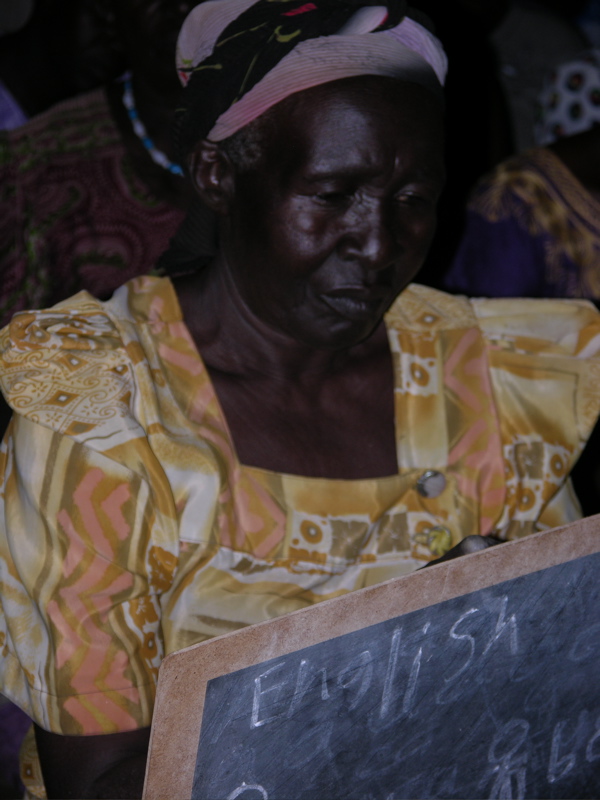
While in Kitgum I visited an MCC sponsored adult literacy program for night commuting women. This woman is in the beginning class.

The women in the adult literacy class sang a song of thanks. "Our fathers did not send us to school, but thank you, you have sent us to school. Now when we go to the bus stop we can see for ourselves, Does this bus go to Kampala or does this bus go to Gulu and how much does it cost? Now we can teach out children and have pride in our homes."