Friday, February 02, 2007

Soft Wood for Widows


Ben spent a week in Soroti training his crew on Childhood Development & Family Counselling and this week we were back in the same venue for Strategic Planning for CPA. The road between Lira and Soroti is horrendous, so I thought, rather than Ben coming back to Lira inbetween I'd go meet him there. We took a spontaneous trip south of Soroti near Mbale to a beautiful place called Sipi Falls and spent a day exploring three of the most beautiful waterfalls and a couple of caves. It's been too long for these two Coloradans since we went hiking and we were happy to put our feet back into our boots. It was good to relax together at the lodge overlooking cliffs, a deep valley and within earshot of one of the falls.

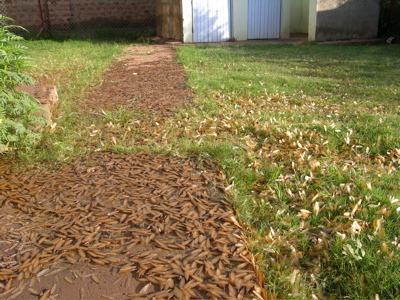
The waterfalls and caves were spectacular but so was everything else we walked past. The trees and flowers were equally stunning up close. This tree, we were told, is only for widows. No one else is allowed to cut it down for firewood. The wood is soft, and so they say it's easier for a woman who has no husband to do it for her to access firewood. It's always encouraging to learn ways that cultures and traditions have built in protection of vulnerable groups.

Sunday, January 14, 2007

Beautiful Things

by Holly
Last night I had a conversation with someone at a goodbye party for yet another transient ex-pat friend (we’ve been here 14 months, and that’s longer than most people stay so we’ve had several waives of goodbyes already). We passed the small talk about our holidays and then she asked if it was hard to come back to Lira. I had a warm sense of joy because the answer is decidedly no. We spent two weeks in the UK at my parents place together with Travis and Tina and I needed it. Maybe “need” is too strong, but I found deep comfort from much that has disturbed my body soul and mind in the soft couches of my parents cozy living room, the food, the walks through the woods, conversations and prayer with wise parents and caring siblings in front of warm fires and in pubs, baking 6 kinds of Christmas cookies in a beautiful kitchen, going to bed without wrestling a mosquito net, feeling cold for the first time in over a year, even shopping was strangely comforting.

I liked looking at all the beautiful stuff I can live without. I appreciated all the material comforts of “home” and was happy to discover that I don’t need them but they’re there whenever I want to enjoy them. One morning I was drinking some thick Italian espresso out of adorable cups the appropriate size. My own set of equally adorable espresso cups are in a box somewhere in Ben’s parents basement and who knows when I’ll use them again. I thought of my cups and was about to tell my mom that I missed them when I realized that I didn’t--this was in fact the first time that I’d even thought of them since they were packed away. I am grateful for many things when they’re there to enjoy but I’m okay without them. That knowledge is freeing.

It’s good to be back. We were surprised by how easy it felt and how nice it was to come back to our house. It is good to see friends and colleagues again. While we were gone one died and one had a child. It is good to get back to work, to get started on new reconciliation opportunities I’ve been looking forward to. It was good to hang the wind chimes I bought in the UK on my porch, to sit in my living room and listen to them. It sounds like home.

Manufacture the Stars

by Holly
Philip met up with us in London for a New Year’s celebration. The night was, for me, a confluence of Ugandan life and the UK. I loved it and it made me laugh to have them both in the same place. The oddness of both get more pronounced. Classically Ugandan, Philip, we thought, would spend the day with us after we met up at King’s Cross but instead he’d found a fellow Ugandan and had other plans. He’d join us later—which he did along with three unexpected others who of course were related to or knew someone that we knew in Uganda. I love it that in Uganda everyone is welcome and invited everywhere and that plans or food or space are never limiting factors. For westerners we tend to think about the composition of a social gathering and plan it to avoid awkward combinations. That just wouldn’t happen here. We had a great evening with delicious cuisine prepared by my brother who became quite the chef since coming to the UK. We shared highlights of 2006 around the table with Tina, Travis, and friends Stephie and Tom.
Of course Philip came so late that he missed the meal but no one minded or apologized. When we told him to come for dinner he said, “Oh, I’ve learned that when you come to dinner here you’re supposed to bring your own drinks like a bottle of wine.” He told us this as if we would think that it was as socially bizarre as he did. I remember when we first got here and were surprised that no guest ever brought anything to share.

We watched the fireworks and had the count down into the New Year from Big Ben and the London Eye. It was an epoch moment to stand with two of my favorite men—my brother and my husband, to hold my sister’s hand and to share that experience with a friend from Uganda and see it through his eyes. Unlike all the Brits around us Philip couldn’t contain his awe and excitement—he cheered at the top of his lungs after each burst of fireworks. “Man has learned to manufacture the stars! God bless the world!” We all found ourselves cheering along with him and the experience was more full.
Re-entering the western world I was surprised by obvious things. First, there are a whole lot of white people. I haven’t seen so many in one place for a long time. I’ve kind of gotten used to being a minority. In England my skin didn’t feel so novel. On New Year’s Eve for a few minutes with Philip and company I was once again the token white.

In the UK there are very particular ways of doing everything--what utensils or dishes or glasses should be used in what context, and when you should or shouldn’t say certain things. It’s a little bit overwhelming when it seems like everyone already knows all the rules to the game and you’re expected to play without being privy to the instructions.

Another thing I noticed is that there is a lot of trash. Not in the street, like in Uganda—but just in general we make a lot more of it. Probably because we package everything and consume a lot. We westerners really like packages. You should note it next time you buy something—I’m sure it’s in a package—whatever it is. Many of them are so unnecessary but it makes it feel cleaner and somehow more special. With food it cuts down on preparation and clean up time a lot but it also makes the food seem further away and less real. I feel close to my food in Uganda. It’s very real and raw. All of life is real and raw and I like it like that. It makes me feel more real too.

There isn’t any dust in the UK, well maybe there is but it’s not red and it is probably from old books or dead skin cells and it isn’t from the earth. Although I enjoyed cooking in an immaculate kitchen with marble countertops and walking all day shopping on London streets without needing to wash my feet I have to say I have a new appreciation for dirt. Sometimes it gets annoying but it makes me feel closer to the earth, to my origin—not separated by layers of pavement and carpet and tile and marble. Life is dirty. Uganda gives me the freedom to acknowledge my dirt, because we’re all human beings walking down the same dusty streets together.

Soft

by Holly
When we got to my parents house this is what I saw when I walked in. I cried. I wasn’t sure why. It just looked so soft and beautiful and it felt like it was exactly the shape of the hole in my heart. It was one of those moments where you get a glimpse of the way life or home is supposed to be and most of the time it isn’t where we live. Where we live isn’t even a shadow of what should be. Maybe that’s true everywhere but in northern Uganda it feels particularly true. That’s not to say that everyone here should have a living room like the Randall family cottage but I do think that we all long for something that is there--comfort, beauty, a loving family that actually likes and looks forward to time together and is restored by it, shelter, safety, more than enough to eat, acceptance.
It broke my heart. Partly, because I miss it and partly because it seems impossible for the people of northern Uganda. And then at the same time those moments happen here too. Some are quiet and simple and others are more profound. I had a simple one yesterday when I walked home under a red sun after a meeting with the management team that was energized and full of common purpose. And then Ben and I sat on the front porch and watched the sun sink and talked about the day. I had a moment like that last year when I first saw Acholis dance. While they sweat and kicked up the red dust to the drums I thought, “this is what they were meant to do, this is how it’s supposed to be with the young people dancing and the children trying from the sides and the old people nodding and watching—they weren’t meant for this war, destruction, displacement and poverty.” But that moment happened right in the middle of it. In a way that’s comforting, because it means that whatever those moments are or whatever they reflect—the longing for home—the restoration of things to the way they should be—life at its fullest—they are more powerful and can’t be overcome by the most gruesome war, or by massive displacement or abject poverty. Human beings will still dance.

Saturday, January 13, 2007

Hunting Giant Edible Rats


On a routine monitoring visit in Gulu, I set aside an afternoon for rat hunting deep in the bush with Eric (an MCCer in Hoima) and Robert (a trainer in Gulu). While we were supposed to join a friend of Robert’s at midday, we didn’t leave for rat-hunting until about 3 in the afternoon. Once we arrived at his home, an IDP camp where most of his extended family lives, we realized that plans weren’t as set as we had been led to believe. Robert approached one of his friends and the word began to spread, “these two muzungus wanted to go hunting for rats in the bush, let’s get our spears and go”. Within a few minutes we had about 12 people in the back of the truck—each carrying his weapon of choice including spears, axes and machetes. Scared that others would jump into the truck, drove away quickly. In the rear view mirror I saw a dog jump into the pile of people riding in the back.

We drove down a small dirt road until we came to Robert’s land. Here, in the middle of nowhere, all that could be seen was tall grass and the skeleton of houses burnt by war. We and the dogs jumped out with high expectations for spearing a rat for supper. No one explained to Eric and I how to hunt rats, and if we didn’t keep up with the break-neck speed of the others, we would be lost. In places the grass was 12 feet tall, we couldn’t see more that 5 feet in front of us. Eric turned to me and asked “how are we supposed to see anything in this, let alone aim and spear it?”

About an hour into our voyage into the mysterious grass, I paused. The sun was setting and the earth turning red, the air untouched by industry and rich with nature, a gentle evening breeze cooled our hot bodies, and the grass was an ocean’s shore as we waded deeper and deeper. I was so exposed to mother-nature that I didn’t know whether to feel immense fear of absolute comfort. The feeling that dominated all others was the feeling of total freedom.

As the sun set, the morale and energy for stabbing a rat was dissipating. The guy in front of me pierced the ground with his spear and dug up a massive tuber. After extracting it, he turned around and generously handed me a piece (about 2 kg). Everyone besides Eric and I rapidly skinned the cassava as if they do it in their sleep. Underneath the layers of dirt and tough skin a beautiful white is revealed. Raw cassava is like eating a raw potato, only harder and starchier. I was hungry and gladly ate my piece.

While we didn’t kill a rat for supper, Robert’s wife had prepared one back home. We walked away with a pheasant’s egg and a bonding experience.

Thursday, November 30, 2006

Splitting the White Ants


By Holly

For a long time I've had the idea of this post in my mind. Probably since the time in March when flying white ants stormed our house for the first time and a rush of neighbors licking their lips came to collect them. People told us then how valued the white ants are. They are considered a precious and tasty morsel--rare and shared only among friends. Another way of describing a dear friend is to say "split the white ant at the waist." Even if you only had one ant you'd share half of it with your friend. Someone told me that if you have a "split the white ant" friend then you know that you have a true friend, someone you can depend on and who depends on you. It reminds me of chilly evening walk with Tina, Kimbal & Kellen in Boston. We went through the Holocaust memorial after consuming massive lobsters and yummy clam chowder. It's a glass hallway in a park with stories etched along the path. One of them was of a girl in a concentration camp who while doing work outside happened upon a raspberry. She hid it in her pocket and brought it back into the camp that night where she shared her now smooshy raspberry with her best friend. It made me cry when I read it--and since I was with very good friends--we teared up together--and promised that we would share the smooshy raspberries of life.

So my idea was to post some of the faces of our growing friendship here--people that we've shared white ants with. The problem is that friendships/relationships are not static. Every day is full of changes-of new closeness, new trust, but also of betrayals and disappointments--some big and some small. The largest blow to my white ant idea was when our closest friend confessed that he'd been stealing from us (see betrayal and reconciliation). Most of our relationships are not so dramatic, but as human beings I think we regularly give one another reason to doubt, reason to wonder about true motives, and reason for me to put off posting the faces of people that I sometimes ask myself, but are they really friends that I can share white ants with? Am I really the kind of friend that they'd share a white ant with? I don't know. I think that there just comes a point when we have to be ok with the fact that our friends will disappoint us, and we will disappoint them and we make conscious choices to continue to trust, hope and love in full knowledge that the human experience is broken and vulnerable.


Dan


Helen


Philip and Tonny


Jane


Godfrey


Priscilla


Sandra

Sunday, November 26, 2006

3 Snapshots

Un-ordinary things happen all the time in Lira. I’m not sharing anything deep or meaningful, just giving you a snap-shot into our daily lives.

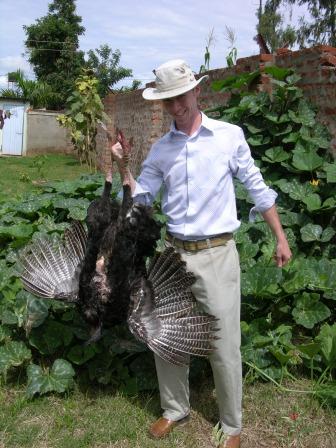
For our 2nd thanksgiving in Lira we invited 20 of our CPA colleagues and other friends over for a delicious meal. Holly spent the whole day cooking and baking all of our favorite thanksgiving dishes. I got to kill a massive turkey named Dr. Fred. As tradition goes, we all shared the things we were thankful for. I am always amazed at the strength and resilience of people who have seen 20 years of war. It was a great evening-some ate grapes for the first time in their lives, others cracked jokes, and an American visitor said that this was the most memorable thanksgiving he has ever had.

Yesterday, War Child (an INGO working with children through games and play-therapy) hosted a volleyball tournament for NGO teams in Lira. The all-day event was a huge success and almost all of us released pent-up stress. On the way to a game I passed by a tree where the surrounding soil had recently been dug up. I looked down and saw two empty AK 47 magazines. I picked one up to see if my eyes were fooling me. A friend on the team quickly advised me to drop it or I was going to be harassed…I followed his suggestion. Even though volleyballs were flying, music was playing, and people were eating BBQ, these empty magazines were a stark reminder that I was still in a war zone.

Today, Holly and I went looking for a Christmas tree. It is not exactly the way we do it in the States. We rode our bikes to a small tree nursery. They only had Christmas twigs (one foot tall seedlings). We told them that we were looking for a small Christmas tree for the holidays. They talked amongst themselves and one person said, “Let me ride my bicycle to the village and dig up a tree for you from our compound there.” The ride iss ten Kilometers and he said that the tree was simply a gift from him. Naturally, we will give him something for the tree, but the offer left Holly and I feeling blessed by his generosity.

Studies in Italy


Dear friends, I hope that you have all been well sustained since we last spoke. I just returned from Italy and wanted to share a few words with you about my time there. Going from Lira to Orvieto, Italy was a shocking experience. Our course in Italy was held in the mayor’s villa, we sat under beautiful frescos and listened to lectures given by leaders in the field of trauma mental health. Students included anthropologists, lawyers, psychologists, psychiatrists, and others.

We stayed in a monastery opposite the Duomo cathedral built in 1260 to host a piece of altar cloth said to have Jesus’ blood on it. Every year, citizens march the piece of cloth around the small town. Orvieto is known for its olive oil and wine.

The most meaningful aspect of the training has been the relationships we all developed while in Italy. The course will continue for another 6 months as we review the lectures, ask questions, and work through clinical and policy case studies on-line in small groups.

Saturday, November 04, 2006

How to Bend a Speer


I’ve found it surprisingly challenging to reconcile hope with critical thinking about current events. I told Ben earlier in the week (on our date night, which we do every week and it’s so great!) that I was having this struggle and as we talked about the dynamic of hope the thought occurred to us that perhaps it was so hard to reconcile the desire not to blindly wait for something that was not going to happen and not giving up on it because we had a wrong view of hope. Maybe hope isn’t convincing yourself to think that something good is actually the most probable outcome, but believing that it should happen and that the good thing you hope for is closer to what God intended—closer to original design. With this little shift in my thinking it’s been easier to reconcile my mind and heart while I achingly long for peace in Uganda and reason through the complexity of the ongoing peace process. People want it so much, I want it so much. The emotional investment in this process is deep. You can see it on people’s faces. After 20 years, God, let this be the end—if not now when? When you talk to most people and ask them about what they think about the process the answers are on the tip of every tongue “I just want to go home,” or “I just want my sister to come back from the bush, that’s all I want.” I’m often humbled and baffled by the unflinching hope that many in the north express—but I do wonder, everyone has their breaking point, if this process fails will they reach it?

I spent most of this week with a delegation from MCCs advocacy offices from DC, Ottawa, and the UN office in New York as well as from the Africa and Peace departments in Akron. It was refreshing to be with them, to experience Uganda with them, and to discuss how we can better support the peace process through advocacy. We had a series of meetings with people from the groups of cultural and religious leaders who have been supporting/observing, military, NGO community, people in IDP camps, people on the monitoring team for the cessation of hostilities agreement, observers of the process from Juba, and others. The views they had, the messages they wanted to send were diverse, and rather than give my own ideas I thought I’d capture a few from what I heard: (paraphrased)

Why is the international community silent? The West is too silent, not showing oneness with Africa. If this conflict was happening somewhere else there would have been more support from the US. (Religious leader)

The incidences of violence around Juba reported in the media are not UPDF and LRA. Most incidences that have taken place have been the result of misinformation. (Monitoring team member)

I think that the government is trying to save face and that the LRA are rebuilding. There is a lack of commitment to relieve the suffering of Acholi people on both sides. They need to build confidence: don’t discuss wounds, don’t praise yourself, the negotiation should include the suffering people because they are motivated to work for peace. Maybe the negotiating teams should visit a camp so that they can get motivated (community leader)

Are you really sure that peace and justice are friends? Who is the parent in this conflict? Parents take all the costs of their children’s misbehavior. Convince the ICC to bend the rules. (Community leader)

What’s needed for peace is restorative justice. This is not a tribal war but crimes against humanity by terrorists. The military method hasn’t succeeded for 20 years. This might work. It is the most hope we’ve had. In the past the LRA wouldn’t eat food provided by the government of Uganda. But now they are accepting food, so there is some trust. (Formerly abducted person)

We want a statement from the Secretary General of the United Nations not only Jan Egeland. Now the Secretary General is leaving, I hope the next one will at least say something. (Religious leader)

Why is Kony so difficult to capture? We have a saying in Acholi, a coward lives longer. But the fighters are there in the bush, for them this is about reorganization. The LRA negotiating team are people who have a power hangover and they are not fighters. They are waiting for it to fail and getting attention and money. If you think I’m lying time will tell. (Military)

Why is Kony so difficult to capture? Because he is surrounded by children. Children are his water. (Community leader)

When I met with Kony, he had 3 messages: 1. He is for peace. 2. Watch and witness who will spoil the process. 3. The suffering should stop and the war should end. He is willing to do Mato Oput (reconciliation ceremony, that means drinking bitter herb) with the community but is not sure how it could be done with the government, since the government is not a tribe. (religious leader)

What specific confidence building measures are needed? UN supportive statements and a visit from the Secretary General to Northern Uganda. The African Union to respond to the call to be on the monitoring team. “Tell off” the government of Uganda to withdraw all troops in Sudan. Media should send positive supportive messages. It should not be a hurried process—there is no hurry in Africa—we need community views and this takes time. LRA needs to listen to the community. Focus on the victims and the costs of more war. (group of cultural and religious leaders)


These all are not exact quotes, but they are the things I remember and scribbled down in my notebook while I listened to people. Someone said, knowledge speaks, and wisdom listens. Trying to be wise, I’m listening--to those who may have accurate information or may be confused and misinformed but who all have a reason behind their words. I have many questions, but one is at the forefront of my mind. In any negotiation, a party’s position is strengthened when their alternative to a negotiated agreement is good. Unfortunately, all the parties have pretty decent alternatives, which may be why we've seen so many walk-outs. As I see it, the degree to which those alternatives are weakened motivation to settle without violence will be strengthened. How do the Juba peace talks become the most attractive option, and how can the alternatives to a negotiated agreement be minimized?

Monday, October 09, 2006

Pray & Fast for Hope


"Hope for the freedom of the children of God." That is the theme of the Commemoration Prayers tomorrow. It has been 10 years since the LRA abducted 139 girls from St. Mary Aboke Boarding School and the bereaved parents came together to form CPA. Every year on October 10th people return to the school to pray and fast for peace, for healing for this land and people, and for the return of the children who are still in captivity. We will be in Aboke tomorrow and invite you to join us in the prayer and fasting in the hope that freedom can come.

Tuesday, October 03, 2006

"Senseless" Continued: by Ben

I was perusing through our blog when Holly's entry of "Senseless" caught my eye. It was a story of an unfortunate event ending in the mob killing of a brother to our friend. It caught my eye today because I was in a village listening to people give stories of difficult life events and how they persevered through them. An old woman said, "My daughter was hit by a car and killed. When I heard the news I ran to the roadside and found a large mob beating the driver who hit my daughter to death. I broke through the mob and stood in protection of him saying, 'don't kill this man over what he has done to my daughter.' The mob released him. Later, when my clan members demanded that some kind of payment be made, I said, 'let him go, I have forgiven him.' My clan said that if the very mother of this girl can forgive, then we should also try to forgive."

I road a motorcycle down a long, winding, red dust road to find the parent support group meeting today. I sat with my heart in my throat as they "testified" one after the other, as to painful life experiences they have endured and the miraculous ways they have shown resilience.

I'm writing this blog for the sake of the great hope that exists here. Too often we see the looming evil, and remember it, instead of recognizing and remembering the ubiquitous goodness and strength in humankind.

Friday, September 22, 2006

Stress and Trauma Healing


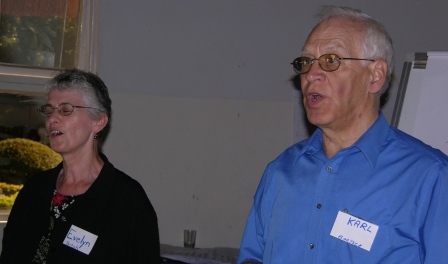
Karl and Evelyn Bartsch came to Uganda to offer the fourth training module for the training of trainers project. The topic was stress management and trauma healing. I was fortunate to receive the training this time around. Normally, I am responsible for writing the manual, conducting the training, and coordinating logisitics, but to my great relief, I was nurtured by the caring support of Karl and Evelyn.
Karl and Evelyn have successful private practices in America, but they chose to leave their comforts behind to stay in a place without electricity, drinkable water, and thier usual diet, to give us a new and deep perspective on our work as caregivers. Karl and Evelyn have been married for 45 years.
In the picture above Karl and Evelyn are leading us in a song called, "Healing River". The participants loved it, and are translating it into Luo.

Wednesday, September 13, 2006

Hopeful Skeptic

by Holly

Cautious optimism characterizes the mood around the peace process for Northern Uganda. That is how I feel anyway. In general, I consider myself a naturally hopeful person, but I want it so desperately for this place that it hurts to allow hope too much liberty—the obstacles to any meaningful peace mean a high risk of disappointment.

We all follow carefully the daily developments in newspapers that unreliably print shadows of truth. We listen to Kony and Otti on the radio. They both apologized “for everything” on two different days within the past weeks on an Acholi broadcast. And I dared to be thrilled at such watershed statements. At the same time, their voices sounded hollow and the words echoed off of so many atrocities. If they were sorry for the abductions, truly, than why do they still refuse to release the women and children?

Otti has said his “wife and children” are part of him and they will all go home together. The women and children are a shield, a bargaining chip, they are still useful—and they are evidence that though they might be “sorry” they aren’t willing to make things right, not yet.

The irony of having men who have committed some of the worst crimes against humanity raising issues that are actually of legitimate concern and are real political grievances of people in the North is sometimes overwhelming and borders on the absurd. A cartoon in the paper depicted new seats being added to Parliament and Kony sat in one of them with a bloodied machete. A nameplate on the table in front of him read: “Minister of Child Rights.”

I read an editorial this morning (by Charles Onyango-Obbo in the Daily Monitor) He says, “If you ask those of us, who support dialogue to end suffering, but are opposed to these pacts with the devil, what creative alternative there is to that, we don’t have an intelligent answer. That’s the real tragedy of Uganda.” I join him, and many others in the fear that, “sleeping with the devil” could produce some very ugly children.

When I passed through Gulu on the way home from Kitgum on Friday I had a drink with the Public Relations Officer for the UPDF in Northern Uganda. I got the party line, or the military line, instead of the medias interpretation of it. He told me the meeting went well with Dominic Ongwen, (one of the ICC indicted) he said Kony was lying when he said they’d been shot at after the cease-fire by the UPDF. He told me about the one abduction that has taken place since the cease-fire. I asked him if he was hopeful about peace. “Honestly,” he said, “It’s hard to tell, I say it’s still a fifty/fifty chance.” I’ve talked with him before—it’s his job to put the best foot of the military forward, and he does it well. So, I was disheartened by his prediction, if he says fifty/fifty, I’m guessing the UPDF is thinking and planning for thirty / seventy—or worse.

Still, hope finds ways of asserting itself. While we were in Kitgum there were hundreds of rebels walking, sitting under mango trees, waiting for others to join them and then continuing. Presumably they were going to the assembly points. They weren’t hostile. They weren’t causing trouble. They were “friendly.” I don’t know whether to let myself get excited or not. It is so delicate, fragile, and precarious. There are so many variables and so many unknowns.

Right now, Angelina, the Chairperson for CPA is moving with a team of others on a National Reconciliation team. The team is meeting with leaders all over the country and while they discuss and reconcile with each other they are gathering consensus around the messages they want to send to the government, the UPDF, and the LRA and to ordinary people in Uganda. She consulted me just before she left on the most recent leg of her journey to Bunyoro. We discussed the dangers of “unconditional forgiveness,” that can encourage impunity and conceal the truth. We discussed the need to convince the ICC that the crimes which have been committed against humanity—not only the people of Uganda--could somehow be redressed in a local context, in the interests of peace, through Roco Wot and Mato Oput. Angelina is admirably reckless with her optimism. While it strengthens my heart, my mind finds some safety in skepticism that guards me against the disappointment that may come.

Tuesday, September 12, 2006

Senseless

I hesitate to write this blog because there are no words. Words are inadequate substitutes for the pain. They can’t describe the depth to which humanity has strayed from our design. I haven’t yet assigned any rational thought to what has deeply stirred me. I don’t know if I will either. It is somewhat freeing not to have to name the emotion. To release the need to make sense of it all. It just doesn’t make any sense.

This past week I went with Tina to Kitgum training a group on conflict transformation. My co-trainer and good friend Anthony was with us. He got a phone call just before breakfast that shattered us. His cousin-brother was driving home to Gulu from Kampala and two kids who were playing ran into the street in front of him. He hit them and they died. Knowing that mob violence is common, it is advisable to go to the police rather than stop if something like that happens. But his cousin decided to go back and apologize toe the family of the children. A mob formed, armed with machetes and hoes. They killed him. Mercilessly and brutally, a death that I don’t even want to describe it was so gruesome and unimaginable. He was 24. The father of the children led the mob. The lack of mercy is confounding. Was it this war that desensitized them to violence that allowed normal human beings to mutilate a young man who’s worst sin might have been speeding? Does it make them feel better? Does the grieved father sleep more soundly knowing that he caused another father and mother to lose their son? That two families are now bereaved instead of one? I just can’t understand and it continues to sicken and disturb my core.

8 years younger on my birthday


Being with Tina makes me feel 8 years younger. It’s fantastic, because I think I’m going through a quarter life crisis, so having her here gives me the freedom to indulge my desire for independence, adventure, and abandon. Since she came I haven’t been taking life or myself so seriously. I’m even behaving less responsibly. I’m sure everyone around me is happy that I have actually matured during the last 8 years, and that this is indeed atypical, but allow me just a few weeks of regression—I’m having fun.

We’ve been sucking the marrow out of life. Last night we went to a friends house for the evening and it started raining on the drive home. As soon as we go to our gate and opened the car door the rain intensified threefold and we were drenched as we dashed to the door and fumbled with the wet keys and lock in the dark. We just giggled, and Tina said, “I think God did it on purpose. He always does that. He thinks it’s funny.” I’d never imagined God in that way, waiting for me to open my car door and then laughing hysterically while He dumped extra water over my head.

Last weekend we took a sister adventure down to Jinja. I can’t write all about it, because there are some things that are just meant to stay between sisters.

Tina jumped 44 meters from a cliff above the Nile, “Nile High Bungee” dipped her to her chest into the water, she jumped with no fear and a scream that sounded more like laughter.


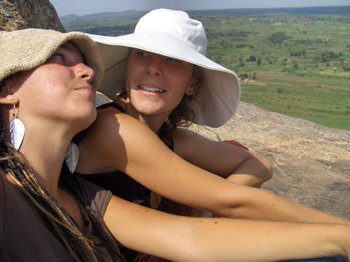
Yesterday we hiked up Ngetta hill. We sat on the massive boulder on the top and talked about life, theology, love and pain and watched clouds pass over the town that is my home. It's remarkable how alike we are. It is a rare blessing to be able to naturally connect to another person with so little effort, with so much understanding and with so much joy.

Tuesday, September 05, 2006

Betrayal and Reconciliation

Over the past two months, Holly and I have had 5 break-ins. One of which left us feeling very vulnerable with the message of “You Must Die” written on our wall outside. Fortunately, Josh was staying with us and heard the thieves in our attic and was able to scare them away.

The mastermind behind all of these incidences turned out to be our very good friend and person responsible to watching our house when we’re away. For nine months we had developed a close relationship with him and considered him a trusted friend. The most recent break in was on the day that Holly’s sister Tina arrived. We came home to notice that some of the bricks above our window were a slightly different color of blue. I also noticed that some plaster on the wall was broken and dust remained on the chair below. Someone had removed bricks, repainted them, and cemented them back in place. I went to the back of the house where I found freshly washed clothes. However, on one piece of our friend’s clothing I found a spot of blue paint. My stomach dropped, I wanted to cry. How could our friend have done this? Later that night he called us and confessed what he had been doing, and wanted a chance to make things right between us. The Lango words for reconciliation are “Roco Wat” which means being in “right relationship”.

Although angry, hurt, and a bit fearful, we tried our best to put into practice what we teach; reconciliation. We extended grace toward our friend and forgave him. Holly went to the Scriptures and read Matthew chapter five. Toward the end of Jesus’ Sermon on the Mount, he talks about turning your other check, not resisting your enemies; that if you cloak is stolen, also offer your tunic, that if forced to walk a mile, walk two. We wanted to put these words into practice.

When one considers the tremendous injustices that our friend faces, being born into an incredibly poor family, having been abducted and forced to kill, Holly and I wanted to be a part of giving him “a way out”, and we decided to pay for one year of his education at an agricultural school. We have come to love our friend, and see a wonderful heart in him. It seems as if this is a critical time in his life where he could continue to make bad decisions, or turn his life around and live out of his talents and loveliness.

I know that forgiving him and even seemingly rewarding him may sound strange. But our faith doesn’t ask us to judge our enemies, it asks us to love and forgive them, over and over.

Monday, September 04, 2006

Visit from Josh and Erin


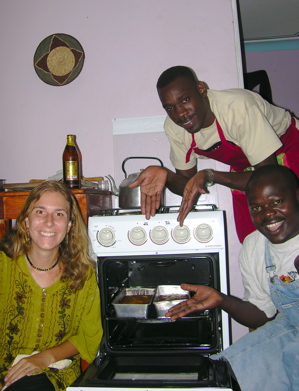
Josh and Erin were with us for about 5 weeks. There was never a dull moment. If we weren't building something, then we were in a remote village dancing and recieving new names! The first thing Josh did when he arrived was install a hot water tank. I think about him every day as I appreciate the warm water. Erin was constantly busy in the kitchen teaching Sandra how to prepare something besides cabbage and beans. (I like cabbage and beans, but every day...) To this day we're eating foods that I thought I would never eat again, and I'm lovein it!
This is a picture of Josh and I at the source of the Nile at Lake Victoria. Having just been to the Nile's outlet in Egypt, Josh and Erin were particularly excited about seeing the other end.
Holly and I really wished that we could've spent more time with them, but work usually kept us late. However, our evenings were blessed.
I all, we had a great time with them and felt rejuveniated by having them with us.

This picture is of Erin and Holly, shortly after the vehicle we rented broke down, in the middle of absolutely nowhere. Fortunately for Holly and Erin someone we knew was a short ways behind us. This is a picture of them leaving us. Unfortunately for Josh and I, we were stuck with figuring out what to do with the car. After hours of dealing with the car situation, Josh and I ended up on the last minibus going North. Because it was the last one, we got to ride with 28 others, 2 goats, some chickens, and I don't know what else. All of this in a vehicle licensed to carry 14 passengers!

The State fof Mental Health Services in Lira, By Ben

In the community, you will frequently here of the “community volunteer counselor” and of their efforts to provide “psychosocial support”. What isn’t clear is how they go about counseling those in need. These individuals are deemed counselors after a one or two day workshop (a week if they’re lucky). Crisis and trauma counselors in rehabilitation centers for formerly abducted children become qualified to do the work with a bachelor’s in social studies (or less) and no clinical experience. While the international community has recognized the great need for psychological recovery in conflict and post-conflict settings, actors seems satisfied with slapping a superficial, insufficient and unprofessional “band-aid” on the ubiquitous and complex psychological issues. This may be a result of the general absence of mental health practitioners in decision-making positions for programming strategies of INGOs.
I’ve been doing a bit of research on the state of mental health care in Lira and have come up with disheartening results. Here is an example of a short interview I had at the main hospital a week ago. The “mental health clinic” was three weeks old. It was staffed by one Psychiatric Clinical Officer (education equivalent: 2 years after high school) and two psychiatric nurses (one was still enrolled). For an office, they were given the tiny room that hosted the electrical breaker for the entire hospital; the room wasn’t painted and the ceiling was leaky.
Me: What do you use as a screening tool for diagnosis and treatment?
PCO: The ICD-10
Me: Okay, do you have a copy of the ICD-10?
PCO: No
Me: Any photocopies?
PCO: No
Me: So, how do you know if you’re asking the right questions?
PCO: I learned all the diagnosis in school.
Me: Do you make referrals for counseling services?
PCO: No, I learned how to do that in school too.
Me: How many clients do you see in one week?
PCO: Around 200.
This man was doing the best that he could, but it was obvious that he needed some help.
I will be going to Italy in Nov. to attend a “Masters Certificate Course” in Global Mental Health: Trauma and Recovery. It is a program run by Harvard University’s program for refugee trauma (since I am unpaid at the moment, they have graciously granted me a full-tuition scholarship!). It consists of two weeks of on-site training in Orvieto and 5 subsequent months of web-based learning. As a component of the program, we will be analyzing trauma clinics in a variety of international/conflict settings. The Concerned Parents Association and I are looking forward to new prospects in bringing a heightened level of mental health expertise into Lira and other Northern districts. Any volunteers? More later…

Wednesday, July 19, 2006

Independence & Inequality


“We hold these truths to be self evident, that all men are created equal, that they are endowed by their Creator with certain inalienable rights, that among these are life, liberty and the pursuit of happiness. That to secure these rights, governments are instituted among men, deriving their just powers from from the consent of the governed…”

This year, we celebrated the declaration of these words, by singing the National Anthem in harmony with Kimbal and Kellen in a swimming pool overlooking the Nile River in Murchison Falls National Park, Uganda. We raised our plastic glasses high, and toasted the independence we enjoy. It was the second official Porter / Kurtz family vacation, and if the first two are telling of those to come, they will be full of good conversation, therapeutic laughter, spiritual inspiration through nature's beauty, and wild animals.

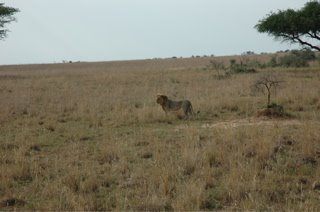
After two weeks with TNL we took our first vacation. We stayed three days in the most luxurious and exotic place I’ve been in Uganda. Five hours after leaving Lira we pulled up in a rented beaten up old car that spewed lung-fulls of dust and exhaust into our faces at every bump—I was almost embarrassed. Then the doorman literally jumped toward us with a huge smile and greeted us with, “Welcome to paradise!” This was followed by cold washcloths for the dust and passion fruit for our dry throats--served on a silver tray. Then we were led to rooms with a classic safari flair with draping old fashioned mosquito nets and a sliding door that led to a patio two steps away from the pool with a swim up bar. Beyond that the Nile ran through a valley of exotic trees, flowers and grasses inhabited by the wildlife we were yet to see (lion, wildebeast, elephants, varieties of monkeys, hippoes, crocodiles, giraffes, kob, etc).
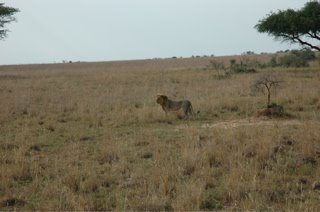
I could barely breathe it was so beautiful--and felt so far—so distant from the community I work with every day, not only the community, but even my colleagues. This place was of another world—out of reach by real Ugandan life and people, a gated protected phenomenon reserved…for who? We saw few African guests—and fewer Ugandans. It was full of short-term missionaries. Having been one of them on more than one occasion myself I had mixed feelings, but somewhat guiltily, I admit I cringed when I overheard most pool-side conversations and had to bite back stinging words and judgmental statements. Kellen, equally sensitive, reminded us that it is just ignorance and not malice. Likely, they had good intentions and good hearts. There is really only so much you can learn in a short time in a country and we all come with our own cultural lenses and assumptions. Ignorance is not so irksome as long as it is accompanied with humility. It’s when ignorance shows up for two weeks to teach the rest of the world the “right” way to do things that my blood starts boiling. (I heard one gray haired Southern Belle tell a Ugandan woman in a thick drawl, “We came over hiyar to teach y’all how to be leaders. Because if we don’t y’all do’ know haow.”)

I have a growing feeling of frustration and quiet outrage over the social assumptions made about black and white.

Besides the clientele, there was something else on our vacation that sparked this tension: the art. It fed a complex of inferiority/superiority. The art fit the overall ambience reminiscent of the early European Explorers on the African continent and depicted much historical drama surrounding the exploration of Murchison Falls, named after the President of the Geographical Society. Before Europeans, the name was derived from the evil spirits believed to be manifest in the Tse tse flies (which are vicious little biters, it’s no wonder they are thought malevolent). There were a series of ink drawings depicting white explorers, usually being hailed or served by scantily clad African men and sometimes shown observing while the Africans in their employment were paid to kill other Africans. One such picture had a caption underneath that referred to the men being killed as, “forest dwarfs.”

This is history. It shouldn’t be hidden. But this display glorified the racist treatment of Africans. Wouldn’t it be more appropriate for such drawings to be accompanied with something acknowledging guilt or a memorial to the victims of the European Explorers ambitions—not framed on the walls of a lodge to make the latest waive of European (and American) Explorers think it is quaint to animalize the African people? In what ways did I participate in the continued exploitation between white and black by silently observing the art, enjoying the ambience, and not even voicing my discomfort to the management? It fed what I believe is a proper response of white woman’s guilt.

In Uganda, issues of race do not feature quite so prominently as they do in many places—even the U.S., in Denver, and in neighboring Kenya—the social divisions and assumptions of unequal power relationships are more on the forefront of social consciousness. It is more sensitive, or our radar is more in tune. In contrast, in Uganda it feels like most people assume the best intentions about their white American and European friends. I have never felt that my words or actions were being scrutinized to detect racism. But the divisions do surface, and I am taken off guard and surprised when they do—however small and seemingly insignificant. Recently, I had a conversation with a friend who asked why I don’t dress in African wear and braid my hair. The simple answer is that I haven’t bought new clothes and my scalp is painfully white—I’m a white girl who can’t pull off the look very well. But my friend didn’t get it—if it’s good enough for African women why not for me? So I braided my hair and my Ugandan friends think it is wonderful. Kellen and I did it together. It took twelve hours.

When we picked up the TNL crew, a friend came to the airport with us. We owed him some money for putting gas in the car, so while we were waiting Ben pulled out some cash to pay him back. He got uncomfortable and said no, give it to me later, not here. Neither of us understood why and we thought it was a little strange. He explained that people would think he was doing a service for us. At the time, I was thinking, who cares what some random people in the airport think. But I missed it. I assume it is evident that he is my friend, my peer and my equal. That is what he wants people to see when we spend time with him. At that moment he was keenly aware of what had not crossed my mind—when we are out together people assume he must be working for me.

“We hold these truths to be self evident, that all men are created equal…” is it so evident? Equality and justice between people requires intentional action, it has to be explained, looked for, fought for. What are evident are relationships characterized by unequal power, choice and access. Governments are instituted to secure our rights but we choose whether to passively acquiesce to their unequal application or to participate in making things right. A friend emailed me recently and suggested that justice and hope were intricately intertwined. Maybe that is because we can’t work for justice without a vision of what it is and some sense that it is possible and we have a role to play. Despite trying to orient my occupation to the end of justice, on a daily basis I struggle to find ways to do justice and avoid perpetuating injustice.

Itchy Grass = Solidarity


by: Holly
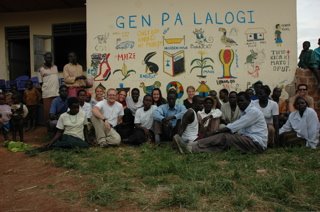
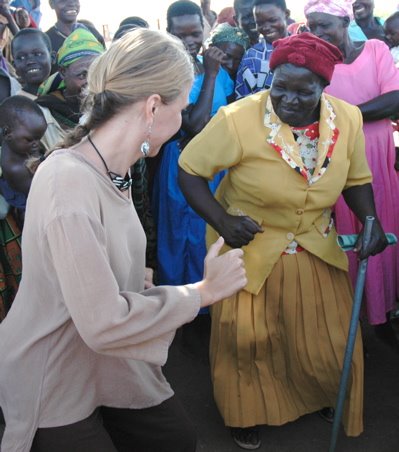
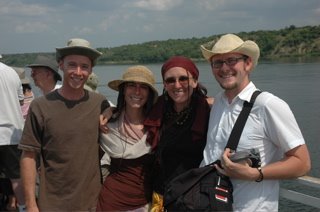
For two weeks we were blessed with a group of 5 people—two old friends plus three new ones. We played with thousands of children in IDP camps in Lira and Gulu, painted a mural, participated in a “Solidarity Day” where the men worked in the fields and women cooked with the community one of the camps. We shared laughter and tears and meals—crammed into two weeks that went by too quickly. In honor of them I offer two Acholi sayings:

“Dako ngwal ki nyeke” A woman gives birth easily when she’s with another woman.


“Lagada yil ki wede,” The grass is itchy when there is a lot of it.