Wednesday, June 07, 2006

Home Bakery


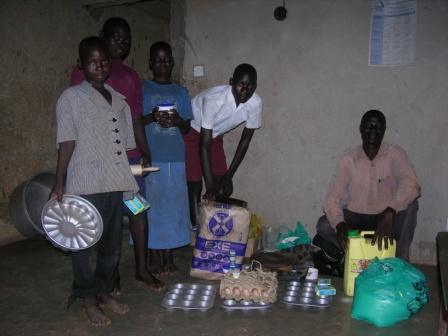
Holly and I are working in the fields of peacebuilding and psychosocial care. Both are fields that often yield slow results. In a country with urgent and pressing needs, I am constantly presented with opportunities to help in very practical ways. For my sanity, I try to contribute to small but tangible requests of an individual or family. This is a short story of Pastor Nicholas and his family. He is helping to start a church plant in Lira and has taken the voluntary position of "Church Coordinator". He is putting four children through school and makes a small income by preaching and translating. We sat together for a short time and decided that we should try to restart a small bakery business run by his wife. We looked at all the costs for baking supplies and reconstruction of his brick oven. One of our friends from the U.S. has generously sponsored this project. He has already established small contracts to sell his bread and cakes to shops nearby. Eventhough this bakery won't put his children through school, it is a significant contribution that will hopefully grow in the next serveral years. When we visited Pastor Nicholas his children sang worship songs and prayed for us.

Monday, May 22, 2006

Outdoor Classroom

This Week

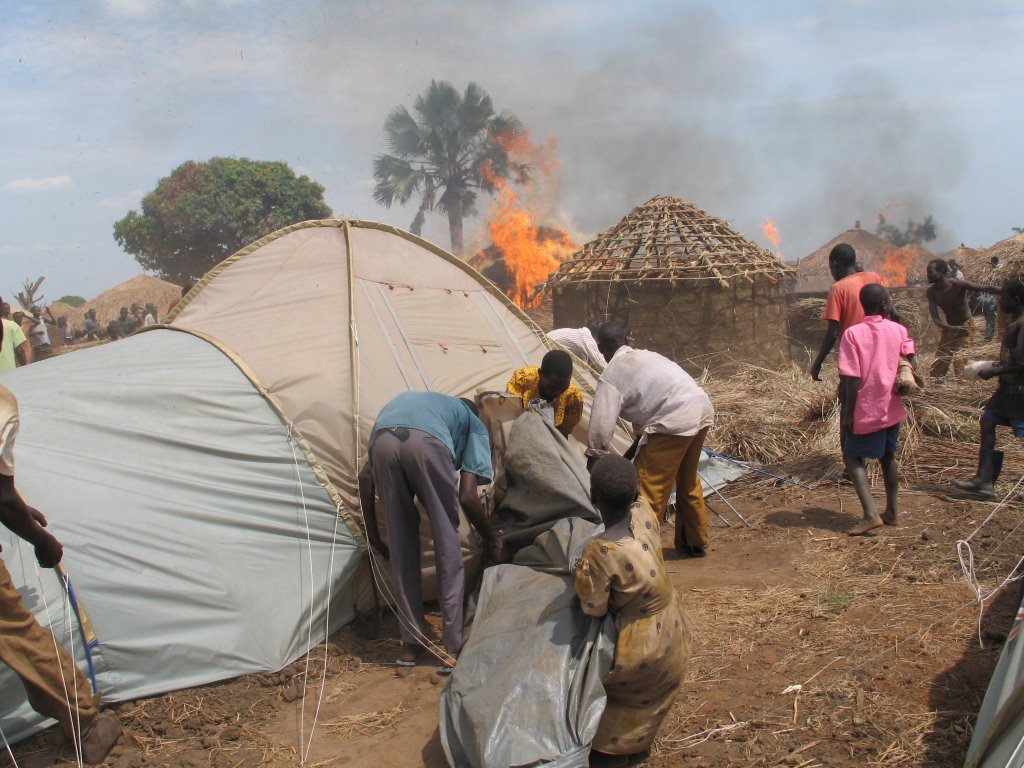
This week Holly has been conducting a conflict resolution training in Apac, a district with virtually no infrastructure. Last week I was training in Gulu. On Tuesday night, while Holly was sitting in the dark (no electricity or candles), she heard someone yelling outside. While I would have encouraged her to stay inside, she peeked her head out to notice that the grass roof on the hut next to her was on fire. The security guard, the cleaner, and Holly were the only people around. While the cleaning woman pumped water from the well, Holly ran back and forth carrying jerry cans of water to the security guard on top of the hut… and they eventually succeeded in putting out the fire! On the same day, I killed two snakes in our yard. They were small but very poisonous.

Last night I woke up to a strange sound. I got out of bed to see what it was and noticed that our entire house was being stormed by giant flying ants (we have the only security lights in the neighborhood that function when electricity is off). In the morning I went outside to find that our gate and parts of our house were plastered with flying ants. I looked at the mess with disgust. Little did I know that all of my neighbors were enviously looking at our house. As soon as Sandra came over, she immediately set her bag down and started gathering the ants. “Wow, this is going to make a great dinner!” She said with incredible excitement. She invited others to come and collect—they even got to keep the ants that they found. Instantly our yard was full of people of all kinds, tearing up our grass to find the treasure. White ants are a delicacy here in Uganda. I’ll let you know what I think after tasting them.

Tonight we’re having a little welcome home party for Holly. This morning I also slaughtered two chickens, and yesterday we bought a small local grill (which consists of a warped wheel rim of a car on posts and strips of metal welded together for the grill). All of our guests will no doubt wish we had more ants to serve.

I spent most of the day today helping a 12 year old girl from an Urban IDP camp. When CPA found her, she couldn’t walk due to a serious infection on her thigh. The infection has become so bad that it has been attacking the bone. The infection has been getting worse for two years. Her family couldn’t afford to take her to a real doctor, so they found a “local” one in the camp. He basically drained the swelling, and most likely made things worse. By the time we found her and took her to the hospital, the doctors told us that she may lose the use of her right leg entirely. I drove her around from place to place getting her x-rays, medication, and blood work. The hospital is struggling so much that they needed me to pay for the envelop to store her x-rays. We scheduled her surgery for Thursday (which is a small miracle in itself). What 10 year old doesn’t get a scraps and bruises—but in the camps this kind of small injury may have life altering consequences. Let’s pray for her.

Thursday, May 04, 2006

Mangoes & Millet Flour


By: Ben & Holly
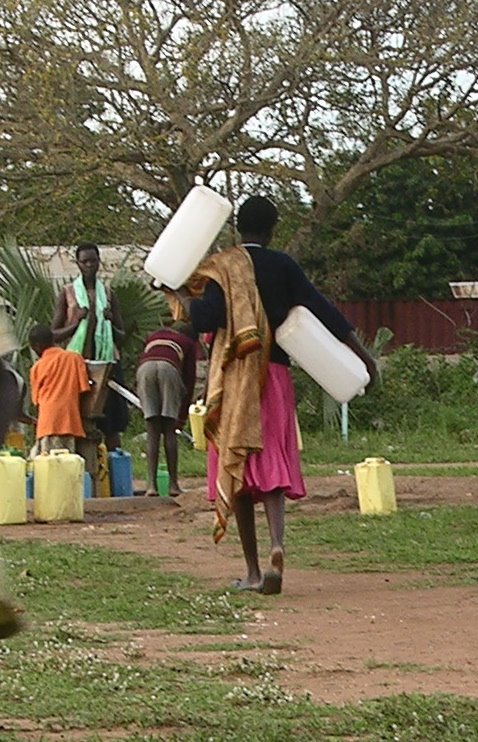
Notice anything about this photo? It might be hard to tell. We ride our bikes past this watering hole every day. There is always a line of women and children with large plastic jugs lined up to collect water. Yesterday there was a lively and colorful soccer game going on in the same field. Not one girl was playing soccer. Not one boy was collecting water.

Last week we were talking to some MCCers who are working in the field of education. They told us that female attendance in school is quite high. Unfortunately, the quality of education they receive is not on par with their male classmates. Girls are required to bring cooking knives to school to help in the kitchen while boys are given free time for studying. Principals have been heard making statements to the effect of, “Girl-child education is a waste of money. All they do is distract the boys from their studies.”

On the weekend I, (Holly) went to Gulu with a friend to see a traditional concert and dance. Apparently, it was meant to be celebrating and appreciating women. But the way women are celebrated and appreciated is as producers of children, cooks, and providers of sexual satisfaction. I wanted to appreciate the culture—and I do—I love so much of it, but there is a part of the culture that is unjust and needs to change. My inner cultural relativist cringes to write that, but really, cultural relativism has its limits and for me at least issues of gender fall outside the boundaries of prudent application. It felt awkward clapping and enjoying amazing dancers and musicians when what they were dancing to and singing about was perpetuating discrimination against women. The mentality that is nurtured is a breeding ground for the high prevalence of sexual and gender based violence.

There was one song about how "all women cook the same" which is code for all women are the same in bed. Apparently, that is supposed to be a song that encourages men to be faithful to their wives because if all women are the same than why bother having more than one. Then there was another one that was supposed to appreciate the work that women do but instead it sounded like a song that encourages women to stay in the kitchen. One line said something to the effect of: "be careful men when you try to do a woman's work, when you grind the millet flour you might get your testicles caught in the grinder."

During the concert something smacked me on the top of the head. I looked around to see who'd thrown something at me, and then I saw a mango had fallen out of the tree and my head happened to be in its path. One of my CPA friends said that is a blessing. Everyone around me insisted I should eat it to get the full benefit of the blessing. Since I’m a woman, I’m sure the blessing has something to do with producing children.

Wednesday, May 03, 2006

Labor Day and Military Men


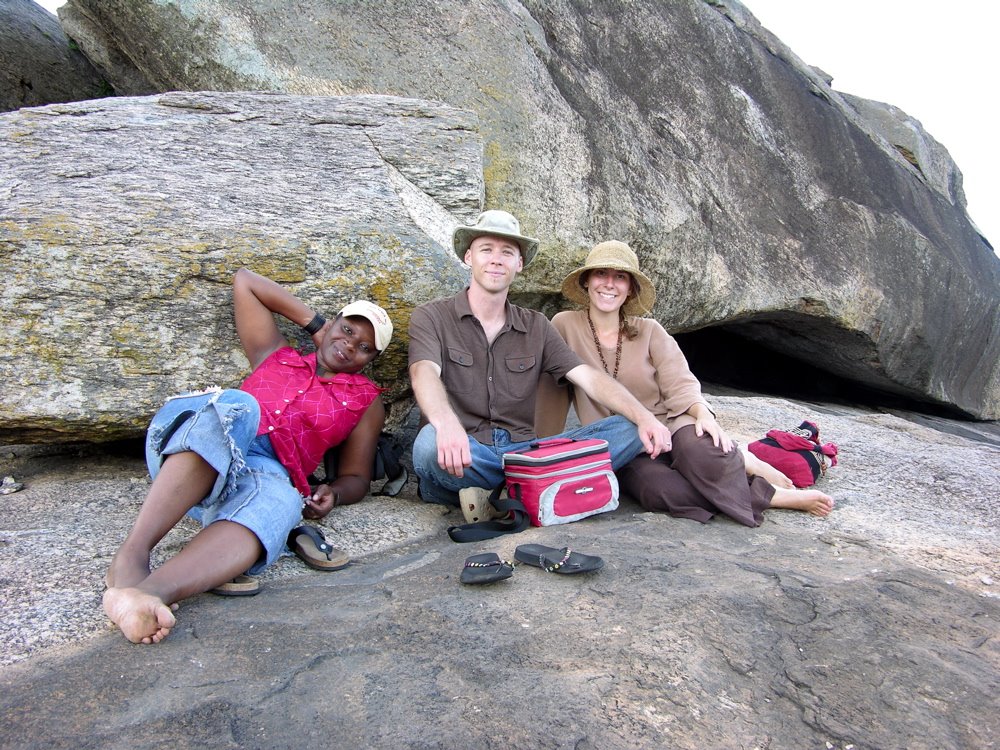
Around Lira there are two amazing hills in an otherwise flat expanse. We hiked one of them with two friends (Jessica is taking the picture and Priscilla is in it) on Labor Day. At the base there is an entire village of people with chisels breaking up rock presumably for construction and landscaping in town. We saw a boy as young as seven chiseling away and a woman who must have been 8 months pregnant determined to show us the way up the "mountain" by running ahead in front of us. We marvelled at her strength. We met some unexpected military men on the top who enjoyed killing their apparent boredom by hastling us for arriving unannounced at an outpost. The view was incredible. Down from the summit, just out of sight from the outpost we stopped and enjoyed some refreshment we brought with us. It was a good Labor Day.

Easter BBQ


On Easter we went to visit other MCCers, Ben and Celesta and son Matthew in Hoima. It was beautiful and we enjoyed relaxing with them and in a totally different climate. The trees there are lush and jungly and they live surrounded by rolling hills--quite different from Lira. We spent the Saturday lounging by a an oasis in the middle of a sugar cane plantation. They have a pool and cold drinks and hot dogs. It felt very American--sort of. The highlight was inviting all their neighbor kids for their first Easter egg hunt ever. We then made deviled eggs. It is strange to try to explain our traditions to Ugandan friends. Celesta just told them that the eggs are called that because they tast so good it's almost sinful. The Bens and a friend BBQ 9 kilos of pork.

Monday, April 24, 2006

“Living your dream is a full-time job”

Our beautiful rock star friends—the Kents—were describing their tour schedule and Seth said something that struck me. “Just because you’re living your dream doesn’t mean that it doesn’t feel like a full time-job.” The funny thing about living your dream is that you don’t morph into a superhero with superhuman powers. When I dreampt about the dream job I was my dream self while I worked it. Instead I have the same limitations and shortcomings that I had before.

The past few weeks I’ve been learning about empowering rather than taking power. I say learning because it sounds more positive than saying I’ve been making lots of mistakes--which is closer to the truth. I’ve acted way too American in several instances when I should have been more sensitive, should have been slower to speak and quicker to listen. My colleagues have been patient while I try to get my foot out of my mouth—a place--I’m afraid I put it too often. I’m learning to stay in my role as an advisor and support efforts of a multi-cultural team. At the moment I’m enjoying the freedom of holding work with open hands. I find that when I let go of the need to control everything my inability to do so isn’t nearly as frustrating. I did yoga during lunch, so we’ll see how long this moment lasts.

Tuesday, April 04, 2006

Life In Captivity of the LRA


by: Dan

Dan is a dear friend who wanted to share his story. I (Holly) also wrote about him in an archived blog "Man Was Made to Broken". Lately we've been enjoying the rainy season with Dan as he's an awesome local gardening guide and we spend whatever daylight is left after the workday getting our hands dirty together. Yesterday we took some time out from "being farmers" to write Dan's story.

"This story is narrated by my own life experience, Dan Feego Omara Obua. I am one of the lucky survivors who escaped from the captivity of the Lord’s Resistance Army based in Northern Uganda.

When yet a child, I never imagined that I would be taken captive. Nonetheless, I was the first to have that experience in my village. Captivity is a situation in which a person lives without rights and without freedom in so many ways, a situation between death and life imposed on innocent people, young children, and foreign citizens who live and travel around the northern parts of Uganda.

According to my memory, on Sunday the 27th November, 2003 at exactly 3:17 in the afternoon, the weather was very cold and dry with total silence around our living environment. In our tradition, we believe the weather can try to tell you something before it happens. This day was unlike the other previous days but no one thought about the indication of the weather. Two hours previously, a well known “madman” by the name Yagayaga Sarapino Odero who always built his house and set it ablaze himself, made a loud ululation calling for people’s help. Very many people were scared because there had been rumors spreading about the rebels in the morning. To some people like me, I thought when he was yelling, he was just making his daily madness just to scare people. I found out later that it was true that it was the rebels beating his legs and elbows.

On that evening I and my younger brother Calvin were playing football at my first primary school, Iwal Primary 7 School. The rebels surrounded the field without our notice and captured us under the command of Ocan Bunia, called “Boxer.” They surrounded the field and entered inside. They told us to sit down at gunpoint and they tied us with rope in one single line and we started to go.

On our journey to Southern Sudan, we detoured places like Aloi in Lira district, Omot in Pader district, and Acek Ocot in Kitgum district where we had “training camp.” During this time many people lost their lives during training, especially those who were grouped to be trained as “Protective Mission Unit” like me, because of the heavy and deadly training where the trainees were forced to jump from a distance of 40-50 meters high to the ground level. They put the rope on the summit of a mountain and tie it to the other side of a cliff. You climb up there holding the rope and try to slide while holding the rope and then jump down from there. If you jump, like me, I jumped from there and I got a sprain in my knee and I couldn’t run so they came and grabbed me and took me for treatment. Other people who broke their legs or died were taken and buried. This had been done or commanded by an Egyptian commando fighter, Abdullah Omar, doing his contract with the LRA leader, Joseph Kony. Under his command, during the training people who are Muslim were the ones to be trained first, and then after they were given Muslim gowns for praying. While training other people, Muslims do prayers and bury the dead. Besides that, other people lost their lives during other “competitions” like laughing, crying and wrestling. They always do it in the evening where the rebels are going to sleep for that day. They choose a good number of people between five and eight to compete with laughing. They come in front and stand and then you wait for the order. If they say start you start laughing. After that they stop you and they have a judge to tell who laughed most. They choose three people, first, second and third place winners, the rest should be killed. The losers were cut into pieces and eaten by the trainees. Why do they do it like that? If they are going to sleep somewhere they have to kill people. It is an order from Kony. Kony doesn’t use his own reason, he gets it from the power that comes on him. I would call it a demon. It was an order from Kony’s demon. Why the losers were cut into pieces and eaten by the trainees is because it is supposed make the trainees to be more courageous in fighting. They call that one “Entertainment Shadow.” Another way which people lost their lives was during crossfire between government forces and the rebels because of the gunshots which makes them scared and scattered, especially along the Ugandan and Sudan border where we spent four days trying to enter Sudan after many clashes.

One day along the bridge that borders Uganda and Sudan, I experienced through action the phrase, “fighting for survival.” I had to fight for survival for myself and for my brother Calvin who was only seven years old. During my childhood I “called the smoke fire.” That is a saying here that means what I had seen when I was still a child was not a “fire” or real suffering, and that fighting was more terrible than anything I’d seen in the past. When I saw the real “fire” along the bridge I realized my mistake and I remembered what my father used to tell me, that “man dies in action.” This phrase means you should not sit and wait for what is coming to kill you, but you should stand up and try to stop rather than leaving it. From there I retook my responsibility as the firstborn in our family by carrying my younger brother, Calvin, on my back and grabbed a gun from a certain rebel who was trying to kill himself after a serious injury. I took an oath by urinating into the barrel of the gun while praying, “God, I am ready to die—for what? I don’t know, but I believe you will never forsake me in this war as You said in the scripture, because I and my entire family members are innocent. Amen.” From here I and my brother survived along with nine rebels. After the fighting stopped we go for charge, that is counting the dead. Forty-one government forces were killed. Twenty-nine rebels were also killed and forty-two captives were also killed.

The situation in Southern Sudan, or Jubba, was so hard to survive. This was because of serious starvation, lack of medical equipment and personnel, serious injuries and frequent attacks by the government forces from Uganda border. After a duration of two weeks the government forces from brigade 25 waged a serious attack on our rebel camps with a helicopter gunship and mobile troop and a lot of people were killed. Other people, like me and Calvin got separated towards the Ugandan border. From here I escaped with Calvin. I started to seek the way to Uganda. We walked for four days. During this walk we were surviving by eating raw leaves and roots and we suffered dehydration because there was no water since Southern Sudan is a desert area. We had nowhere to get water for drinking except at one oasis on the way with little water. We met a patrolling unit before we reached the border. It was commanded by Okello Bony. When we met them other soldiers were so suspicious that we were real rebels but because Bony was from Lira he welcomed us, but first they put us at gunpoint and asked us our ranks because they mistook us for real rebels. I had to explain everything to them, that I was a student from Amuca Seventh Day Adventist Secondary School in Lira and we were captured from our village and taken to Southern Sudan and we managed to escape because of the attack waged by the UPDF on the rebels camp and we were trying to find our way back home. Then they welcomed us and took us to their detach along the border and transported us to Kitgum town where we were handed to Captain Okori from Lira. He put us in his office truck and brought us back to Lira. He dropped us at Ngetta dispensary to get some medical treatment and he gave us some money for transport and recovery, about $50. We went back home. People were very happy and celebrating our coming back. During the celebration they do traditional things. Old men, like my grandfather wear animal skins and carry a shield and long speer. They point it at you but don’t touch you to symbolize that no harm should come to you. They slaughter a goat and smear something on your head and pray with traditional words. Then they put two eggs on the ground and you step on them and they slaughter a baby chicken and take a piece of the stomach and smear it on your neck and pray in traditional words. They do it so that we should be cleaned from the past and not be captured again. Two weeks after that I went back to school. Very many students were questioning me because they heard that I was captured and they were not happy. They wanted to find out what life was like in captivity. I narrated everything to them. They comforted me.

After going back to school I continued with my studies until I finished secondary school. I wanted to go to University but because of the insecurity my parents cannot raise enough money to send me. I’m trying on my own to earn money to go back to school. It is still hard because there is no way to get good money. If I can manage I will study agricultural course for a beginning. Then after I’d like to go for law. My family has good acres of land and I want to use them in a way that my people can benefit. Then my dream is to be a lawyer because I feel that I can stand up and advocate for justice in my country, freedom and the welfare of humanity.

The best thing was prayers during that time because without that I don’t think I would have been able to come back after that hard life. After coming back to school I went straight to the pastor and got saved because I wanted not to commit any sins the rest of my life and because I knew that God loves me. Without that I couldn’t come out of my captivity. I know that God loves me and I love God. But I feel that what I should do to let God know that I love Him is to love His creation—especially, human beings because He created them in His image. Whoever lives around the world and thinks that they love God should show it by loving God’s creation."

Saturday, March 11, 2006

How to Fight a Dragon: Advice anyone?

by Holly
Last night I sat watching a massive lightning storm from the fourth story balcony of my hotel room. It’s the tallest building in Gulu. The electricity was out as usual but nature lit the scene better than any street lamps: women with jugs of water on their heads, large horned cows grazing in what should be a park but is a de facto rubbish dump, street kids running barefoot through it while the town closes up shop and people make their way home. While I let the view and the breeze wash over me the scenes that flashed through my mind, were of the past days in Kitgum. The faces of the children. The desperation of the mothers. The drunkenness of fathers. I hesitate to describe in too much detail, because to do so would mean I’d have to keep thinking about it and to let those images continue to burn. And right now I want it all to stop and I feel so helpless. There is a dragon going about setting fires with its poisonous lungs. And I am torn. Confront the beast with a stick, or more accurately a toothpick and try to plunge it into its heart. Or follow in its tracks crying over the fires hoping my tears might quench the flames.

Anything, anything to make this stop. To make it better. But it is so big. And they say if the war ends tomorrow there will still be no peace. I believe it. I’ve seen the social ills that will remain for generations. My thinking is evolving and I even question what I wrote last week about the ICC. If the arrests of four people could even have a chance of alleviating the deplorable suffering of the eyes I looked into than by all means, somebody send in the special ops and make the arrests. It won’t kill the dragon but maybe it would keep it from lighting more fires and we could concentrate on extinguishing the flames.

Of course my analogy depicts a more lonely scenario than the reality. There are many of us here crying over the fires and wielding our little toothpicks as best we can—we’ve got SUVs galore to prove our valiant efforts: activities in night commuter centers to keep the children busy, income generating activities for returned abductees, dances and dramas to “sensitize” the community to issues of peace, educational support to “orphans and vulnerable children,” trainings and workshops on psycho social support, conflict management and sexual and gender based violence.

How many toothpicks does it take to kill a dragon?

How many tears to make the fire stop?

Today I feel quite small. I’m supposed to advise my organization. That’s what Technical Advisors do. And while I try to think of diplomatic sensitive ways of addressing issues of governance within CPA and how to improve our policies and activities—the dragon is still at work. I make suggestions that do have a small impact, and I feel I’m able to contribute something—more than I could before I came--but it is a pittance nonetheless and leaves one feeling utterly disempowered. My toothpick is charred and the fire has dried my eyes.

Kitgum in Pictures


CPA runs 8 night commuter centers in Kitgum. I spent an evening at one of them. These kids told riddles and stories and sang songs to pass the hours between arrival at dusk and their bedtime.

This is where they sleep. There is one oil lamp (a fire hazard) to provide light for 180 people--mostly children and a few mothers. They are given a blanket and they tie up any belongings in case of flooding in the tent when it rains. The women and children under five are in one side of the tent and boys on the other.

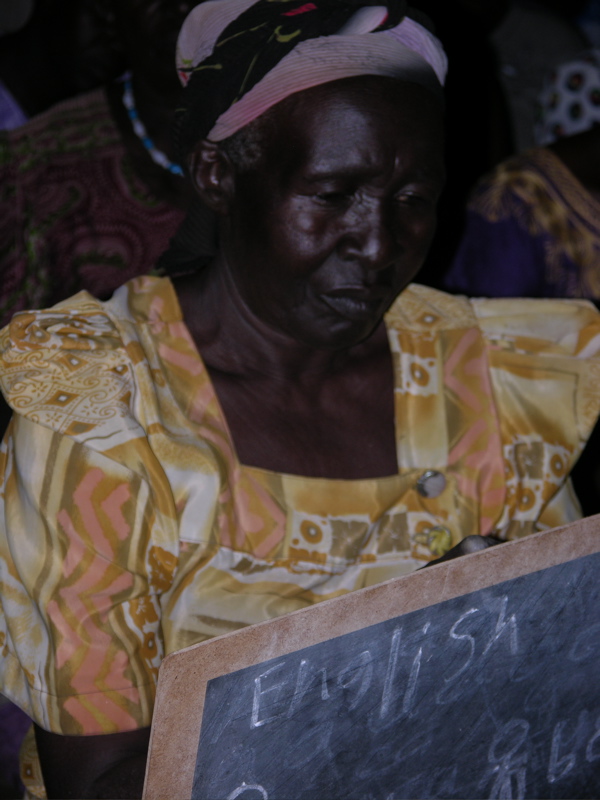
While in Kitgum I visited an MCC sponsored adult literacy program for night commuting women. This woman is in the beginning class.

The women in the adult literacy class sang a song of thanks. "Our fathers did not send us to school, but thank you, you have sent us to school. Now when we go to the bus stop we can see for ourselves, Does this bus go to Kampala or does this bus go to Gulu and how much does it cost? Now we can teach out children and have pride in our homes."

Monday, February 27, 2006

Protected Villages


by: Holly

Last week I spent time in 4 different Internally Displaced People (IDP) Camps. There are some who prefer to call them “Protected Villages.” The label is grossly inaccurate and derides the suffering of the people who live there. It implies permanence—which may be what is intended by those who use it, but is not accepted by anyone who lives there. They want to go home. On the way to the camps I drove over bumpy roads with abandoned fertile fields that fed thousands of hungry mouths before the war. My colleague, himself displaced, as 94% of all those who live in Gulu are, pointed to a mango tree and then another and said, “You see, wherever you see a mango tree, that is the place where peoples homes used to be.” There are no villages in Gulu. There is only Gulu town and 53 IDP camps. The residents must be within the camp between 4:30 and 6:00 every evening depending on the camp and a strict curfew is enforced. After that the roads will be blocked and any patrolling UPDF might mistake the resident for a rebel. The same applies if they venture further than 3 km from their camp to “dig” the fields. I spent time with CPAs parent groups, youth groups, child mothers who were formerly abducted, camp leaders, elders, and others.


One of these women described how they sometimes become so discouraged that they want to commit suicide. Then they come to their friends in the Parent Support Group and they remind each other that their children need to find them alive when they finally come out of the bush. They have to persevere. They can’t give up. They have to hang on to hope.

One woman said that she passed by a center for formerly abducted children the other day and there were three kids who were just arriving having just been rescued from the LRA. And she wept. She said, “It gave me courage, to see them, it means that there are still children returning and that next time it might even be my son coming home to me.”


This man just learned that he is a grandfather. His granddaughter was born in the bush and was rescued two weeks ago by the Ugandan army. His son was abducted ten years ago and is still in the bush. Now he and his wife will raise the granddaughter and hope that someday her parents will come home. I asked him what he would say to his president if he could have lunch with him. He said, “I would tell him two things. First, I would ask him to stop using guns—use dialogue. The gun does not select. Our children will die without even knowing what they are dying for. They are dying for nothing. Second I would ask for an extension of Amnesty. It should be open.” Amnesty has been offered to combatants who surrender but it is due to expire in March next month. Anyone surrendering after that date could ostensibly be prosecuted regardless of the circumstances of their “enlistment” in the LRA.


I asked this man the same question. Tired, he said, “I just want to go home.”

During a conversation with one of the camp leaders he pressed his heart and admitted the thing that weighs on him and other elders the most is the youth. “We have many concerns I could tell you, but more than anything we are worried for his coming generation. This is no way to grow up. All of our cultural values are being lost. The ways that we used to pass them on to the young we cannot do here in the camp. It is all disintegrating. And when we look at them we worry for the future.” I asked him what he as a camp leader is doing to meet that challenge. He said that they the main thing he would like to do is to encourage some of the traditional ways of passing on cultural values like the “Wango” a gathering of the clan around a fire at night for the elders to tell stories, for debates, for dancing, for the young to ask the old their questions, for the life of the clan. The curfew is prohibitive of doing things in just the same way—wango should be after dark when everyone is required to be in their huts. He is waiting and hoping for a government decision to provide security and an exception to curfew.

The Proof, The Trick & Restorative Justice

by Holly
Over a mug of coffee this morning I read the Sunday paper of one of the two most prominent Ugandan newspapers. The article that caught my attention was discussing how the political opposition uses the ongoing war to cast a shadow on the incumbent’s track record while addressing crowds of supporters in the North. It was an op-ed piece that was sharply criticizing the practice and setting the record straight: those who are responsible for the war are the LRA rebels—not the current government. The proof, the journalist opined, is that the International Criminal Court(ICC) has issued warrants for the top 5 in LRA command. I’ve been meaning to write a few thoughts about the hotly debated role of the ICC in Northern Uganda and this article is an excellent example of one of the many (unintended) byproducts of the international community’s attempt to administer justice. While I hold my own opinions on ICC involvement it seems most appropriate to focus on the perception and desires of those who are directly affected by it—the people in the North. While I can’t claim to speak for them, in my limited time here my conversations with colleagues, formerly abducted children, parents, camp leaders, religious leaders, and others have confirmed without exception empirical research that has been conducted that I’d read. (Justice & Peace Commission and Refugee Law Project are two main organizations). Three main beliefs about the ICC are reoccurring themes in conversations and research on the subject.

It is not seen to be objective. The case was referred to the court by the government of Uganda and by indicting only the top 5 in command of the LRA the perception (whether it is valid or not may be another story) is that the ICC has “chosen sides” in an ongoing conflict. Although virtually no one supports the LRA, many in the North don’t support the current government either and have been victims of human rights abuses committed by both warring parties. Most people believe that if there is to be accountability for injustices it should be comprehensive. The ICC has made statements indicating that the government would not be exempt from investigation. However, they only indicted top LRA and those statements seem to have only been read by a rare few who relish sifting through reports and not by your average (often illiterate) camp resident in Northern Uganda.

It undermines amnesty and therefore, many believe, the only shot at achieving sustainable peace. The government’s attitude towards the amnesty process is widely perceived to be at best ambiguous and at worst a trick to lure rebels out of the bush and then when peace is achieved to use the documentation of amnesty recipients as incriminating evidence to prosecute them—letting a thousand flowers bloom Ugandan style. In a strictly legal sense, if I understand it properly, it truly only undermines the amnesty of five individuals, however, it is NOT understood properly by the general population and even less so by those (children) who remain in the bush afraid of what will happen to them if they try to come out. The risks of escape are great. The stigmatization experienced while trying to reunite with a community and a family plagued with grievance is inevitable. The perceived liklihood of being prosecuted for crimes committed involuntarily does not provide the assurance that many need to even begin contemplation of surmounting the other hardships. Couple that with the fact that many of those trying to decide if they should risk escape and apply for amnesty are or were children when they were abducted and have undergone significant “mental conditioning” since then. The ICC has said that it would consider postponing the case “in the interests of justice.” If even one child is dissuaded from coming home to his/her family by confusion over the ICC is that in the interests of justice?

It imposes a western version of justice ignoring both the traditional way as well as the needs of the victims. Someone recently told me that they don’t want Kony sent to the Hague and then shipped to some comfortable jail somewhere. Nor do they want him tried by Ugandan courts where capitol punishment (by hanging) would be his likely sentence. No, they don’t want his blood on their hands, they want him to spend his life working in the fields. He should have to plow and sweat just like the rest of Northern Ugandans. While this scenario might not sound viable it reflects a widely held belief and practice of reintegrating perpetrators into their communities. If the victims do not believe the ICC is achieving justice—than who is the justice for? Does it only satisfy the international community’s desire to do something? It pours some water on our burning consciences as each day we continue to fail to effectively respond to the growing suffering of the people of Northern Uganda. While the crimes that the ICC deals with are those against humanity—we must not neglect the fact that the victims of those crimes have faces and names and many of them are still alive and thinking about their futures. One mother told me that there could be no meaningful restitution for what she has suffered—the injury is too great. For her, justice means that her daughter and the children that she bore in captivity receive the best possible education. Justice for Northern Uganda, will not be achieved by 5 arrest warrants. It will need to move beyond retributive and punitive justice and draw from the deep traditional well that the people of Northern Uganda have used for centuries—of restorative justice.

Tuesday, February 14, 2006

News Flash...

This morning Ben and I were watching BBC and sipping on instant coffee at our hotel here in Gulu. Across the bottom of the screen it read 'Ugandan elections unlikely to be free and fair--U.S. based Human Rights Watch reports.' They catch on quick. Check it out: http://www.hrw.org/english/docs/2006/02/13/uganda12669.htm

Elections are in a week and we're praying, hoping and working for peace.

Sunday, February 12, 2006

The Senate's Resolve

We heard about this the day after the prayer week was over. A good move in the right direction--there is still a chasm between the depth of suffering and the response, but I thought some of you might be interested to know what our government is saying about our place of work. -Holly

SRES 366 ATS

109th CONGRESS

2d Session

S. RES. 366

Affirming the importance of increased international action and a
national week of prayer for the Ugandan victims of Joseph Kony's Lord's
Resistance Army, and expressing the sense of the Senate that Sudan,
Uganda, and the international community bring justice and humanitarian
assistance to Northern Uganda and that February 2 through 9, 2006,
should be designated as a national week of prayer and reflection for the
people of Uganda.

IN THE SENATE OF THE UNITED STATES


February 2, 2006


Mr. INHOFE (for himself, Mr. COLEMAN, Mr. SANTORUM, Mr. DEMINT, Mrs.
HUTCHISON, Mr. DEWINE, Mr. MARTINEZ, Mr. BOND, Mr. CHAMBLISS, Mr. KYL,
Mr. SPECTER, Mr. SMITH, Mr. ROBERTS, Mr. ALLARD, Mr. BURNS, Mr. BUNNING,
Mr. ENSIGN, Mr. MCCAIN, Mr. SESSIONS, Mr. HATCH, Mr. ENZI, Mr. BENNETT,
Mr. GRASSLEY, Mr. CRAIG, Mr. MCCONNELL, Mr. COBURN, Mr. FRIST, Mr.
BROWNBACK, Mr. VITTER, Mr. NELSON of Florida, Ms. MIKULSKI, Mr. AKAKA,
Mr. PRYOR, Mr. CARPER, Mrs. LINCOLN, Mr. DAYTON, Mr. JEFFORDS, Ms.
LANDRIEU, Mr. ROCKEFELLER, Mr. SALAZAR, Mr. NELSON of Nebraska, Mr.
FEINGOLD, Mr. KENNEDY, and Mr. LAUTENBERG) submitted the following
resolution; which was considered and agreed to

________________________________

RESOLUTION

Affirming the importance of increased international action and a
national week of prayer for the Ugandan victims of Joseph Kony's Lord's
Resistance Army, and expressing the sense of the Senate that Sudan,
Uganda, and the international community bring justice and humanitarian
assistance to Northern Uganda and that February 2 through 9, 2006,
should be designated as a national week of prayer and reflection for the
people of Uganda.

Whereas Joseph Kony has led the Lord's Resistance Army (LRA) since 1987,
terrorizing the region of Northern Uganda;

Whereas up to 200,000 people have been killed in violent conflict and
from disease and malnutrition;

Whereas 80 to 90 percent of Kony's fighters are enslaved
children--brutalized and brainwashed to kill;

Whereas sources estimate that between 20,000 and 50,000 children have
been abducted by the LRA since 1987;

Whereas these children are sexually abused, raped, beaten, taunted and
traumatized by older soldiers in the LRA;

Whereas these children are maliciously coerced to mutilate, rape, and
murder others, even their own family members and friends;

Whereas LRA leaders often force the friends and siblings of unsuccessful
escapees to carry out vicious punishments to further the LRA's culture
of fear, intimidation and guilt;

Whereas even those children who do manage to escape are unspeakably
traumatized, often infected with sexually transmitted diseases, and
stigmatized by society;

Whereas approximately 40,000 children in rural Uganda trek miles into
towns each night to sleep under the protection of soldiers and attempt
to avoid capture;

Whereas more than 1.6 million people have been forced to flee their
homes;

Whereas the conflict has slowed Uganda's development efforts, costing
the country at least $1.33 billion, or 3 percent of its GDP; and

Whereas, starting in October 2005, the Sudan government gave Joseph Kony
a three month grace period to surrender: Now, therefore, be it

Resolved, That it is the sense of the Senate--

(1) that the government of Sudan continue to prosecute LRA terrorists
within its borders and aid Uganda in ending the conflict;

(2) that Uganda use every available resource to end the atrocities of
the LRA and bring its members to justice;

(3) that the United States and international community recognize the
atrocities occurring daily in Uganda and provide necessary humanitarian
assistance; and

(4) that the week of February 2 through 9, 2006, should be designated as
a National Week of Prayer and Reflection for the people of Northern
Uganda.

Wednesday, February 01, 2006

Light Bulbs


By Holly:
I love teaching. Actually, what it is that is so thrilling is not the actual teaching but watching people transform even in little doses—their minds, their attitudes, their behavior. I like watching them realize that they have power and decidedly set about using it to participate in creative processes. I facilitated my first training at CPA for 5 days on Conflict Resolution. It was intense. I could not have asked for a better group of participants—20 of the most committed members of CPA’s “youth” branch (all 20 and 30 somethings). They were excellent. Many of them were formerly abducted, some had lost parents or siblings, all of them were war affected.

I’m hopeful that the training was a beginning of a lot of things—as they work to apply new skills and ideas to their activities as an organization and in their lives I hope to continue being a resource to them. I think there were the beginning of some friendships, some mentoring relationships and a lot of potential that will need a little guidance and focus. We gave them certificates at the end. I was originally critical of the idea but it is an expected norm that has become part of educational culture put in place by the presence of so many NGOs. By the end I was fully convinced that they deserved certificates because of the great progress they made and I prepared a little speech for the “commencement.” I couldn’t get through it. I choked up when I got to the part when I noted that they had lived their whole lives never knowing peace but they were the ones who would insure that their children would grow up never knowing war.

In Northern Uganda watching the lights go on in the eyes of training participants is especially powerful as they shine it on some of the darkest deeds in human history. I really believe that. These “youth” have lived through things that those of us who haven’t can’t imagine—when we try we feel like if it had been us we’d have just stopped breathing or died under the crushing weight of the unspeakable evil that human beings are capable of inflicting on each other. But somehow they not only kept on breathing but they emerged activists that refuse to accept this unjust way of life as normal. They are wounded activists but they will not be stopped.

A Case Study


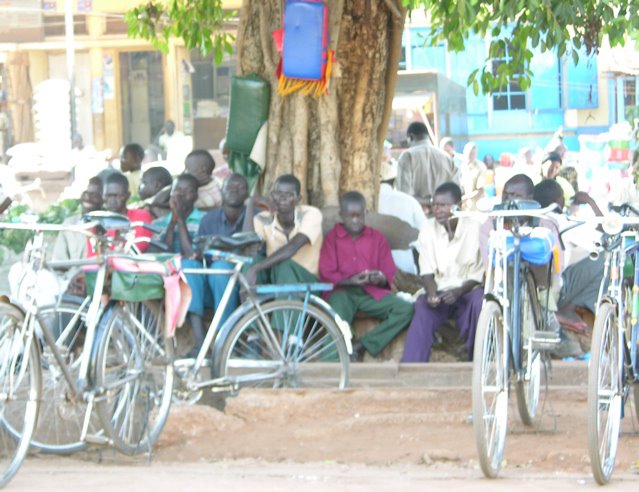
A group of Bodas waiting for their next customer.
By Holly:
Before the training I asked the participants to each write about two real conflicts that affected them. We used them as case studies during the training. As I read through a stack of 40 conflicts there was one that stuck out, not for its severity but as depressingly commonplace. It was about a participant’s neighbors. The breadwinner is a “Boda” someone who makes money by carrying people on the back of their bicycle. Income comes slow at about 15 cents per trip. The boda was supporting his wife and 8 kids on his meager and irregular income. All year he had been struggling to save enough money to buy his family meat for Christmas. Because of the Christmas rush he bought the meat one week before the expected feast. It would be the first time for most of the children to ever eat meat and in the novelty of it they would smell the meat and increase their anticipation. The family felt like the week “lasted for two years.” While the father was at work on the 23rd the smell and desire became so overwhelming that they cooked the meat and ate it. When the boda came home he found that most of the meat was gone and that the choicest pieces had been given to the children (in Ugandan culture it should be given to the man). In a rage the boda beat the woman and smashed her hand badly breaking it. The neighbors all heard the sounds of domestic violence and rushed to take her to the hospital.

MEET OGIKO

Friday, January 27, 2006

FIRE IN THE CAMPS


We’re in the middle of the dry season here. The intense heat, dust and wind makes the people in the IDP camps even more vulnerable. Last week there were massive fires in 4 large camps. One camp, Amoro, saw 450 grass roofs burn, resulting in the death of 3 children. A friend of mine who was there said, “You can’t imagine, even if you saw it, you couldn’t believe it”. As we discussed this issue in a United Nations Working Group on Child Protection, an INGO representative said, “This is our fault, we are to blame. We knew this was coming, and yet we’re working with the aftermath of the fires without taking the proper preventative measures. Child-headed households are cooking meals with little to no concept of how to manage a fire for cooking. Look even now, we’re reacting to the catastrophe of the fires and making no plan for preparing the camps for the rainy season-which causes even more damage and claims more lives.” Everyone can become frustrated at the circumstances here. Some NGOs blame the camp residents for setting their own homes on fire so that they can receive non-food aid from the government or INGOs. I personally have a hard time believing that, and others I’ve talked to feel as though that response is given out of sheer frustration at the immense challenge of keeping the people in the camps safe.

Wednesday, January 11, 2006

Peace is Like Glass

Officially, we started work last week. But the needs are great and I was getting restless, so before Christmas I assisted with a small part of an assessment and I learned so much. During that week I spoke with parents of young women who returned from the LRA last year. I met their daughters. Most of them were in captivity for about 8 years. I’m struggling to find the right words for my interactions with them. They may not exist—somehow I was inspired and heartbroken by the same conversations. Most of the girls who have returned came back with children. When I talked to the parents I noted that the moms seemed to have adjusted to that more easily than the dads. The dads all shared their struggle to accept and love the children that were a constant reminder of how they had failed to protect their daughters and how they had been repeatedly raped while in captivity. It's so heavy.

Angelina, the Chairperson of CPA, says that peace is like glass. You have to keep it carefully. If it breaks it shatters and you can only hold onto a few splintered shards. What we’re doing is trying to put the pieces back together. The conversations I had feel like splinters of peace. There was resilience. There was pain and hope.

Angelina is an amazing woman whose approach to suffering is profoundly spiritual. She shares her painful stories openly. She told me of how she used to pray lying on the concrete floor pleading with God for the release of her daughter. After 7 years of pleading she told me how one night she reminded God that the seventh year is the year of freeing those who are in captivity. “God, you do not break your promises—you are not a liar,” she told Him, “are you going to let this year pass without fulfilling your promise?” She told me that the same night her daughter had a dream where God told her that she was going home to her people. The next day in the middle of 4 guards and a convoy of rebels she felt that she should turn left at a fork in the road. In broad daylight she walked to the left holding the hand of her son while the LRA walked to the right. No one stopped her or asked where she was going. She was free. Then, Angelina asks, how can we not know that God is supreme? That He is faithful? She told me that once a white woman told her that if her God was faithful and supreme He wouldn’t have let the girls be taken from Aboke in the first place and the war would never have started. She told me that expecting me to be equally shocked that someone would say such a thing. But I confess, I identified with the other white woman. After hearing about the things her daughter went through during the 7 years before her miraculous escape I found myself questioning God’s timing. If God was going to intervene eventually anyway, than why did it take Him so long? Angelina asked a different question, “How can a WHITE woman who has so much not have the one most important thing--the knowledge that God is good?”

Saturday, December 31, 2005

A Day in Lira, December 26th

By Ben


Today I played with the neighbor boys for most of the day. Before we went to Kenya the boys asked if we could make a pigeon house together, naturally I agreed. In Lira the boys raise pigeons (called “amam”) for both eating and selling. We gathered some scrap metal, stripped an electrical cord for binding wire, and began making the birdhouse. Our backyard had a constant stream of boys who wanted to help with the project, or just hang out and play. Their resourcefulness never ceases to surprise me. They make games out of rocks, and slip-n-slides out of torn up cardboard boxes.
This evening Holly and I attended a worship service for a friend who was involved in a serious car accident three years ago. Every year he calls his friends and family together to celebrate God’s goodness in keeping him alive. After a lengthy sermon we gathered around the vehicles present and prayed for them. The prayer session ended in starting the car and making the sign of the cross over the hood.
It had just gotten dark when we left to go home. As we rode our bicycles home, a girl ran past me in the tall grass on the side of the road. A couple hundred meters later, she was still running and Holly heard her sobbing. Holly asked her if she was okay. The man accompanying us home spoke with her and found out that her father had just beaten her, and she was running away from home. She was about 14 years old. The man we were with advised her to go home, and assured us that it was the best thing for her. I wish I knew if he was right. The risks of being on the street for a girl her age are tremendous, but her home is no longer a safe place. During this time of year so many men celebrate the holidays by drinking together and come home thoroughly drunk. When we got home we did all that we knew how—we prayed.