Monday, May 28, 2007

Traditional Wedding (by Ben)


(The group from Lira)

Yesterday, Holly and I went to a village outside of a small town bordering Congo to attend a friend’s wedding. Carol, the bride (who works with us at CPA) grew up in the village near Congo, while Tom, the groom (a good friend) grew up in Lira. As such, we all woke up very early and caravanned to the village. Several goats and cows accompanied us on the journey.

(Congratulating Tom)


Holly and I have attended wedding ceremonies before, but this was the first one we really felt integrated with the other guests; the newly weds are friends of ours, and we had been to enough ceremonies like this to know how to conduct ourselves.

(Holly in her stylish Gomaz)

Holly wore a traditional dress called a gomaz, and I wore the traditional suit. After we arrived at the wedding, we waited for the “negotiations” between Tom’s elders and Carol’s elders to decide on the “bride price”. Half and hour was designated for the negotiations, but they lasted for over five hours. By the time they finished it was dark. But no problem…it was time to celebrate! Women were ululating, pounding the ground with weeding hoes, and waving dried fish on a stick. In the initial hours, men needed to wear a stern face, without smiling, or they would be fined. After speeches by fathers, everyone was allowed to visibly enjoy themselves.
(traditional dancing)

(Carol the bride)

Theories of Nonviolence and Community Reconciliation (by Ben)


(Lam and I)


Last week Holly and I were with CPA’s trainers in Soroti, Uganda. This was our eighth out of ten training modules. Holly and Lam (an Acholi peace activist) worked together to bring new levels of understanding and commitment to nonviolence. Lam vividly described his real life experiences and challenges of brining peace to Northern Uganda, while Holly placed new ideas and inspired reconciliation.

(Holly teaching a model on reconciliation designed by JP Lederach)


A common training technique to get participants to express and debate their views is an activity called “Agree-Disagree”. After a statement is read, individuals take a position by standing along the spectrum of "agreeing" or "disagreeing". One statement provoked an interesting discussion. It is a widely-held belief in the community that “the best punishment for a thief is death.” Participants stood along the entire spectrum of this statement. The legal system is Uganda is so unstable at times that “taking justice into your own hands” is the only way to deter crime. If thieves are brought to the police station, the police will often tell them that they should’ve been dealt with in the traditional way, and that they would release the thief in a day or so. Mob justice certainly is an effective deterrent to crime (and thousands lose their lives to mob violence every year). One trainer raised her hand and spoke of the passage in the Gospels where an angry mob is ready to stone a woman caught in adultery. In this story, Jesus says, “let he who has not sinned cast the first stone”. Slowly the crowd dissipated with the elders first to leave. Holly then asked, “Raise your hand if you have ever stolen anything in your life. Whether it be large sums of money or knowingly accepting more change than you were owed after a purchase”. Everyone raised their hands...and there was silence. The following day some participants expressed their new views: that killing wasn’t the answer. This led to discussions and questions on “what true restoration, reconciliation and rehabilitation would look like in Northern Uganda”

(Trainers hard at work)

Saturday, May 12, 2007

Labor Day Football (by Ben)

Hi Friends,
We spend a lot of time doing our routine work in the office, but when we break away, it's fun share with all of you. On labor day, Holly and I traveled to Gulu for a Bi-annual football tournament. Several NGO's spend months training to win the tournament. This year, CPA was geared up and ready to defeat the returning champion, CARITAS.


Training and playing football keeps a lot of us balanced. Adrenaline and endorphins flood into our bloodstream and give us natural highs, as stresses from the office fade away. We were defeated again this year. 0-1. It was a good game and we're already looking forward to the rematch in October!

(disappointment)

(Our "football mothers". Members of CPA's board who came to support our team)

Next week we're both out of town conducting a training in "Peacebuilding: Theories of Non-violence and Community Reconciliation". We hope to keep you posted.

Sunday, April 22, 2007

Friends Continued (by Ben)

Yesterday we celebrated the birthdays of two of our closest work colleagues. On this special day, the birthday boys are called "Babies". Birthdays are often recognized in Uganda (especially if the D.O.B. is known), but seldom is a birthday an occasion for a party. Imagine the drain on resources if you had a party for all 15 of your children...

(Tonny "Warming Up" for the competition)

Godfrey, CPA's program manager, celebrated his first b-day party at the age of 35, and Tonny, the District Coordinator, had celebrated once before. We had an afternoon of games and competitions, an evening meal, and two cakes for the group of about 25 close friends and colleagues. Godfrey's cake read "Mzee (elder) Okello". He then turned to the oldest man in the room and sincerely asked, "May I be received into Mzee-hood?"

(Godfrey showing us his strokes in the dance competition)

Godfrey and Tonny were touched by the outpouring of affection and gifts given to them on their day. After presenting the gifts, all spoke aloud "what we liked best about the birthday boys". Godfrey's son (age 5) came up to him after the gifts were given and said with surprise, "Why is everyone giving you free things? I'm little, why don't I get something?" As it turns out, Tonny's team won the dance competition and won.... A NEW CAR!!!...as a prize. Because it was a toy car, Tonny was generous enough to give Godfrey's son something after all.

(Godfrey's children, Dan and Rachel also wanted to show us how to dance)

There is something bonding about celebrating a common tradition with our friends here. Sharing this experience made me feel closer to my culture and to theirs.

Sunday, April 15, 2007

Friends and Family: by Ben

Having Travis with us for the past week really made me wish that all of our friends and family were closer. It feels like there is something “hard-wired” into me that makes me crave long-term relationships and regular contact with those I love most. Many of our African friends have such pity on us for being so far away from our families; they can’t imagine a life so far away from their families. In the West, we have access to travel that takes us to the ends of the earth in relatively little time. Jobs easily take us to other cities, states, and continents, and our contact with our loved ones diminishes.


I just finished a training on indigenous ways of healing. In this module we discussed ways in which people have traditionally sought healing through community collectivism and various ceremonies. I learned so much, and was amazed at the richness of social support built into the culture. We learned traditional ceremonies meant to cure physical, emotional, and spiritual illnesses, but we also learned about lifestyle practices such as hunting (dwar), sitting around the fireplace (Wang Oo), and dancing/singing (Myelo/Wer) that naturally build a sense of community cohesion.


There is a controversial debate whether resilience is a product of nature or nurture. Some people believe that resilience is inherited; that some individuals have a resilience gene or perhaps inherit a resilient personality. Others believe that it is the neurobiological process that occurs after the initial fight/flight survival reaction. The absence of “calming” hormones after the survival reaction leaves people over-alert; consciously and subconsciously awaiting a reoccurrence of the traumatic event. Such hyper-vigilance also works against our physical bodies. Others believe it is the social support offered after an individual has endured a traumatic event.

(This is one of seven parent support group representative trainers)

I suppose the answer should consider all of these factors. However, living in Uganda has highlighted the social support component of resilience. Imagine the personal resources someone has when in the presence of generations of family and a cohesive community versus going through a mental breakdown in an alien or isolated environment such as a hospital. All this to say that my heart is torn between the longing I feel from being so far away from friends and family and the joy I feel in sharing my life with remarkable friends here.

Saturday, April 14, 2007

After You've Hurt or Every Day is like Holy Saturday


Photography can't begin to capture the beauty that we experienced in Queen Elizabeth National Park--not even with Travis' good eye and camera. Travis arrived in Entebbe in the middle of the night--we picked him up only after he'd been half eaten by mosquitoes and then drove straight to Mweya Safari Lodge--6 hours southwest. Travis is writing an article about them for his magazine so they were putting him up. Ben and I had intended to camp or stay in a hostel nearby but when we showed up the manager said they'd prepared a two room suite for Travis with plenty of room if we wanted to stay together. It was the first of surprising gifts during our week with my brother.

The last time we'd been this spoiled in Uganda was with Kimbal and Kellen at Paraa in Murchison Falls. Both times we thoroughly enjoyed the break, the luxury, the companionship of some of dear friends, and incredible beauty. Can I draw conclusions about a "trend" if I've only experienced it twice? I think this kind of beautiful experience has changed for me forever since coming to northern Uganda. The first time, I would've called it white-girl's guilt. This time, the change has matured into something more nuanced and difficult to express. Though a totally different experience--the only comparable emotion I can compare it to is the way that you feel in moments of love after you've deeply hurt and been hurt by your lover. There is a simplicity, gratitude and open hearted freedom when you're in love before you've ever hurt each other. After the first major injury--the relationship may be stronger, deeper, even better--but it's never the same because now you know how much it can hurt.
The Holy Week before Easter is a good time of reflection for these things. Between amazing food, swimming in the pool, enjoying the view, and the cool wind at dawn sticking our heads out of the jeep on game drives and watching lions--I had two of my favorite men to process with. I don't feel guilty for my full life--and I have a really full life. (though I try to be conscious of and avoid the ways my privelege can contribute to the injustice of others) But I don't feel as free to just be grateful for it because I'm kind of mad that not everyone has the same freedom. I feel loved by God but I'm not sure I would if I'd been born in an IDP camp or if I'd been raped or watched my family members decapitated. It's easy to say "thank you God" when I get to stay in a beautiful suite at a luxury safari lodge instead of camping in the rain--but I don't want God to be loving to me, I want him to be love. My life isn't in the middle of the sorrow of Good Friday. But that sorrow is a daily reality for a lot of people--and without the hope of redemption of Easter Sunday--I can't hold the belief that He is good and loving.

I confessed to Travis, sometimes I'm totally sure God is good and loving but maybe he just isn't trying. I get angry. I feel like I'm here--totally inadequate and working as hard as I can--and what is He doing? He could fix this tragic mess if he tried, and I can't--but at least I'm trying. This isn't really what I believe--it's how I honestly feel when I get discouraged. I have my sense of the problem of evil and I know what I think the answers to these questions are--but it's not where I operate from consistently. Being with family is healthy. It was a time of a strengthening faith. It reminds me where I've come from and makes me feel like I have roots that are still in tact. Somehow, the questions are easier to hold unanswered in my heart when they're voiced to someone who gets it, who doesn't judge, and who reminds me of the character I believe God has--that He wants a full life for every broken human being and to redeem the earth and everything in it. And we're on that day inbetween crucifixion and resurrection, groaning for redemption.
Easter Sunday we were back at home in Lira and sharing things that were new to Travis--like kasava. We got up late, ate a great breakfast, listened to a sermon online from Celebration, dug in the garden, and ran around the house looking for chocolate eggs that Ben surprised us with. The week with Travis was refreshing and wonderfully comfortable and natural. It seemed like he ought to just be able to come over every Saturday and hang out. Sharing what has become familiar to us in Uganda with him was so much fun. Doing life together and enjoying the ordinary as well as the awesome beauty was a gift we received gratefully. My parents just got our home videos from when we were kids put on DVD and sent them to us. So we got nostalgic watching younger versions of ourselves and marvelled at our parents' youthfulness, how totally adorable Tina was, and how much relationships change in 15 years.

Sunday, March 25, 2007

Accepted Foreigner


by Holly
It’s been awhile since I’ve blogged. Partly, I think because I didn’t have any interesting photos to go along with what’s kept me busy. I thought about taking one of me and the team of people (Anthony, Sylvia, Charles, Godfrey, Ben) who were working on one of two intense proposals we’ve done this year. It would have had all of us gathered around a computer very late at night and pulling out our hair and gritting our teeth. The title would have been, “Is this Framework Really Logical?” But, like most people, I don’t bring my camera with me for long days of office work.

Finally, I’ve broken out of the office again. I’ve been in Gulu this week monitoring the office there with the Program Manager. Ben always teases me because I love meetings so much—and I really like trying to improve systems to manage and support and supervise our staff and programs. It’s so much fun—although I sometimes want something really concrete that I can point to and say that-that’s what I do and why I’m here. We had a conversation with a friend last night who (among many other things) has installed playground equipment at a water hole near our office. I ride past everyday on the way to work on my bike. There are always kids there laughing and playing. He said how encouraging that was. I’d like to have something like that—a daily reminder that what I’m doing makes a difference to somebody. I get moments. In Gulu I spent a few hours under a mango tree in a camp talking with community members that are in a committee that protect children’s rights. In the past month because of what they’ve done one kid is back in school, another that was neglected is getting medical treatment and a girl that was sexually abused is in a safe environment. That’s wonderful—but it doesn’t even scratch the surface of what’s facing kids in the camps.

Last week I joined the TOTs (Ben’s project) in Soroti to learn more about “Traditional and Religious Ways of Healing in Acholi and Lango.” I went to learn and to spend time with the facilitators and ask my burning questions. I’ve been reading and thinking a lot about traditional ways of reconciliation and restorative justice--an integral part of healing. The instructors for the training were the key people from the traditional leadership of Lango and Acholi. The discussions were remarkably honest and I was encouraged by how progressive those entrusted with the preservation of traditions are.

Sometimes I start to feel like I’ve really adjusted and know the people that I work with and for and then I get a window into something deeper—something that I will never be a part of and may never understand. I was reading a book (which I hope to post about soon) about the ICC. It’s insightful, but there were times when reading it when I thought to myself, “This author doesn’t really know people here.” He’s probably spent more time with them than the majority of researchers, but still, he doesn’t understand the world view. I said this to myself with a kind of smug self-congratulatory tone—until last week when I had to confess that I don’t really know people here either. There is so much that surprises me, that seems unreal, or that even when it’s translated and explained I just can’t understand.

Once after a session where the Acholi leader was describing how to read signs of impending success or failure before leaving on a journey (like which direction birds chirp from or which toe you stub first or whether you first meet a man or woman on the road) he came up to me and asked if we had similar things. The only thing I could think of was a black cat crossing your path, but I explained that was a superstition that we don’t take very seriously and in general we don’t know how to read the noises of animals and birds. He looked at me with disbelief and said, “Do you mean to say that you just do things blindly? You have no idea what is coming and don’t try to read the signs that are there for you!” He admitted though, sometimes the signs can really disrupt life. What do you tell your boss when you don’t go on a business trip because the morning you were meant to leave you stubbed your left toe instead of your right and met the opposite sex of your first born child when you walked down the street? I’ve never felt particularly blind, but maybe I am. Could it be that in the physical world there are messages that if interpreted could guide us in constructive ways and avoid danger?


One night we practiced Wang Oo a communal time of gathering around the fire at night. It’s a time to educate the young children, to tell stories and riddles, share local brew, dance, and “deceive the hunger” while you wait to eat supper. Though I sat as the women should slightly away from the fire (traditionally to avoid eye contact with men who might want an “appointment”) with bare feet on a grass mat and shelled g-nuts and told riddles—I felt very much a foreigner. I was taught a riddle so that I could share it. “Two birds crossed the sea.” The answer is “eyes.” I don’t understand. Apparently, that’s really hilarious—but I have no idea why. All night I laughed with our friends but mostly because I loved the shared joy. Whenever the jokes were translated (or even when they were simple enough for me to catch in Luo) I rarely understood why they were funny—but I was so happy to be an accepted member of the circle around the fire.

Saturday, March 03, 2007

The Party Church

A package just came (I know those of you who put it together--you did it a long time ago!) from the family in the UK that had been forwarded from Celebration. And after about an hour of reading all the love sent out on 3x5 cards--we thought-we had to send out a HUGE THANK YOU! And thought, the internet not only tells you Celebration readers what we think, but everyone else on the world wide web that the party church is the most amazing community ever--truly, the way you support us in prayer and in action is a source of immense encouragement, strength, accountability, solidarity, hope, etc. etc. We are so happy that some of you will get to see our lives here pretty soon and experience Uganda for yourselves. (it seems like a couple more men would lead to greater gender balance, not to mention any names--cough...Jim P,ahem...Steve)

We really want to thank you for loving "the real and not the ideal" us. One of the great beauties of community is that in ways we can't fully imagine you are part of us and life here as we are part of you and life in Denver.

I was reading a book (thanks to Ryan) last week where the characters are looking at old map and reminded of a time when you could live without knowing where you were't living. Life in Uganda is good-we love what we're doing, our colleagues and friends, each other, the raw beauty/pain and freedom--but we have a constant awareness of where we aren't living--near you.

Tuesday, February 27, 2007

A Metaphorical Earthquake

A short blip by Ben:
Last weekend, Holly and I stayed up late working on a proposal. The 100+ page document had all of us at the head office working late hours. After going to bed at 1:00 am Sunday, I was woken up by a deep grone and shaking bed 2 hours later. I have never been in an earthquake, so in my sleepiness, I nudged Holly and told her to stop shaking the bed. When she didn't wake up, I realized that we were in an earthquake. The earthquake became a metaphor for my life last week. I felt unsettled.
Yesterday, the ground was pounded with hail for hours. It was particularly strange as Uganda is currently in the middle of the dry season.
Maybe these incredible natural occurances are trying to remind me of the huge forces at work in the world; that my "work" should be put into a larger perspective.

Friday, February 02, 2007

Soft Wood for Widows


Ben spent a week in Soroti training his crew on Childhood Development & Family Counselling and this week we were back in the same venue for Strategic Planning for CPA. The road between Lira and Soroti is horrendous, so I thought, rather than Ben coming back to Lira inbetween I'd go meet him there. We took a spontaneous trip south of Soroti near Mbale to a beautiful place called Sipi Falls and spent a day exploring three of the most beautiful waterfalls and a couple of caves. It's been too long for these two Coloradans since we went hiking and we were happy to put our feet back into our boots. It was good to relax together at the lodge overlooking cliffs, a deep valley and within earshot of one of the falls.

The waterfalls and caves were spectacular but so was everything else we walked past. The trees and flowers were equally stunning up close. This tree, we were told, is only for widows. No one else is allowed to cut it down for firewood. The wood is soft, and so they say it's easier for a woman who has no husband to do it for her to access firewood. It's always encouraging to learn ways that cultures and traditions have built in protection of vulnerable groups.

Sunday, January 14, 2007

Beautiful Things

by Holly
Last night I had a conversation with someone at a goodbye party for yet another transient ex-pat friend (we’ve been here 14 months, and that’s longer than most people stay so we’ve had several waives of goodbyes already). We passed the small talk about our holidays and then she asked if it was hard to come back to Lira. I had a warm sense of joy because the answer is decidedly no. We spent two weeks in the UK at my parents place together with Travis and Tina and I needed it. Maybe “need” is too strong, but I found deep comfort from much that has disturbed my body soul and mind in the soft couches of my parents cozy living room, the food, the walks through the woods, conversations and prayer with wise parents and caring siblings in front of warm fires and in pubs, baking 6 kinds of Christmas cookies in a beautiful kitchen, going to bed without wrestling a mosquito net, feeling cold for the first time in over a year, even shopping was strangely comforting.

I liked looking at all the beautiful stuff I can live without. I appreciated all the material comforts of “home” and was happy to discover that I don’t need them but they’re there whenever I want to enjoy them. One morning I was drinking some thick Italian espresso out of adorable cups the appropriate size. My own set of equally adorable espresso cups are in a box somewhere in Ben’s parents basement and who knows when I’ll use them again. I thought of my cups and was about to tell my mom that I missed them when I realized that I didn’t--this was in fact the first time that I’d even thought of them since they were packed away. I am grateful for many things when they’re there to enjoy but I’m okay without them. That knowledge is freeing.

It’s good to be back. We were surprised by how easy it felt and how nice it was to come back to our house. It is good to see friends and colleagues again. While we were gone one died and one had a child. It is good to get back to work, to get started on new reconciliation opportunities I’ve been looking forward to. It was good to hang the wind chimes I bought in the UK on my porch, to sit in my living room and listen to them. It sounds like home.

Manufacture the Stars

by Holly
Philip met up with us in London for a New Year’s celebration. The night was, for me, a confluence of Ugandan life and the UK. I loved it and it made me laugh to have them both in the same place. The oddness of both get more pronounced. Classically Ugandan, Philip, we thought, would spend the day with us after we met up at King’s Cross but instead he’d found a fellow Ugandan and had other plans. He’d join us later—which he did along with three unexpected others who of course were related to or knew someone that we knew in Uganda. I love it that in Uganda everyone is welcome and invited everywhere and that plans or food or space are never limiting factors. For westerners we tend to think about the composition of a social gathering and plan it to avoid awkward combinations. That just wouldn’t happen here. We had a great evening with delicious cuisine prepared by my brother who became quite the chef since coming to the UK. We shared highlights of 2006 around the table with Tina, Travis, and friends Stephie and Tom.
Of course Philip came so late that he missed the meal but no one minded or apologized. When we told him to come for dinner he said, “Oh, I’ve learned that when you come to dinner here you’re supposed to bring your own drinks like a bottle of wine.” He told us this as if we would think that it was as socially bizarre as he did. I remember when we first got here and were surprised that no guest ever brought anything to share.

We watched the fireworks and had the count down into the New Year from Big Ben and the London Eye. It was an epoch moment to stand with two of my favorite men—my brother and my husband, to hold my sister’s hand and to share that experience with a friend from Uganda and see it through his eyes. Unlike all the Brits around us Philip couldn’t contain his awe and excitement—he cheered at the top of his lungs after each burst of fireworks. “Man has learned to manufacture the stars! God bless the world!” We all found ourselves cheering along with him and the experience was more full.
Re-entering the western world I was surprised by obvious things. First, there are a whole lot of white people. I haven’t seen so many in one place for a long time. I’ve kind of gotten used to being a minority. In England my skin didn’t feel so novel. On New Year’s Eve for a few minutes with Philip and company I was once again the token white.

In the UK there are very particular ways of doing everything--what utensils or dishes or glasses should be used in what context, and when you should or shouldn’t say certain things. It’s a little bit overwhelming when it seems like everyone already knows all the rules to the game and you’re expected to play without being privy to the instructions.

Another thing I noticed is that there is a lot of trash. Not in the street, like in Uganda—but just in general we make a lot more of it. Probably because we package everything and consume a lot. We westerners really like packages. You should note it next time you buy something—I’m sure it’s in a package—whatever it is. Many of them are so unnecessary but it makes it feel cleaner and somehow more special. With food it cuts down on preparation and clean up time a lot but it also makes the food seem further away and less real. I feel close to my food in Uganda. It’s very real and raw. All of life is real and raw and I like it like that. It makes me feel more real too.

There isn’t any dust in the UK, well maybe there is but it’s not red and it is probably from old books or dead skin cells and it isn’t from the earth. Although I enjoyed cooking in an immaculate kitchen with marble countertops and walking all day shopping on London streets without needing to wash my feet I have to say I have a new appreciation for dirt. Sometimes it gets annoying but it makes me feel closer to the earth, to my origin—not separated by layers of pavement and carpet and tile and marble. Life is dirty. Uganda gives me the freedom to acknowledge my dirt, because we’re all human beings walking down the same dusty streets together.

Soft

by Holly
When we got to my parents house this is what I saw when I walked in. I cried. I wasn’t sure why. It just looked so soft and beautiful and it felt like it was exactly the shape of the hole in my heart. It was one of those moments where you get a glimpse of the way life or home is supposed to be and most of the time it isn’t where we live. Where we live isn’t even a shadow of what should be. Maybe that’s true everywhere but in northern Uganda it feels particularly true. That’s not to say that everyone here should have a living room like the Randall family cottage but I do think that we all long for something that is there--comfort, beauty, a loving family that actually likes and looks forward to time together and is restored by it, shelter, safety, more than enough to eat, acceptance.
It broke my heart. Partly, because I miss it and partly because it seems impossible for the people of northern Uganda. And then at the same time those moments happen here too. Some are quiet and simple and others are more profound. I had a simple one yesterday when I walked home under a red sun after a meeting with the management team that was energized and full of common purpose. And then Ben and I sat on the front porch and watched the sun sink and talked about the day. I had a moment like that last year when I first saw Acholis dance. While they sweat and kicked up the red dust to the drums I thought, “this is what they were meant to do, this is how it’s supposed to be with the young people dancing and the children trying from the sides and the old people nodding and watching—they weren’t meant for this war, destruction, displacement and poverty.” But that moment happened right in the middle of it. In a way that’s comforting, because it means that whatever those moments are or whatever they reflect—the longing for home—the restoration of things to the way they should be—life at its fullest—they are more powerful and can’t be overcome by the most gruesome war, or by massive displacement or abject poverty. Human beings will still dance.

Saturday, January 13, 2007

Hunting Giant Edible Rats


On a routine monitoring visit in Gulu, I set aside an afternoon for rat hunting deep in the bush with Eric (an MCCer in Hoima) and Robert (a trainer in Gulu). While we were supposed to join a friend of Robert’s at midday, we didn’t leave for rat-hunting until about 3 in the afternoon. Once we arrived at his home, an IDP camp where most of his extended family lives, we realized that plans weren’t as set as we had been led to believe. Robert approached one of his friends and the word began to spread, “these two muzungus wanted to go hunting for rats in the bush, let’s get our spears and go”. Within a few minutes we had about 12 people in the back of the truck—each carrying his weapon of choice including spears, axes and machetes. Scared that others would jump into the truck, drove away quickly. In the rear view mirror I saw a dog jump into the pile of people riding in the back.

We drove down a small dirt road until we came to Robert’s land. Here, in the middle of nowhere, all that could be seen was tall grass and the skeleton of houses burnt by war. We and the dogs jumped out with high expectations for spearing a rat for supper. No one explained to Eric and I how to hunt rats, and if we didn’t keep up with the break-neck speed of the others, we would be lost. In places the grass was 12 feet tall, we couldn’t see more that 5 feet in front of us. Eric turned to me and asked “how are we supposed to see anything in this, let alone aim and spear it?”

About an hour into our voyage into the mysterious grass, I paused. The sun was setting and the earth turning red, the air untouched by industry and rich with nature, a gentle evening breeze cooled our hot bodies, and the grass was an ocean’s shore as we waded deeper and deeper. I was so exposed to mother-nature that I didn’t know whether to feel immense fear of absolute comfort. The feeling that dominated all others was the feeling of total freedom.

As the sun set, the morale and energy for stabbing a rat was dissipating. The guy in front of me pierced the ground with his spear and dug up a massive tuber. After extracting it, he turned around and generously handed me a piece (about 2 kg). Everyone besides Eric and I rapidly skinned the cassava as if they do it in their sleep. Underneath the layers of dirt and tough skin a beautiful white is revealed. Raw cassava is like eating a raw potato, only harder and starchier. I was hungry and gladly ate my piece.

While we didn’t kill a rat for supper, Robert’s wife had prepared one back home. We walked away with a pheasant’s egg and a bonding experience.

Thursday, November 30, 2006

Splitting the White Ants


By Holly

For a long time I've had the idea of this post in my mind. Probably since the time in March when flying white ants stormed our house for the first time and a rush of neighbors licking their lips came to collect them. People told us then how valued the white ants are. They are considered a precious and tasty morsel--rare and shared only among friends. Another way of describing a dear friend is to say "split the white ant at the waist." Even if you only had one ant you'd share half of it with your friend. Someone told me that if you have a "split the white ant" friend then you know that you have a true friend, someone you can depend on and who depends on you. It reminds me of chilly evening walk with Tina, Kimbal & Kellen in Boston. We went through the Holocaust memorial after consuming massive lobsters and yummy clam chowder. It's a glass hallway in a park with stories etched along the path. One of them was of a girl in a concentration camp who while doing work outside happened upon a raspberry. She hid it in her pocket and brought it back into the camp that night where she shared her now smooshy raspberry with her best friend. It made me cry when I read it--and since I was with very good friends--we teared up together--and promised that we would share the smooshy raspberries of life.

So my idea was to post some of the faces of our growing friendship here--people that we've shared white ants with. The problem is that friendships/relationships are not static. Every day is full of changes-of new closeness, new trust, but also of betrayals and disappointments--some big and some small. The largest blow to my white ant idea was when our closest friend confessed that he'd been stealing from us (see betrayal and reconciliation). Most of our relationships are not so dramatic, but as human beings I think we regularly give one another reason to doubt, reason to wonder about true motives, and reason for me to put off posting the faces of people that I sometimes ask myself, but are they really friends that I can share white ants with? Am I really the kind of friend that they'd share a white ant with? I don't know. I think that there just comes a point when we have to be ok with the fact that our friends will disappoint us, and we will disappoint them and we make conscious choices to continue to trust, hope and love in full knowledge that the human experience is broken and vulnerable.


Dan


Helen


Philip and Tonny


Jane


Godfrey


Priscilla


Sandra

Sunday, November 26, 2006

3 Snapshots

Un-ordinary things happen all the time in Lira. I’m not sharing anything deep or meaningful, just giving you a snap-shot into our daily lives.

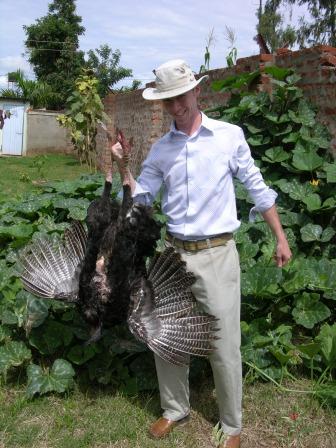
For our 2nd thanksgiving in Lira we invited 20 of our CPA colleagues and other friends over for a delicious meal. Holly spent the whole day cooking and baking all of our favorite thanksgiving dishes. I got to kill a massive turkey named Dr. Fred. As tradition goes, we all shared the things we were thankful for. I am always amazed at the strength and resilience of people who have seen 20 years of war. It was a great evening-some ate grapes for the first time in their lives, others cracked jokes, and an American visitor said that this was the most memorable thanksgiving he has ever had.

Yesterday, War Child (an INGO working with children through games and play-therapy) hosted a volleyball tournament for NGO teams in Lira. The all-day event was a huge success and almost all of us released pent-up stress. On the way to a game I passed by a tree where the surrounding soil had recently been dug up. I looked down and saw two empty AK 47 magazines. I picked one up to see if my eyes were fooling me. A friend on the team quickly advised me to drop it or I was going to be harassed…I followed his suggestion. Even though volleyballs were flying, music was playing, and people were eating BBQ, these empty magazines were a stark reminder that I was still in a war zone.

Today, Holly and I went looking for a Christmas tree. It is not exactly the way we do it in the States. We rode our bikes to a small tree nursery. They only had Christmas twigs (one foot tall seedlings). We told them that we were looking for a small Christmas tree for the holidays. They talked amongst themselves and one person said, “Let me ride my bicycle to the village and dig up a tree for you from our compound there.” The ride iss ten Kilometers and he said that the tree was simply a gift from him. Naturally, we will give him something for the tree, but the offer left Holly and I feeling blessed by his generosity.

Studies in Italy


Dear friends, I hope that you have all been well sustained since we last spoke. I just returned from Italy and wanted to share a few words with you about my time there. Going from Lira to Orvieto, Italy was a shocking experience. Our course in Italy was held in the mayor’s villa, we sat under beautiful frescos and listened to lectures given by leaders in the field of trauma mental health. Students included anthropologists, lawyers, psychologists, psychiatrists, and others.

We stayed in a monastery opposite the Duomo cathedral built in 1260 to host a piece of altar cloth said to have Jesus’ blood on it. Every year, citizens march the piece of cloth around the small town. Orvieto is known for its olive oil and wine.

The most meaningful aspect of the training has been the relationships we all developed while in Italy. The course will continue for another 6 months as we review the lectures, ask questions, and work through clinical and policy case studies on-line in small groups.

Saturday, November 04, 2006

How to Bend a Speer


I’ve found it surprisingly challenging to reconcile hope with critical thinking about current events. I told Ben earlier in the week (on our date night, which we do every week and it’s so great!) that I was having this struggle and as we talked about the dynamic of hope the thought occurred to us that perhaps it was so hard to reconcile the desire not to blindly wait for something that was not going to happen and not giving up on it because we had a wrong view of hope. Maybe hope isn’t convincing yourself to think that something good is actually the most probable outcome, but believing that it should happen and that the good thing you hope for is closer to what God intended—closer to original design. With this little shift in my thinking it’s been easier to reconcile my mind and heart while I achingly long for peace in Uganda and reason through the complexity of the ongoing peace process. People want it so much, I want it so much. The emotional investment in this process is deep. You can see it on people’s faces. After 20 years, God, let this be the end—if not now when? When you talk to most people and ask them about what they think about the process the answers are on the tip of every tongue “I just want to go home,” or “I just want my sister to come back from the bush, that’s all I want.” I’m often humbled and baffled by the unflinching hope that many in the north express—but I do wonder, everyone has their breaking point, if this process fails will they reach it?

I spent most of this week with a delegation from MCCs advocacy offices from DC, Ottawa, and the UN office in New York as well as from the Africa and Peace departments in Akron. It was refreshing to be with them, to experience Uganda with them, and to discuss how we can better support the peace process through advocacy. We had a series of meetings with people from the groups of cultural and religious leaders who have been supporting/observing, military, NGO community, people in IDP camps, people on the monitoring team for the cessation of hostilities agreement, observers of the process from Juba, and others. The views they had, the messages they wanted to send were diverse, and rather than give my own ideas I thought I’d capture a few from what I heard: (paraphrased)

Why is the international community silent? The West is too silent, not showing oneness with Africa. If this conflict was happening somewhere else there would have been more support from the US. (Religious leader)

The incidences of violence around Juba reported in the media are not UPDF and LRA. Most incidences that have taken place have been the result of misinformation. (Monitoring team member)

I think that the government is trying to save face and that the LRA are rebuilding. There is a lack of commitment to relieve the suffering of Acholi people on both sides. They need to build confidence: don’t discuss wounds, don’t praise yourself, the negotiation should include the suffering people because they are motivated to work for peace. Maybe the negotiating teams should visit a camp so that they can get motivated (community leader)

Are you really sure that peace and justice are friends? Who is the parent in this conflict? Parents take all the costs of their children’s misbehavior. Convince the ICC to bend the rules. (Community leader)

What’s needed for peace is restorative justice. This is not a tribal war but crimes against humanity by terrorists. The military method hasn’t succeeded for 20 years. This might work. It is the most hope we’ve had. In the past the LRA wouldn’t eat food provided by the government of Uganda. But now they are accepting food, so there is some trust. (Formerly abducted person)

We want a statement from the Secretary General of the United Nations not only Jan Egeland. Now the Secretary General is leaving, I hope the next one will at least say something. (Religious leader)

Why is Kony so difficult to capture? We have a saying in Acholi, a coward lives longer. But the fighters are there in the bush, for them this is about reorganization. The LRA negotiating team are people who have a power hangover and they are not fighters. They are waiting for it to fail and getting attention and money. If you think I’m lying time will tell. (Military)

Why is Kony so difficult to capture? Because he is surrounded by children. Children are his water. (Community leader)

When I met with Kony, he had 3 messages: 1. He is for peace. 2. Watch and witness who will spoil the process. 3. The suffering should stop and the war should end. He is willing to do Mato Oput (reconciliation ceremony, that means drinking bitter herb) with the community but is not sure how it could be done with the government, since the government is not a tribe. (religious leader)

What specific confidence building measures are needed? UN supportive statements and a visit from the Secretary General to Northern Uganda. The African Union to respond to the call to be on the monitoring team. “Tell off” the government of Uganda to withdraw all troops in Sudan. Media should send positive supportive messages. It should not be a hurried process—there is no hurry in Africa—we need community views and this takes time. LRA needs to listen to the community. Focus on the victims and the costs of more war. (group of cultural and religious leaders)


These all are not exact quotes, but they are the things I remember and scribbled down in my notebook while I listened to people. Someone said, knowledge speaks, and wisdom listens. Trying to be wise, I’m listening--to those who may have accurate information or may be confused and misinformed but who all have a reason behind their words. I have many questions, but one is at the forefront of my mind. In any negotiation, a party’s position is strengthened when their alternative to a negotiated agreement is good. Unfortunately, all the parties have pretty decent alternatives, which may be why we've seen so many walk-outs. As I see it, the degree to which those alternatives are weakened motivation to settle without violence will be strengthened. How do the Juba peace talks become the most attractive option, and how can the alternatives to a negotiated agreement be minimized?

Monday, October 09, 2006

Pray & Fast for Hope


"Hope for the freedom of the children of God." That is the theme of the Commemoration Prayers tomorrow. It has been 10 years since the LRA abducted 139 girls from St. Mary Aboke Boarding School and the bereaved parents came together to form CPA. Every year on October 10th people return to the school to pray and fast for peace, for healing for this land and people, and for the return of the children who are still in captivity. We will be in Aboke tomorrow and invite you to join us in the prayer and fasting in the hope that freedom can come.

Tuesday, October 03, 2006

"Senseless" Continued: by Ben

I was perusing through our blog when Holly's entry of "Senseless" caught my eye. It was a story of an unfortunate event ending in the mob killing of a brother to our friend. It caught my eye today because I was in a village listening to people give stories of difficult life events and how they persevered through them. An old woman said, "My daughter was hit by a car and killed. When I heard the news I ran to the roadside and found a large mob beating the driver who hit my daughter to death. I broke through the mob and stood in protection of him saying, 'don't kill this man over what he has done to my daughter.' The mob released him. Later, when my clan members demanded that some kind of payment be made, I said, 'let him go, I have forgiven him.' My clan said that if the very mother of this girl can forgive, then we should also try to forgive."

I road a motorcycle down a long, winding, red dust road to find the parent support group meeting today. I sat with my heart in my throat as they "testified" one after the other, as to painful life experiences they have endured and the miraculous ways they have shown resilience.

I'm writing this blog for the sake of the great hope that exists here. Too often we see the looming evil, and remember it, instead of recognizing and remembering the ubiquitous goodness and strength in humankind.