by Holly
I've been wanting to post something for quite awhile on Uganda's Anti-Homosexuality Bill that includes the death penalty for "aggravated homosexuality" that is being considered in Parliament. There is just so much to say, it's hard to know where to start. So I've included most of a slightly altered comment I made on another blog for your benefit/to get myself started: (you can find the blog post and my original comment here)
This bill is a crying shame. It’s a crying shame that Musevini and others would only consider opposing it because of money—not because it’s obvious that if enacted it would be an unjust law. I’ve been totally appalled by how the religious leaders in particular have supported it and the extreme threat that they seem to think homosexuality poses to health and family life (not to mention that in a lot of the rhetoric the words homosexuality and pedophilia are used interchangeabley..um, what?). If the Ugandan Christian clergy really wants to fight for an issue of sexual morality that is threatening their communities, spreading HIV and breaking up families it should be to promote faithfulness in marriage through their lives and pastoral work rather than throwing their weight behind this insidious and hateful legislation against homosexuality.
I'm deeply concerned about the legal impact, but perhaps even more so about the social implications. Citizens taking justice into their own hands is not only common but encouraged by police and many will inevitably interpret this bill as the state condoning violence against homosexuals (even without it we’ve heard cases of sexual violence against homosexuals to "turn them straight").
I don’t even know how to begin engaging this issue with friends and colleagues here (although I regularly try--and would love some new ideas if anyone's got them)—and have a hard time getting my mind around how people who are otherwise compassionate human beings can think that it’s okay to imprison if not kill homosexuals. (It's already illegal to be gay in Uganda, and you can get up to 7 years in prison for it--really, do we need a harsher law?) I know maybe I shouldn’t be surprised by this stuff anymore, but even Ugandan friends who are involved in human rights advocacy and that I’d consider relatively progressive will dismiss the issue as “cultural” and are at best ambivalent if not supportive of the bill. It seems that in Uganda, like the Minister of Ethics and Integrity (the irony of his title kind of makes my stomach churn) said, “gays can forget about human rights.” Seriously, I lose sleep having imaginary arguments with people about this. It’s a crying crying shame.
I should note, that since i wrote about my dismay of the Christian clergy's support of the bill, I was encouraged that at least the Catholic Archbishop has described the bill as "Un-Christian." It seems like somewhat of an understatement, but it's something.
Get off our backs, donors told was published in the Monitor the same day I had an intriguing discussion with a friend. Here is the most amazing quote in the article from Steven Mukitale, the chair of Parliament's Committee on National Economy:
"We can cover the aid money they (the US) want to stop through disciplined spending and curbing corruption."
Wow. It's not every day you hear a government official boast that all the money the US gives is lining officials pockets and undermining accountable and responsible government spending. I wonder what USAID in Kampala thinks about this...
I was discussing this article with a Ugandan friend with a refreshingly different if somewhat conspiracy-theory-esque take on it all. He's one of the first Ugandan guys I've talked to that opposes the bill, although, he really doesn't take it all that seriously. Instead, he thinks it is political posturing. He had three arguments, two that I found somewhat compelling. First, the bill has hugely distracted from the massive swindling of CHOGM (Commonwealth Heads of Government Meeting) funds. The evidence of corruption was climbing up the President's cabinet. After it reached the VP hints of the big man's implication were made and then this bill was introduced and little attention has been given to it since. Second, Musevini is quite aware that he has in recent years fallen from favor in the eyes of many western leaders. As my friend says, "he's not the blue-eyed boy they once thought him to be." His plan, my friend believes, is to rush in at the last hour to kill the bill and save the homosexuals, scoring points with the west. I pointed out that this seemed an odd time to be so concerned in appeasing the international community when the constituency that has to re-elect him is warming up for the poles and seems to support the bill. "He's not worried about that. He knows he'll go through--so he only cares about restoring his image in the international community." The third, I didn't really follow the logic--somehow human rights NGOs were part of a conspiracy to attract funding for promoting human rights of homosexuals but all the money that would pour in would somehow be diverted for political campaigns. I'm not sure about all that, but I do find the idea that there's no reason to fear this bill will ever be enacted rather comforting. Sadly, I think there is still good reason to be concerned. Parliament has planned public dialogues and gathering views from the 'grassroots' that risk giving an air of legitimacy to what can only be an unjust law if enacted.
If you're interested, the Civil Society Coalition on Human Rights and Constitutional Law, that formed in response to this Bill, has compiled articles, opinions, press statements and other information on the Bill that is available to download.
Monday, January 25, 2010


Friday, January 15, 2010
Who says truth is stranger than witty satire?
Oh yes, that was me (Holly)—inspired by the headlines “Christmas Bull Kills Butcher” and “Buried Girl Survives Death” which appeared in the Monitor recently.
But the Onion has given the Monitor’s “Truth Every Day” a run for their money with this one.
Congo Approves Economic Stimulus Package Of AK-47 For Every Citizen
But the Onion has given the Monitor’s “Truth Every Day” a run for their money with this one.
Congo Approves Economic Stimulus Package Of AK-47 For Every Citizen
Tuesday, January 12, 2010
Do no harm--but how much do we need to know before we act?
by Holly
This blog is prompted out of a cumulative effect of reading better educated, better informed, more clever people bash the (often misguided) efforts of well intentioned but less educated, less informed, less clever people to change their world for good.
We all know where the road of good intentions leads...(historical examples abound--Biafra, BandAid, I could go on, but you get the idea)
But really, should only clever very well informed people ever take action? I mean, how much do we need to know before it's a good idea for us to do anything? Nobody with good intentions (those who are being critisized) wants to act in ways that ultimately screw things up (undermine self-reliance, create dependence, bolster power of political miscreants, corrode political accountability and good governance, feed racism and negative stereotypes, encourage false perceptions about realities on the ground to extort money and support--I could continue, but you get the idea).
Many of the critiques I find not only valid, but self-satisfying. I find myself marveling at how ignorant some interventions are--like many western run 'orphanages'--or how insensitive the use of particular language is--e.g. when I read someone's website recently talking about how they provide a "voice for the voiceless" "Who told you?" I asked the author in my mind, "that they are voiceless? They have voices and things to say if you were listening but even your tag-line smacks of a power dynamic you should resist and an unconsciousness to your own assumption of superiority." But then I read another couple of blogs that are proverbially critical of organizations like Invisible Children and Falling Whistles. I confess that I find myself equally put off by some of the self assured pomp and judgementalism (especially in the comments) as I am rather pleased with myself for arriving at many of the same critiques as the authors. Yes, I congratulate myself, (I guiltily admit this thought enters my mind), I'm more informed and more clever. Or am I? It's all so relative--and when I make mistakes and there are unintended consequeces to my interactions and writing about northern uganda someone more informed and cleverer than I will rightly point them out, critique my work and show how I could have avoided my pitfalls if only I had known more and been cleverer.
We're all in process and surely being paralyzed by a recognition of our limited understanding isn't the right way of living? We know that ignorance is no defence--but truly--we're all ignorant. I've always been of the mind that we have a responsibility to act on what we know and know as much as possible. But perhaps we equally have a responsibility to not act on what we don't know?
This blog is prompted out of a cumulative effect of reading better educated, better informed, more clever people bash the (often misguided) efforts of well intentioned but less educated, less informed, less clever people to change their world for good.
We all know where the road of good intentions leads...(historical examples abound--Biafra, BandAid, I could go on, but you get the idea)
But really, should only clever very well informed people ever take action? I mean, how much do we need to know before it's a good idea for us to do anything? Nobody with good intentions (those who are being critisized) wants to act in ways that ultimately screw things up (undermine self-reliance, create dependence, bolster power of political miscreants, corrode political accountability and good governance, feed racism and negative stereotypes, encourage false perceptions about realities on the ground to extort money and support--I could continue, but you get the idea).
Many of the critiques I find not only valid, but self-satisfying. I find myself marveling at how ignorant some interventions are--like many western run 'orphanages'--or how insensitive the use of particular language is--e.g. when I read someone's website recently talking about how they provide a "voice for the voiceless" "Who told you?" I asked the author in my mind, "that they are voiceless? They have voices and things to say if you were listening but even your tag-line smacks of a power dynamic you should resist and an unconsciousness to your own assumption of superiority." But then I read another couple of blogs that are proverbially critical of organizations like Invisible Children and Falling Whistles. I confess that I find myself equally put off by some of the self assured pomp and judgementalism (especially in the comments) as I am rather pleased with myself for arriving at many of the same critiques as the authors. Yes, I congratulate myself, (I guiltily admit this thought enters my mind), I'm more informed and more clever. Or am I? It's all so relative--and when I make mistakes and there are unintended consequeces to my interactions and writing about northern uganda someone more informed and cleverer than I will rightly point them out, critique my work and show how I could have avoided my pitfalls if only I had known more and been cleverer.
We're all in process and surely being paralyzed by a recognition of our limited understanding isn't the right way of living? We know that ignorance is no defence--but truly--we're all ignorant. I've always been of the mind that we have a responsibility to act on what we know and know as much as possible. But perhaps we equally have a responsibility to not act on what we don't know?
Saturday, January 09, 2010
Whatever Comes Next
by Holly
I was reflecting on why I have been so remiss about writing my thoughts and sharing them here.
I must admit, a small part of my aversion to our blog in the last months is that it made me sad whenever I opened it and saw Godfrey's smiling face and yet he is missing from this wonderful world that we've come back to and the friends we've been reconnecting with since we got back to Uganda at the end of September. On some level, I still expect to see him. It feels like he could just show up, or walk around a corner, or call. When I put my old Ugandan sim card back in the phone, it was painful to delete his number, especially when I clicked on "options" with a menu that suggested I might also "call" him or "send a message." Another good friend recently fell quite sick. At least this time I could take her to the hospital, check on the care she was getting and be present with her while we hoped for recovery (she's doing much better now). I can't deny, I was afraid of losing another friend. The average life expectancy in Uganda is 51 (UNICEF 2008). Of course, none of these things can be taken for granted, but it struck me that based on our nations statistics and health care I am likely to continue living while many of my friends go through the end of life. In a kind of typical life progression and western psychological expectation of the kinds of things that different age categories deal with, this seems like something that would have come later in life--my parent's generation is only just beginning to have life expectancy ages in their peer group. But lately, it seems like our peers are inviting us either to weddings, kids baptisms or burials--and these are all ceremonies happening in the same phase of life--ours. It makes me think about death more, being nearer it than I (at least felt) in the US or UK. (this preoccupation might also be encouraged by the absolutely terrifying driving conditions we sometimes encounter on Ugandan roads)
Yesterday we had a wonderful day of celebrating Ben's birthday. In the evening we sat with good friends under a canopy of stars around a fire pit near a palm tree in our garden after a delicious meal. I was quietly thinking of conversations with Ugandan friends recently that have reflected their surprise and delight at having reached another birthday and another new year. Maybe that's why my increasing cognizance of the unavoidable reality of death doesn't seem at all depressing but is producing a really lovely kind of gratitude for life. Somehow our conversation turned to some eschatological issues, life after death, what happens, what we imagine, and some theological questions that I've been rather intentionally lazy about trying to answer for myself. It's mostly because I don't think I'll be able to figure it out (if I thought I had figured it out, I would assume I was probably wrong) and because I just trust that's it's all going to be good--even better than anything I might try to imagine. For human beings to attempt to grasp it seems like a fetus trying to understand the world outside a mother's womb. After a short silence with only the sound of our crackling fire and the wind in the trees, one of our friends said, "It's nights like tonight that make you wish you could forget that there's suffering in the world." "hmm," I realized outloud, "I appreciate nights like tonight because there is suffering in the world." Someone asked why and the same friend that posed the question said, "because of the contrast." Yes. That's what makes it sweet and that's what makes whatever comes next sweet. Death has lost it's sting because of the contrast.
I was reflecting on why I have been so remiss about writing my thoughts and sharing them here.
I must admit, a small part of my aversion to our blog in the last months is that it made me sad whenever I opened it and saw Godfrey's smiling face and yet he is missing from this wonderful world that we've come back to and the friends we've been reconnecting with since we got back to Uganda at the end of September. On some level, I still expect to see him. It feels like he could just show up, or walk around a corner, or call. When I put my old Ugandan sim card back in the phone, it was painful to delete his number, especially when I clicked on "options" with a menu that suggested I might also "call" him or "send a message." Another good friend recently fell quite sick. At least this time I could take her to the hospital, check on the care she was getting and be present with her while we hoped for recovery (she's doing much better now). I can't deny, I was afraid of losing another friend. The average life expectancy in Uganda is 51 (UNICEF 2008). Of course, none of these things can be taken for granted, but it struck me that based on our nations statistics and health care I am likely to continue living while many of my friends go through the end of life. In a kind of typical life progression and western psychological expectation of the kinds of things that different age categories deal with, this seems like something that would have come later in life--my parent's generation is only just beginning to have life expectancy ages in their peer group. But lately, it seems like our peers are inviting us either to weddings, kids baptisms or burials--and these are all ceremonies happening in the same phase of life--ours. It makes me think about death more, being nearer it than I (at least felt) in the US or UK. (this preoccupation might also be encouraged by the absolutely terrifying driving conditions we sometimes encounter on Ugandan roads)
Yesterday we had a wonderful day of celebrating Ben's birthday. In the evening we sat with good friends under a canopy of stars around a fire pit near a palm tree in our garden after a delicious meal. I was quietly thinking of conversations with Ugandan friends recently that have reflected their surprise and delight at having reached another birthday and another new year. Maybe that's why my increasing cognizance of the unavoidable reality of death doesn't seem at all depressing but is producing a really lovely kind of gratitude for life. Somehow our conversation turned to some eschatological issues, life after death, what happens, what we imagine, and some theological questions that I've been rather intentionally lazy about trying to answer for myself. It's mostly because I don't think I'll be able to figure it out (if I thought I had figured it out, I would assume I was probably wrong) and because I just trust that's it's all going to be good--even better than anything I might try to imagine. For human beings to attempt to grasp it seems like a fetus trying to understand the world outside a mother's womb. After a short silence with only the sound of our crackling fire and the wind in the trees, one of our friends said, "It's nights like tonight that make you wish you could forget that there's suffering in the world." "hmm," I realized outloud, "I appreciate nights like tonight because there is suffering in the world." Someone asked why and the same friend that posed the question said, "because of the contrast." Yes. That's what makes it sweet and that's what makes whatever comes next sweet. Death has lost it's sting because of the contrast.
Sunday, December 27, 2009
24 Years Coming
by Holly (I know, it seems so long, you thought the title of this blog referred to our blogging absence--but no, it's about this christmas)
Christmas in Mzee Oling's home, with six daughters, one son, an aunty, two cousins, and some of the most adorable grandkids imaginable. This is where I spend most days learning Acholi and doing "participant observation" for my research. Today is different. It's christmas. The 4 huts that make up this home are teeming with smiling friends, chickens oblivous to their destiny, and kids laughing chasing Ogiko (our dog) who we brought with us. The neighbors father works in the local radio station so he's brought home a huge sound system that is competing with Mzee's small hand held radio to play alternating traditional Acholi and western christmas songs. I found the ladies all in the kitchen, sweating seriously over charcoal stoves and laughing. They got up at 5 am to start cooking and they are still laughing. We laugh for happiness, not an identifiable joke or funny incident. "We laugh to show the whiteness of our teeth," goes one of my favorite Acholi proverbs. Lamaro, my favorite little girl is still getting used to Ben. His white skin and blue eyes are rather terrifying. She's running from the kitchen hut to the bedroom hut to avoid being seen by him (or eaten by him?) She also behaved like this with me for the first few weeks. Now, I've been told she told her father (who comes to visit occasionally) that she has two mommy's, one black and one white. I'm thrilled the affection is mutual--even if she did have to overcome the obstacle of my strange skin.
Ben and Mzee are sitting under the tree discussing Mzee's christmas memories. He recounted christmas parties from when he was in his 20s and worked with Uganda Wildlife Authority and with a big luxury hotel company. His favorite christmas was the first christmas that they spent with the whole family here. They moved here in 1995, the war had begun but it had not yet directly touched the family. They came for access to better schools for his girls--and all the kids were home that christmas of '95. That was the year before he lost his leg in a tank mine explosion while he was collecting wood for charcoal. It was a year before a massacre in their home village, Attiak where they lost many relatives. Even his eldest daughter, escaped narrowly. She had been visiting an aunty in Attiak when the rebels began the massacre. She fell into a pit latrine where she hid until the bloodshed stopped and the rebels left all for dead. "This war spoiled everything," he says, "this is the first year since 1995 when we've felt safe and free to celebrate. It has been 24 years we've waited for this celebration." I can't help but pause prayerfully to remember the Congolese who feel anything but safe. The LRA has reportedly written several letters threatening a repeat of last years "Christmas Massacres." Several rebels who have escaped admitted they had joked about "celebrating christmas" like last year. Fortunately, no reported violence means they decided to celebrate some other way--but no doubt, our friends across the border will have to wait longer to experience the safety and freedom from violence that Uganda is now enjoying.
They really are enjoying it. The girls are dressing up, and combing out their hair. I came with nail polish a few days ago and painted over 20 pairs of hands or toes I'm sure.
The food is an amazing spread and they generously share with us as well as the random uninvited guests that are always welcome: a drunk neighbor who is a widow, a young woman who is only halfway in control of her mind that is happily singing and eating their food, and anyone else who seems to have an empty belly. We brought simple gifts: candy for the kids, a couple of t-shirts for the young men and some jewelry for the ladies, a book written by an Acholi preist on being a traditional Acholi and a Christian for Mzee. As they open each gift, Josephine ululates over the laughter of the rest of us who are clapping and happily watching what the next person is given. I felt some of the gifts weren't nice enough, for this incredible family that has helped me so much. I was worried about the reception--but I could not have imagined anything better! They all claimed that each gift was perfect for the receiver, and none envied other gifts. Personally, I am very grateful for the odii (ground sesame and peanut paste) that they lovingly gave us.

What is it that enables such easy laughter? such wholehearted gratitude? It might be a lack of expectation. If so, I(cynically/sadly?)thought to myself while sitting there, this is the first and the last christmas we will experience like this. Next year there will be an expectation. I have chatted with a few friends and family members from home and contrasted the blessed simplicity of christmas in Uganda with the materialistic madness and pressure to buy right, dress right, cook right, etc. of christmas at home. Every year must at least maintain, if not add on to the precedent of previous years. And yet, here, for the first time in decades people are enjoying the relative calm and prosperity so that they are finally able to celebrate materially--with small things like christmas dresses or even little artifical christmas trees--and it is a beautiful thing to see! Is that terrible? The materialism we turn our noses up to at home we welcome here as a sign of the absence of war.
Isn't there a way to maintain expectant wonder for this great celebration and accept every moment of it in whole hearted gratitude without holding it up for comparison to our unconscious (or conscious) standard of "shoulds"?
My friends in Wii Aworanga did it this year. Maybe it's the lack of expectation. Maybe it's the eruption of joy that has been waiting 24 years for peace to allow it's full expression. Whatever it is, I pray it is sustained--and that perhaps, it is contagious.
(Happy 100th blog to us! This is our 100th post. We intend to try to write more regularly in the coming year--yes, it's a proper new year's resolution. Regarding the new blog look and background--the quote on the top of the page must be accredited to Annie Dillard. And I have a confession. The woman in the banner photo is not from northern Uganda. She's actually Sudanese, and I took this photo while doing a consultancy in Yei (the blog I wrote about that time was "What Grows in This Soil". Her face is just so amazing--and I loved it here. I know, I really should replace it with one of the amazing Ugandan faces that I interact with and that grace my iPhoto library, and someday I will--but for now, I share her beautiful face with you and disclose her nationality.)
Christmas in Mzee Oling's home, with six daughters, one son, an aunty, two cousins, and some of the most adorable grandkids imaginable. This is where I spend most days learning Acholi and doing "participant observation" for my research. Today is different. It's christmas. The 4 huts that make up this home are teeming with smiling friends, chickens oblivous to their destiny, and kids laughing chasing Ogiko (our dog) who we brought with us. The neighbors father works in the local radio station so he's brought home a huge sound system that is competing with Mzee's small hand held radio to play alternating traditional Acholi and western christmas songs. I found the ladies all in the kitchen, sweating seriously over charcoal stoves and laughing. They got up at 5 am to start cooking and they are still laughing. We laugh for happiness, not an identifiable joke or funny incident. "We laugh to show the whiteness of our teeth," goes one of my favorite Acholi proverbs. Lamaro, my favorite little girl is still getting used to Ben. His white skin and blue eyes are rather terrifying. She's running from the kitchen hut to the bedroom hut to avoid being seen by him (or eaten by him?) She also behaved like this with me for the first few weeks. Now, I've been told she told her father (who comes to visit occasionally) that she has two mommy's, one black and one white. I'm thrilled the affection is mutual--even if she did have to overcome the obstacle of my strange skin.

Ben and Mzee are sitting under the tree discussing Mzee's christmas memories. He recounted christmas parties from when he was in his 20s and worked with Uganda Wildlife Authority and with a big luxury hotel company. His favorite christmas was the first christmas that they spent with the whole family here. They moved here in 1995, the war had begun but it had not yet directly touched the family. They came for access to better schools for his girls--and all the kids were home that christmas of '95. That was the year before he lost his leg in a tank mine explosion while he was collecting wood for charcoal. It was a year before a massacre in their home village, Attiak where they lost many relatives. Even his eldest daughter, escaped narrowly. She had been visiting an aunty in Attiak when the rebels began the massacre. She fell into a pit latrine where she hid until the bloodshed stopped and the rebels left all for dead. "This war spoiled everything," he says, "this is the first year since 1995 when we've felt safe and free to celebrate. It has been 24 years we've waited for this celebration." I can't help but pause prayerfully to remember the Congolese who feel anything but safe. The LRA has reportedly written several letters threatening a repeat of last years "Christmas Massacres." Several rebels who have escaped admitted they had joked about "celebrating christmas" like last year. Fortunately, no reported violence means they decided to celebrate some other way--but no doubt, our friends across the border will have to wait longer to experience the safety and freedom from violence that Uganda is now enjoying.
They really are enjoying it. The girls are dressing up, and combing out their hair. I came with nail polish a few days ago and painted over 20 pairs of hands or toes I'm sure.

The food is an amazing spread and they generously share with us as well as the random uninvited guests that are always welcome: a drunk neighbor who is a widow, a young woman who is only halfway in control of her mind that is happily singing and eating their food, and anyone else who seems to have an empty belly. We brought simple gifts: candy for the kids, a couple of t-shirts for the young men and some jewelry for the ladies, a book written by an Acholi preist on being a traditional Acholi and a Christian for Mzee. As they open each gift, Josephine ululates over the laughter of the rest of us who are clapping and happily watching what the next person is given. I felt some of the gifts weren't nice enough, for this incredible family that has helped me so much. I was worried about the reception--but I could not have imagined anything better! They all claimed that each gift was perfect for the receiver, and none envied other gifts. Personally, I am very grateful for the odii (ground sesame and peanut paste) that they lovingly gave us.

What is it that enables such easy laughter? such wholehearted gratitude? It might be a lack of expectation. If so, I(cynically/sadly?)thought to myself while sitting there, this is the first and the last christmas we will experience like this. Next year there will be an expectation. I have chatted with a few friends and family members from home and contrasted the blessed simplicity of christmas in Uganda with the materialistic madness and pressure to buy right, dress right, cook right, etc. of christmas at home. Every year must at least maintain, if not add on to the precedent of previous years. And yet, here, for the first time in decades people are enjoying the relative calm and prosperity so that they are finally able to celebrate materially--with small things like christmas dresses or even little artifical christmas trees--and it is a beautiful thing to see! Is that terrible? The materialism we turn our noses up to at home we welcome here as a sign of the absence of war.
Isn't there a way to maintain expectant wonder for this great celebration and accept every moment of it in whole hearted gratitude without holding it up for comparison to our unconscious (or conscious) standard of "shoulds"?
My friends in Wii Aworanga did it this year. Maybe it's the lack of expectation. Maybe it's the eruption of joy that has been waiting 24 years for peace to allow it's full expression. Whatever it is, I pray it is sustained--and that perhaps, it is contagious.
(Happy 100th blog to us! This is our 100th post. We intend to try to write more regularly in the coming year--yes, it's a proper new year's resolution. Regarding the new blog look and background--the quote on the top of the page must be accredited to Annie Dillard. And I have a confession. The woman in the banner photo is not from northern Uganda. She's actually Sudanese, and I took this photo while doing a consultancy in Yei (the blog I wrote about that time was "What Grows in This Soil". Her face is just so amazing--and I loved it here. I know, I really should replace it with one of the amazing Ugandan faces that I interact with and that grace my iPhoto library, and someday I will--but for now, I share her beautiful face with you and disclose her nationality.)
Saturday, December 26, 2009
Christmas Ugandan Style
MERRY CHRISTMAS FRIENDS!
by Ben
Sorry it has been so long since we have posted, but we would like to do better in the coming year. Finally feeling settled, I have the mental space to reflect on this journey and share budding ideas, joys and sorrows with anyone who is interested. To start off lightly, this post is dedicated to our Christmas day.
Here are a few heart-warming text messages that we got from friends on Christmas. A prize goes to the first person to fully understand them
-When u trace down da maiden origin of mankind, it leaves u with huge imagination only 2 be revitalized by da glorious news of Savior’s birth.
-We wud like you to be safe always, so please do not tamper with meter boxes, main switches or any part of the internal wiring in your house. Stay safe. Merry Christmas. (From the national power supplier)
-When my arms can’t reach da ones I love, I hug them with my prayer and surrender them 4 God’s care and loving arms! Wish you a Merry Christmas and hapi 2010
-If you could feel my heart’s wish u wud b as delightful as I am, u wud jump up n dance 4 me as I sing 4 u Christmas hymns! B blessed as 4 celebrate this day.
-I’m sure you did a great spiritual shopping. Please receive the peace, joy, and love as bonus on your spiritual shopping.
-I hav deposited in your account 365 days of luv, wisdom, care, and unity in the bank 2010. Pliz spend them wisely. Happy celebrations
-This season’s a great time “2 pray” “2 love” “2 care” “2 smile” “2 celebrate” and above all “2 thank God”
-Ho! Ho! Merry Christmas. May your Christmas stocking be filled with loads of peace, love and joy. Drink, eat and make merry.
-God knew that our problem wasn’t hunger or thirst but salvation. So He did not send us food or water, but a Savior who was born 4 us.
-Hearts receive love, minds receive wsdm, hands receive gifts en only special pple receive warm wishes. Merry Christmas en let God god in 2010
-May da birth of Christ be a blessing 2 U n UR loved ones! Merry Christmas and a juicy nu ya.
I, for one, do intend on having a very juicy new year.
Here are a few pictures of our Christmas: Home, then village:

Our home in Kirombe, Gulu

I made Holly hunt for her presents. One of them took her up our water tower.

Eggs Benedict mmmmm. And it only took about three hours to make the English Muffins (or for our English readers...muffins)

Christmas dinner and Quote of the day. "That is one impressive cock"

Steven, Mzee, me, Galdin, and Innocent

The girls

Ulilating for presents. "Agili" in Luo

Holly, Koncy and Beatrice
We have had a wonderful holiday season and miss you all dearly. Wishing you the juiciest New Years ever.
by Ben
Sorry it has been so long since we have posted, but we would like to do better in the coming year. Finally feeling settled, I have the mental space to reflect on this journey and share budding ideas, joys and sorrows with anyone who is interested. To start off lightly, this post is dedicated to our Christmas day.
Here are a few heart-warming text messages that we got from friends on Christmas. A prize goes to the first person to fully understand them
-When u trace down da maiden origin of mankind, it leaves u with huge imagination only 2 be revitalized by da glorious news of Savior’s birth.
-We wud like you to be safe always, so please do not tamper with meter boxes, main switches or any part of the internal wiring in your house. Stay safe. Merry Christmas. (From the national power supplier)
-When my arms can’t reach da ones I love, I hug them with my prayer and surrender them 4 God’s care and loving arms! Wish you a Merry Christmas and hapi 2010
-If you could feel my heart’s wish u wud b as delightful as I am, u wud jump up n dance 4 me as I sing 4 u Christmas hymns! B blessed as 4 celebrate this day.
-I’m sure you did a great spiritual shopping. Please receive the peace, joy, and love as bonus on your spiritual shopping.
-I hav deposited in your account 365 days of luv, wisdom, care, and unity in the bank 2010. Pliz spend them wisely. Happy celebrations
-This season’s a great time “2 pray” “2 love” “2 care” “2 smile” “2 celebrate” and above all “2 thank God”
-Ho! Ho! Merry Christmas. May your Christmas stocking be filled with loads of peace, love and joy. Drink, eat and make merry.
-God knew that our problem wasn’t hunger or thirst but salvation. So He did not send us food or water, but a Savior who was born 4 us.
-Hearts receive love, minds receive wsdm, hands receive gifts en only special pple receive warm wishes. Merry Christmas en let God god in 2010
-May da birth of Christ be a blessing 2 U n UR loved ones! Merry Christmas and a juicy nu ya.
I, for one, do intend on having a very juicy new year.
Here are a few pictures of our Christmas: Home, then village:

Our home in Kirombe, Gulu

I made Holly hunt for her presents. One of them took her up our water tower.

Eggs Benedict mmmmm. And it only took about three hours to make the English Muffins (or for our English readers...muffins)

Christmas dinner and Quote of the day. "That is one impressive cock"

Steven, Mzee, me, Galdin, and Innocent

The girls

Ulilating for presents. "Agili" in Luo

Holly, Koncy and Beatrice
We have had a wonderful holiday season and miss you all dearly. Wishing you the juiciest New Years ever.
Friday, June 12, 2009
We Have Lost Godfrey

(an excerpt from my journal the day Godfrey died.)
We have lost Godfrey. I don’t know what to say or write but somehow I hope that if the words come out they will replace the tears. We had heard that Godfrey was in the hospital and then the news came that he passed away on Friday morning at 2am. That was midnight for us--I was awake then, lying in bed and praying for his recovery, sure that he would be okay, that Dan and Rachel would not grow up without their father, that we would not lose our friend, that we would see his amazing smile and clap hands again with him in September. We were looking forward to coming back to Uganda to share sorrows and trials and laughs with him and hear the sound of his unique gravelly voice. Godfrey was a good friend to us. For three years we helped to carry each others burdens, made decisions together, cast vision together, mediated conflicts together. We realized more of our potential because we did everything together. I loved working with him. We were a good team. In all that time he rarely lost his cool in anger and even when he did the only indication was the way he would widen his eyes and flare his nostrils. He didn’t act hastily but thought things through and acted in ways he believed would be in the best interest of others. He was a trustworthy man who kept my confidence and shared his life with us. We loved how proud he was of Rachel and Dan, especially how Rachel danced so well and how Dan is a stubborn ‘pocket’ version of him. It is so painful to accept that he is not with us anymore.

I was in the bus when I go the call. I couldn’t hold back the tears. A woman near me handed me a tissue. This odd community of strangers on their commute to work sat with me while I cried. A woman behind me made a phone call—making plans for Sunday lunch with her mom and it struck me that these were everyday things. People go from home to work and back again. They make weekend plans. And they die.

None of us knows how long we will be here. We could lose anyone, anytime. But I didn’t expect to lose Godfrey so soon. I took for granted that we would have many more everyday moments together: birthday parties, Sunday afternoons with slip and slide, drowning work and life stresses in laughter. Uganda is not the same country without him. The world is poorer for the loss of him.

A few years ago we celebrated his 35th birthday together and one of our elders (Emmanuel) said that he was now welcomed into being a Mzee (elderly man). He only had 2 years of Mzee-hood. He had dreams of starting an NGO to help young people in Apac and of running for parliament. He would have been a great MP. He could have done so much more for his community and his country. He would have been a great friend to have all our lives. He would have been a great old Mzee. He was a good man, a good friend, and I miss him.

Sunday, June 07, 2009
Remembering Godfrey
Dear friends,
Last week we learned of the death of our good friend and colleague, Okello Godfrey. His sudden death was shocking and it has been hard to be so far away. We had a small memorial service for him at our church in London, and wanted to share a few of our thoughts and pictures in remembering Godfrey.
By Ben:
Godfrey was a thoughtful man. Each word he spoke had meaning and direction. Whether he was mediating a dispute between the youth group and a staff member, talking with beneficiaries in an IDP camp or presenting strategic plans to the board of trustees-every word was carefully placed.
Godfrey was a collected man. I never saw Godfrey lose his cool. He faced crisis the same way he faced ordinary life events: calm and collected. I remember driving with him to get his car fixed when he made a joke about having good “shock absorbers” for dealing with the stress that came across his desk, better than the shock absorbers on his car. At times, I wanted him to express his anger or frustration, but he knew that life was too short to be bothered by the small stuff. Godfrey preferred the sounds of boisterous laughing, meaningful dialogue and the hiss and clinking of bottles of Club.
Godfrey was the guy we trusted to keep an eye on our place when we were out of town and the person we could openly ask questions of a sensitive subject, knowing that we would get his most thoughtful response.
Godfrey was a forgiving man. Even when things at work were tense, he would happily invite us for drinks at the end of the day. He was able to compartmentalize his work from his fun and relaxation. I was really looking forward to hanging out with Godfrey without the influence of the organisation in our relationship. Godfrey would brag about Holly and I, telling his buddies that he had the best mzungus, and his friends would often tell him, “Hey, I saw your mzungus in town today…” He stuck his neck out for us, and invited us to integrate into the life and culture of young professionals (through weddings, funerals, birthday parties). We were proud to be his mzungus.
I think Godfrey knew how much I loved him. I think we were both surprised at how close we could become, given the cultural obstacles. He was open to knowing me, and I was open to knowing him. His life has enriched mine in so many ways. He has taught me lessons that I will carry for my lifetime.
Godfrey was one of the good ones. We will miss him dearly.


Last week we learned of the death of our good friend and colleague, Okello Godfrey. His sudden death was shocking and it has been hard to be so far away. We had a small memorial service for him at our church in London, and wanted to share a few of our thoughts and pictures in remembering Godfrey.
By Ben:
Godfrey was a thoughtful man. Each word he spoke had meaning and direction. Whether he was mediating a dispute between the youth group and a staff member, talking with beneficiaries in an IDP camp or presenting strategic plans to the board of trustees-every word was carefully placed.
Godfrey was a collected man. I never saw Godfrey lose his cool. He faced crisis the same way he faced ordinary life events: calm and collected. I remember driving with him to get his car fixed when he made a joke about having good “shock absorbers” for dealing with the stress that came across his desk, better than the shock absorbers on his car. At times, I wanted him to express his anger or frustration, but he knew that life was too short to be bothered by the small stuff. Godfrey preferred the sounds of boisterous laughing, meaningful dialogue and the hiss and clinking of bottles of Club.
Godfrey was the guy we trusted to keep an eye on our place when we were out of town and the person we could openly ask questions of a sensitive subject, knowing that we would get his most thoughtful response.
Godfrey was a forgiving man. Even when things at work were tense, he would happily invite us for drinks at the end of the day. He was able to compartmentalize his work from his fun and relaxation. I was really looking forward to hanging out with Godfrey without the influence of the organisation in our relationship. Godfrey would brag about Holly and I, telling his buddies that he had the best mzungus, and his friends would often tell him, “Hey, I saw your mzungus in town today…” He stuck his neck out for us, and invited us to integrate into the life and culture of young professionals (through weddings, funerals, birthday parties). We were proud to be his mzungus.
I think Godfrey knew how much I loved him. I think we were both surprised at how close we could become, given the cultural obstacles. He was open to knowing me, and I was open to knowing him. His life has enriched mine in so many ways. He has taught me lessons that I will carry for my lifetime.
Godfrey was one of the good ones. We will miss him dearly.


Tuesday, December 09, 2008
Bits and Bobs
by Ben
Please forgive us for our lack of communication over the past couple of months. Not surprisingly, life in London is full of opportunities that send my easily-distracted mind (and person) on continuous and exciting tangents.
Maybe we’re still in the honeymoon phase of re-entry, but our transition into London life has been very pleasant, not least because Holly’s parents and sister are nearby and we have a great place to live and fun flat-mate.
My professor of the refugee studies class I’m taking coined the phrase “nostalgic disorientation” to describe a common experience of refugees in asylum countries. It is the phenomenon of a mixture of emotions like frustration, sadness, angst, confusion,……disorientation, but not really knowing why. He talks about the “mosaic” or “tapestry” that is home, including the tangible and intangible elements that are continually processed intuitively. On a much different level than a refugee, I can relate to this confusing nostalgia. A few days ago, I suddenly became aware of the absence of African music playing behind our house and the murmur of men gathered around the drinking pot. Where is the ubiquitous scent of sunflower oil, the warmth of the red earth, the sound of children laughing and crying, the breeze coming through open windows, or the occasional roar of youth watching a football match down the road? Sometimes, I imagine the buzzing of mosquitoes at my ear and try to make sure the net is in place when I fully wake up and realize where I am.
Thanksgiving really highlighted the difference in our new environment. We always celebrated Thanksgiving in Uganda, but I had to kill the turkey, Holly had to roll the pie crusts on the floor, and 50 people came to eat in the front lawn. It was so nice to be with family this year. We shared our thankfulness with one another, cuddled around the fireplace to talk philosophy and theology, and ate delicious food for hours on end.

Jay and Teri wanted to minimize my culture shock so they let me pretend that I was going to kill the turkey (that came in plastic wrap with the inner organs tied neatly inside)

Here is Holly and I hanging the mistletoe. Guess what we did when I put her down :)

Teri thought I would look nice with a raw liver mustache

Last weekend we attended the European gathering, a place for leaders in high profile places and up-and-coming leaders to network and talk about how their faith impacts and influences their work.

The venue for the gathering
Please forgive us for our lack of communication over the past couple of months. Not surprisingly, life in London is full of opportunities that send my easily-distracted mind (and person) on continuous and exciting tangents.
Maybe we’re still in the honeymoon phase of re-entry, but our transition into London life has been very pleasant, not least because Holly’s parents and sister are nearby and we have a great place to live and fun flat-mate.
My professor of the refugee studies class I’m taking coined the phrase “nostalgic disorientation” to describe a common experience of refugees in asylum countries. It is the phenomenon of a mixture of emotions like frustration, sadness, angst, confusion,……disorientation, but not really knowing why. He talks about the “mosaic” or “tapestry” that is home, including the tangible and intangible elements that are continually processed intuitively. On a much different level than a refugee, I can relate to this confusing nostalgia. A few days ago, I suddenly became aware of the absence of African music playing behind our house and the murmur of men gathered around the drinking pot. Where is the ubiquitous scent of sunflower oil, the warmth of the red earth, the sound of children laughing and crying, the breeze coming through open windows, or the occasional roar of youth watching a football match down the road? Sometimes, I imagine the buzzing of mosquitoes at my ear and try to make sure the net is in place when I fully wake up and realize where I am.
Thanksgiving really highlighted the difference in our new environment. We always celebrated Thanksgiving in Uganda, but I had to kill the turkey, Holly had to roll the pie crusts on the floor, and 50 people came to eat in the front lawn. It was so nice to be with family this year. We shared our thankfulness with one another, cuddled around the fireplace to talk philosophy and theology, and ate delicious food for hours on end.

Jay and Teri wanted to minimize my culture shock so they let me pretend that I was going to kill the turkey (that came in plastic wrap with the inner organs tied neatly inside)

Here is Holly and I hanging the mistletoe. Guess what we did when I put her down :)

Teri thought I would look nice with a raw liver mustache

Last weekend we attended the European gathering, a place for leaders in high profile places and up-and-coming leaders to network and talk about how their faith impacts and influences their work.

The venue for the gathering
Tuesday, October 14, 2008
Out of Africa

As you can imagine, this photos was not taken in Lira, Uganda. (behind Dad's new boat in Colorado)
The last three years of my life cannot be described in absolutes, nor can the people of Uganda be described in a blog posting. I can say absolutely, however, that I found another piece of myself in Uganda. By engaging in a culture radically different from my own, I have shaken off big pieces of what both cultures have led me to believe as true or right and now live knowing fewer truths, but holding them stronger. It is difficult to hold these worldviews simultaneously. Someone told me in church yesterday, that "our true selves only emerge after being put through trying experiences", using the analogy of a teabag being placed in hot water (a proper English analogy).
I like analogies, more so, I like twisting or stretching their meaning past the original intention. If I am a "teabag" and have been placed in hot water through my experience in Uganda, and am now being placed in another cup of hot water in London, I ask myself, "Is my flavor going to run out or get weak?" Before landing in London, I was accepted into a PhD programme for the therapeutic care of refugees at Essex University. I also decided that I was going to find a job and work full time. In other words, I wanted to put the same used teabag into another cup of boiling hot water. After some prayer and reflection, I decided that I needed something else this year. As a counsellor, I have given advise about self care to many burnt out, disillusioned, cynical, and angry workers who have depleted their energy, ambition, hope and meaning. I made the tough decision to seek spiritual and psychological restoration over my drive to excel academically and professionally. I will not be joining the PhD course this year.
What this will look like is still unfolding, but I already have a good start. I am looking for part time work and voluntary opportunities with agencies who work therapeutically with refugees (and have a few leads). I am creating enough space to respond spontaneously to artistic and intellectual events. I have already attended public lectures by : Lord Nick Stern (leading climate change activist), Luis Moreno-Ocampo (Chief Prosecutor at the International Criminal Court) and tonight Thomas Friedman (of the NY Times). I am also looking for ways to rejuvenate spiritually, both in community and individually. I will still be attending the most interesting class of the PhD programme called "Working with Refugee Families". I also realized that overloading myself with work and school would distract from my desire to be more available and loving to Holly, so one of my goals is to be a better support to her this year. And, I have joined the LSE orchestra! We had rehearsal last night and I am overjoyed to be playing cello again. Lastly, I wanted some time to think about and potentially start fundraising for a very exciting idea that has been surfacing regarding an initiative with war-affected youth in Uganda next year (Ask me more!).
So, family and friends, go get another teabag. Life is too short to spend it spent.
Sunday, October 05, 2008
Kitenge in London
The move to London has been a contemplative transition. It’s prompted me to ask profound questions about the universe and the nature of life, such as: Do all the women in London live with feet that hurt? Or do they adjust to walking long distances at frantic paces in such high heels? Are all the people in London cold? They must not be. They must adjust, because when they are in short sleeved shirts on a pleasantly sunny autumn day I’m still fidgeting with my scarf and sweater (I think I’ll keep calling a sweater a sweater. I am comfortable with changing my vernacular from trash to rubbish, cilantro to corriander and a toilet to a lieu, and pants to trousers, but calling a sweater a jumper conjures images of myself in the eighties and dress-like things with huge arm holes I wore over turtle necks --I’m happy to leave that memory in the past) and occasionally shivering.
Tina met me at the airport with a housewarming orchid, a big hug and smile and all the makings for supper in her weekend bag. The next three days she gave me a crash course in shopping and public transportation in London. Yesterday when I picked Ben up from the airport I appreciated my progress in London geography as I tried to pass it on. I was even asked for directions inside the tube by an elderly Italian man and I was actually able to direct him. I missed my train in the process, but another one came a minute later and it was unquestionable worth the little delay to help him. He grabbed both of my hands and shook them and said, “bless you!” It is not easy being a foreigner in a strange place.
At least I’ve got the geography of my new kitchen down now. Our house-mate is out of town so we’re exploring on our own (though he left us such a thoughtful welcome in our room we felt warmly received). I know where the herbs, pots and pans and the plates are located. I even know where to go to re-stock the kitchen. There are small supermarkets and vendors with butchers and fruits and veggies in walking distance. Our neighbourhood (According to a friendly Indian shop owner who made me tea and chatted with me while fixing a broken pair of earrings he refused let me pay for) has about one third actual British people and the rest are mostly from Nigeria, Somalia, Ghana, India and Pakistan. I felt so at home yesterday in the supermarket when a woman used a piece of kitenge fabric and re-tied her baby on her back exactly the way Ugandan moms do. People in the neighbourhood have, so far, been friendly, they even say hello when you pass them on the street sometimes. Tina says that’s so not like London. When I told Ben about the old man in the subway he said the same thing. But it is characteristic of my experience of London in the first few weeks.
I spent the weekend in the country. That is what it feels like after this city just a short train ride away to mom and dad’s house. We went to the market in Hitchin and stopped by their local pub for strawberry beer. We caught up on life and they drove me in to London with some of our things we’d left at their house. It will be really good to live near them this year.
I registered at the London School of Economic & Political Science last week, so I have now officially re-entered the academic world. I expect studies to get more intense in the next weeks, but until then it’s a nice time to get settled in a new place. We will still blog, not just about our lives and musings in London. We will continue to focus on northern Uganda in both of our studies and connecting our thoughts and work towards building peace there.
Tina met me at the airport with a housewarming orchid, a big hug and smile and all the makings for supper in her weekend bag. The next three days she gave me a crash course in shopping and public transportation in London. Yesterday when I picked Ben up from the airport I appreciated my progress in London geography as I tried to pass it on. I was even asked for directions inside the tube by an elderly Italian man and I was actually able to direct him. I missed my train in the process, but another one came a minute later and it was unquestionable worth the little delay to help him. He grabbed both of my hands and shook them and said, “bless you!” It is not easy being a foreigner in a strange place.
At least I’ve got the geography of my new kitchen down now. Our house-mate is out of town so we’re exploring on our own (though he left us such a thoughtful welcome in our room we felt warmly received). I know where the herbs, pots and pans and the plates are located. I even know where to go to re-stock the kitchen. There are small supermarkets and vendors with butchers and fruits and veggies in walking distance. Our neighbourhood (According to a friendly Indian shop owner who made me tea and chatted with me while fixing a broken pair of earrings he refused let me pay for) has about one third actual British people and the rest are mostly from Nigeria, Somalia, Ghana, India and Pakistan. I felt so at home yesterday in the supermarket when a woman used a piece of kitenge fabric and re-tied her baby on her back exactly the way Ugandan moms do. People in the neighbourhood have, so far, been friendly, they even say hello when you pass them on the street sometimes. Tina says that’s so not like London. When I told Ben about the old man in the subway he said the same thing. But it is characteristic of my experience of London in the first few weeks.
I spent the weekend in the country. That is what it feels like after this city just a short train ride away to mom and dad’s house. We went to the market in Hitchin and stopped by their local pub for strawberry beer. We caught up on life and they drove me in to London with some of our things we’d left at their house. It will be really good to live near them this year.
I registered at the London School of Economic & Political Science last week, so I have now officially re-entered the academic world. I expect studies to get more intense in the next weeks, but until then it’s a nice time to get settled in a new place. We will still blog, not just about our lives and musings in London. We will continue to focus on northern Uganda in both of our studies and connecting our thoughts and work towards building peace there.
Tuesday, August 12, 2008
Happy Days
 My sweet little sister, Mrs. Tina Randall James is now married to this dear Mr. Mark Randall James. The wedding was beautiful, the time was beautiful, and Tina was, of course, beyond beautiful.
It was great to have family together. Here three generations of women with "hidden" names. At the rehearsal dinner, the groom shared about names, and especially the ways in which the hidden maiden names and what they mean have contributed to the character of our families.
 It was a happy day. I was just so happy. I loved seeing the happiness of my parents and especially, the happiness of my sister and my new brother-in-law.
 Listening to my sister, a person who is, more than anyone else, kindred to me, say her wedding vows, made me think about my own. It was less a reminiscence of my own wedding day, six years ago this Saturday, but a remembering and affirmation of what I have promised before God and a community of supporting friends and family. So powerful and right the vows are and yet somewhat ambiguous. There is a bit where we promise to be a comfort to each other. Comfort is a continuum. There are times in marriage when we are guilty of inflicting pain rather than offering comfort. But happy days, like July 31st for Tina and Mark, and August 16th for me and Ben remind us, inspire us, to live out our promises to the fullest.

Monday, July 14, 2008
15 Minutes or Never
Mom and dad visited a couple of weeks ago. We took them to Kampala and booked rooms, but there was some mix-up and their room was not self-contained room. Wanting to make my parents feel comfortable in my Ugandan home, I tried to convince the lady who ran the place to give them a room with an en-suite bathroom. There was an empty room but it needed some cleanup, so I asked when it could be ready. Her reply: "15 minutes"...long pause, "or...never."
With all the momentum behind the Juba Peace Process--the plan to negotiate the last item on the agenda and have all parties sign within a few short days in April--it seemed like it was all going to happen, in perhaps the same time frame as my parents' room. 15 minutes...or never.
The first time we really expected/hoped/doubted that Kony would sign the final peace agreement (April 10th) I was on Ssese Island for the CPA staff induction. I sat with Immaculate, Sylvia and Tonny on the edge of the water and we watched the sun set while we listened to the day's news on radio. In this case, no news was bad news. If the peace agreement had been signed, something would have been reported. But it got darker and still the announcer said nothing about what we hoped to hear.
While peace delays, our days have been full. We finally had some time in an Acholi village--something we've planned to do for a long time. We spent a week in grass thatch hut. We were hosted by a Parent Support Group that we've interacted with a lot over the past years. Ben spent time in the garden with the men, constructed a chicken house and swept the compound.
As much as possible, I wanted to do what a traditional Acholi woman would do. I woke up each morning and swept and mopped the hut and then carried water from the well (on my head) and prepared the water for Ben to bathe. I had to take a break from feminist practice in order to really experience tradition. I practiced Acholi and listened to countless stories of village gossip, usually involving someone allegedly stepping on charms, speculation about who was charming who, etc. I wanted to learn Acholi cooking, so every day I went to a different household to make lunch and dinner. That meant twice a day of collecting food from the garden, pounding sesame or ground nuts, then grinding, cooking, serving, kneeling for washing hands before eating. All the pounding, grinding and cooking takes place in kitchens that have charcoal fires and virtually no ventilation. After the first day, my back ached, my eyes burned and my hands were covered in blisters. Because of the novelty of it, and because my effort was so appreciated--it somehow retained an element of fun. Were I born in that village, and the work was all I knew and it was as thankless as it is for most of the women, it would not have been fun. It is tough being an Acholi woman. And they are tough.
After supper, the drums come out and there is dancing for those with any sweat left in their bodies.

One evening after we danced we sat around a fire and told stories. It felt like any typical campfire, and they told stories with an easiness in their voices. The ensuing laughter would have given the impression to anyone that subject matter was light. But they were all stories of war, encounters with rebels, nights spent lying in maize fields shivering in terror in hope of escaping being burnt in their huts. They could laugh, because they felt safe. They felt like what the recalled was behind them. The unspoken claim was, "It's over." One of the women my age turned to me and said, "I've never known anything like peace in my life." I held her hand, and hoped that it really was over, and that she would know peace now. It is all so fragile, maybe deceptive--this fake or fragile peace we're enjoying in northern Uganda.

It was wonderful to spend time with my parents when they visited. We shared a taste of life in Lira, work in Gulu, Philip's traditional marriage in Kampala and a game drive and relaxing at the lodge in Murchison. My favorite animal is the giraffe.
We thought we'd miss the big cats. The grass was so tall, my dad said, "they could be 15 feet away and we wouldn't even know it." At that moment we saw this one, a baby, even less than 15 feet away. It's mother woke up and another cub emerged and the threesome ran off.
Mom and jelly bonded.

We finished our time with them dropping them off for a conference they had in Jinja. An hour before they had to arrive dad suggested bungee jumping. I've never had any desire to do it (I don't like the sensation of my heart being in my throat), so mom and I watched Ben and dad leap off a huge tower at Bujagali falls down to the Nile below them. I think we were more scared than they were.
I can hardly believe how soon we will be leaving for London. In periods of transition time takes on a curious character. The days somehow seem longer, but the months fly. I find myself in the middle of a tension, straining toward what's ahead and dissolving into nostalgia/regret on what's past. I find equilibrium in the middle of that tension. I manage to be fully present. In those moments every conversation has it's own life and meaning and each encounter is accepted and appreciated for what it is. It's often humbling. Sometimes, my expectations far exceed the reality and I wish for more. Usually, I feel grateful.
With all the momentum behind the Juba Peace Process--the plan to negotiate the last item on the agenda and have all parties sign within a few short days in April--it seemed like it was all going to happen, in perhaps the same time frame as my parents' room. 15 minutes...or never.
The first time we really expected/hoped/doubted that Kony would sign the final peace agreement (April 10th) I was on Ssese Island for the CPA staff induction. I sat with Immaculate, Sylvia and Tonny on the edge of the water and we watched the sun set while we listened to the day's news on radio. In this case, no news was bad news. If the peace agreement had been signed, something would have been reported. But it got darker and still the announcer said nothing about what we hoped to hear.
While peace delays, our days have been full. We finally had some time in an Acholi village--something we've planned to do for a long time. We spent a week in grass thatch hut.
 We were hosted by a Parent Support Group that we've interacted with a lot over the past years. Ben spent time in the garden with the men, constructed a chicken house and swept the compound.
 As much as possible, I wanted to do what a traditional Acholi woman would do. I woke up each morning and swept and mopped the hut and then carried water from the well (on my head) and prepared the water for Ben to bathe. I had to take a break from feminist practice in order to really experience tradition. I practiced Acholi and listened to countless stories of village gossip, usually involving someone allegedly stepping on charms, speculation about who was charming who, etc. I wanted to learn Acholi cooking, so every day I went to a different household to make lunch and dinner. That meant twice a day of collecting food from the garden, pounding sesame or ground nuts, then grinding, cooking, serving, kneeling for washing hands before eating. All the pounding, grinding and cooking takes place in kitchens that have charcoal fires and virtually no ventilation.
 After the first day, my back ached, my eyes burned and my hands were covered in blisters. Because of the novelty of it, and because my effort was so appreciated--it somehow retained an element of fun. Were I born in that village, and the work was all I knew and it was as thankless as it is for most of the women, it would not have been fun. It is tough being an Acholi woman. And they are tough.
 After supper, the drums come out and there is dancing for those with any sweat left in their bodies.

One evening after we danced we sat around a fire and told stories. It felt like any typical campfire, and they told stories with an easiness in their voices. The ensuing laughter would have given the impression to anyone that subject matter was light. But they were all stories of war, encounters with rebels, nights spent lying in maize fields shivering in terror in hope of escaping being burnt in their huts. They could laugh, because they felt safe. They felt like what the recalled was behind them. The unspoken claim was, "It's over." One of the women my age turned to me and said, "I've never known anything like peace in my life." I held her hand, and hoped that it really was over, and that she would know peace now. It is all so fragile, maybe deceptive--this fake or fragile peace we're enjoying in northern Uganda.

It was wonderful to spend time with my parents when they visited. We shared a taste of life in Lira, work in Gulu, Philip's traditional marriage in Kampala and a game drive and relaxing at the lodge in Murchison. My favorite animal is the giraffe.

We thought we'd miss the big cats. The grass was so tall, my dad said, "they could be 15 feet away and we wouldn't even know it." At that moment we saw this one, a baby, even less than 15 feet away. It's mother woke up and another cub emerged and the threesome ran off.

Mom and jelly bonded.

We finished our time with them dropping them off for a conference they had in Jinja. An hour before they had to arrive dad suggested bungee jumping. I've never had any desire to do it (I don't like the sensation of my heart being in my throat), so mom and I watched Ben and dad leap off a huge tower at Bujagali falls down to the Nile below them. I think we were more scared than they were.
I can hardly believe how soon we will be leaving for London. In periods of transition time takes on a curious character. The days somehow seem longer, but the months fly. I find myself in the middle of a tension, straining toward what's ahead and dissolving into nostalgia/regret on what's past. I find equilibrium in the middle of that tension. I manage to be fully present. In those moments every conversation has it's own life and meaning and each encounter is accepted and appreciated for what it is. It's often humbling. Sometimes, my expectations far exceed the reality and I wish for more. Usually, I feel grateful.
Sunday, May 04, 2008
Last Month By Picture --by Ben
We are sorry that is has been so long since we last posted. The past few weeks have flown by. Here are a couple of recent highlights.
STAFF INDUCTION
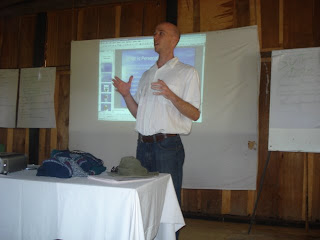
Here is a picture of me given a presentation on personality in the workplace using the Enneagram exercise

Holly and Immaculate. We reviewed procedures and policy during the day and enjoyed our evenings growing closer personally and as an organization.

Holly flying her kite on the beach of Sesse Island where we conducted the staff induction.

After session beach ball
CPA CHAIRPERSON

Angelina, CPA's Chairperson left for a six week-long advocacy trip with MCC in Canada and the US.
FINANCIAL COMPLIANCE MEETING

Christian Aid, one of our partners, brought us together for a week long capacity building workshop to improve our financial compliance to EU funding.
PSYCHOSOCIAL TRAINING

Here is one of seven groups of trainers for the second phase of the psychosocial training.
GODFREY AND TONNY'S BIRTHDAY

We had fun embarrassing Tonny and Godfrey

It turns out that we played the same games at childhood birthday parties as our Ugandan colleagues, so we thought it would be fun to reminisce.
MONITORING VISIT TO PARENT SUPPORT GROUP

We were making an assessment of a Savings and Loan Group. It's hard to visit without a dance show. So here we are watching.

Fun with a camera
STEP TOWARDS RECONCILIATION PROJECT

Holly has been busy helping the Peacebuilding Programme Officers train community mediators and develop a new curriculum for youth to reintegrate ex-combatants.
LABOR DAY PICNIC

Holly and Sylvia at Karuma Falls on the Nile

Philip was very proud of his fish
STRESS MANAGEMENT AT HOME

Here is my new demonstration plot for tomatoe plants

Jelly is always so dirty

Here is Ogiko getting headbutted by Jelly
STAFF INDUCTION

Here is a picture of me given a presentation on personality in the workplace using the Enneagram exercise

Holly and Immaculate. We reviewed procedures and policy during the day and enjoyed our evenings growing closer personally and as an organization.

Holly flying her kite on the beach of Sesse Island where we conducted the staff induction.

After session beach ball
CPA CHAIRPERSON

Angelina, CPA's Chairperson left for a six week-long advocacy trip with MCC in Canada and the US.
FINANCIAL COMPLIANCE MEETING

Christian Aid, one of our partners, brought us together for a week long capacity building workshop to improve our financial compliance to EU funding.
PSYCHOSOCIAL TRAINING

Here is one of seven groups of trainers for the second phase of the psychosocial training.
GODFREY AND TONNY'S BIRTHDAY

We had fun embarrassing Tonny and Godfrey

It turns out that we played the same games at childhood birthday parties as our Ugandan colleagues, so we thought it would be fun to reminisce.
MONITORING VISIT TO PARENT SUPPORT GROUP

We were making an assessment of a Savings and Loan Group. It's hard to visit without a dance show. So here we are watching.

Fun with a camera
STEP TOWARDS RECONCILIATION PROJECT

Holly has been busy helping the Peacebuilding Programme Officers train community mediators and develop a new curriculum for youth to reintegrate ex-combatants.
LABOR DAY PICNIC

Holly and Sylvia at Karuma Falls on the Nile

Philip was very proud of his fish
STRESS MANAGEMENT AT HOME

Here is my new demonstration plot for tomatoe plants

Jelly is always so dirty

Here is Ogiko getting headbutted by Jelly
Subscribe to:
Posts (Atom)